

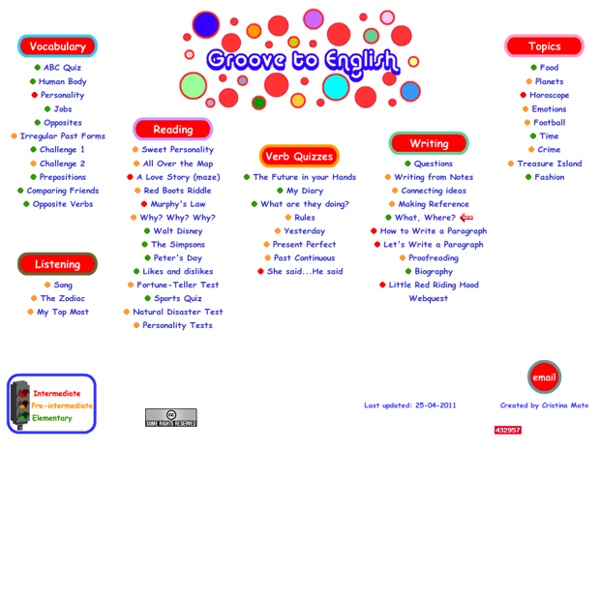
http://www.groovetoenglish.com/
Related: AnglaisFree Printable English Worksheets Welcome to tlsbooks.com, where you'll find a variety of free printable language arts worksheets for home and school use. These printable English worksheets cover a variety of topics including grammar, vocabulary, and reading comprehension. You are encouraged to view worksheets by grade level or browse this page for skill appropriate worksheets. Printable worksheets from TLSBooks will allow your child to gain valuable readiness skills or serve as reinforcement for material they may already be learning in school. This site features thousands of worksheets as well as coloring pages, teacher resources, puzzles, and reading tips.
10 ways to use tongue twisters in your class! I LOVE tongue twisters! Sometimes I am pretty good at them. I feel like I have an agile frog's tongue attacking sounds as they come. Other times I get so tangled I feel more like I have the dog's tongue, a useless appendage that just hangs from my mouth. Free Textbooks Internet Library Editorial Economic Wellbeing Recent economic history helps figure out what workers can expect concerning future their economic wellbeing. New Normal #1 was the high profits and wages made possible by WW 2 generated savings and pent-up consumer demand plus a lack of meaningful foreign competition. Its demise began in 1973 as business faced added pressure created by OPEC oil embargos soon to be enhanced by increased Asian competition. This New Normal #2 required workers and owners to compete with payroll taxes for a share of company revenue. The results were stagnating wages as measures by Census Bureau CPI measured median household income and the Rust Belt.
ESL Plans EFLWeb (English as a Foreign Language Magazine). EFLWeb is an on-line magazine for those teaching and learning English as a Foreign Language. Includes articles, Web resources, information on books and software, product reviews, events and conferences and more. ELT Newsletter. Teachers of ESL and EFL can read weekly articles on topics of interest, gather teaching tips from the weekly articles, discuss their thoughts on anything to do with English Language Teaching in the ELT Forum, find links to other sites of interest to English teachers (and learners) and submit articles to for publication here in their weekly column.
Writing Topics Jump to navigation All online writing units are free ($0) during the global crisis. Thank you for teaching! Writing Topics How do I use writing topics in my classroom? Hide video How in questions -ENGAMES The word “HOW” is one of the most productive words in English. It helps us create meaningful questions and sentences. The word “HOW” combines with many other words to create these questions. In this post I try to introduce the basic phrases “How much”, “How many”, “How often”, “How well”, “How long”, “How far” and “How old”. How in questions – mindmap Verb Tenses in English - ESL Overview In English grammar, verb tenses or forms indicate the moment when something happens, such as the past, present, or future. These three primary forms can be subdivided further to add detail and specificity, such as whether the action is ongoing or to describe the order in which events occurred. For example, the present simple verb tense concerns actions that happen every day, while the past simple verb tense refers to something that happens in the past. In all, there are 13 tenses.
How To Get Your Creativity All Hot & Bothered Arouse your creativity Electric flesh-arrows … traversing the body. A rainbow of color strikes the eyelids.