

Celebrating MLK Day Updated: Jan., 2014 In recognition of Martin Luther King Jr. Day, here is a collection of New York Times, Learning Network and other materials for teaching and learning about Dr. King, the civil rights movement he led and his legacy. Selected Times Resources Historical Front Pages and Articles “Martin Luther King Wins The Nobel Prize for Peace” Oct. 15, 1962Front Page | Article (PDF)“200,000 March for Civil Rights in Orderly Washington Rally” Aug. 29, 1963Front Page | Article (PDF) “The Big Parade: On the Way to Montgomery” March 21, 1965Front Page“25,000 Go to Alabama’s Capitol” March 25, 1965Front Page“Martin Luther King is Slain in Memphis” April 4, 1968Front Page | Article (PDF) Multimedia Video Articles and Opinion Pieces Slide Show Important Moments in Black History Times Topics Learning Network Lesson Plans and Resources Text to Text | ‘I Have a Dream’ and ‘The Lasting Power of Dr. Student Crossword Puzzles Other Resources Nobelprize.org The official Nobel Prize biography of Dr.
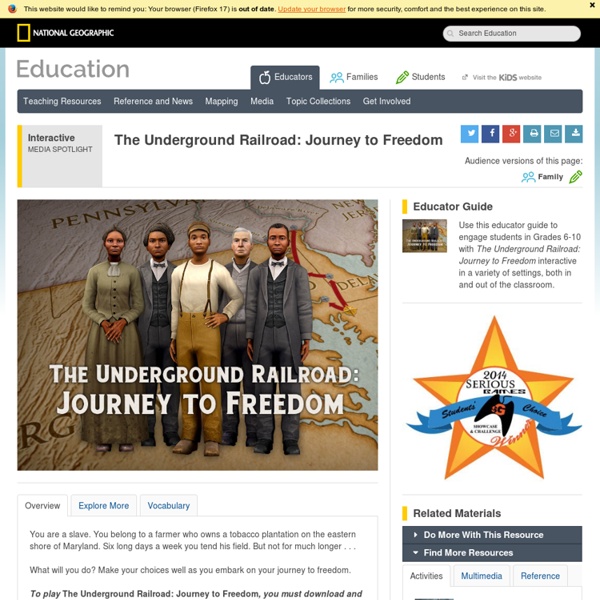
Smithsonian Civil War Studies: Article - A Pathway To Freedom: Maryland's Underground Railroad A Pathway To Freedom: Maryland's Underground Railroad The Smithsonian Associates Civil War E-Mail Newsletter, Volume 8, Number 6 Because of its location just below the Mason-Dixon Line, Maryland occupied a pivotal place in a secret network of trails and sanctuaries known as the Underground Railroad. This was the last "station" that separated North from South - and freedom from bondage - for countless slaves secreted across back roads and waterways. Harriet Tubman completed the daring journey repeatedly during the 1800s, having escaped from a plantation in Dorchester County to become the railroad's most famous "conductor." In and around Cambridge, visitors can see the small church where Tubman worshipped, as well as a humble marker noting her approximate birthplace. Farther south, the Hollywood-based Sotterley Plantation has a rare slave cabin and outbuildings beside the Patuxent River. Download the publications, plan a trip, follow the maps, read some books, have fun, and learn something!
webenglish Related topics: Thanksgiving, Year 3-7 Background Colonization in the New World An informative text for the teacher about the British colonisation of the East Coast.A Clash of Cultures in the New World (14:00) This VOA radio programme clarifies the underlying reasons for the clashes between the settlers and the natives. Very slow speech; would benefit from a different method, e.g. by reading and discussing, if used in class.Native American Houses There is a common misunderstanding that all “Indians” lived in Teepees. This article shows various types of housing that different tribes used.The Basic Indian Stereotypes For the teacher who wants to go deeper, much deeper Warm-up Native American Nations A map of the natives’ tribes before the White Man came. Music Native American – Music- (Rain dance) (8:11) Rain Dance is one of the most well-known cultural features of the Native Nations. Vocabulary Lesson Plan Reading Pocahontas Listening Watching Speaking More Ideas Final Words
Reader Ideas | Teaching the Civil Rights Movement Jeremy M. Lange for The New York TimesThe International Civil Rights Center and Museum opened in 2010 inside a former Woolworth building in Greensboro, N.C. The store was the site of a series of luncheonette “sit-ins” against segregation beginning on Feb. 1, 1960. Go to related article » This month, we asked educators, How Do You Teach the Civil Rights Movement? Many echoed the findings of the Southern Poverty Law Center by writing that this era of history is little taught in their own schools and districts. Just as many educators mentioned the importance of teaching the civil rights movement in the context of African-American history as a whole, since many students bring very little background knowledge to the subject. A comment from John Padula, a Boston middle school teacher, brought together many of the points others raised: I teach grades 6, 7 and 8 in the Boston Public Schools. It’s not too late to add your own thoughts. History, Social Studies, Civics English Language Arts The Arts
Internet U.S. Army soldiers "surfing the Internet" at Forward Operating Base Yusifiyah, Iraq The Internet is a global system of interconnected computer networks that use the standard Internet protocol suite (TCP/IP) to link several billion devices worldwide. The origins of the Internet date back to research commissioned by the United States government in the 1960s to build robust, fault-tolerant communication via computer networks.[2] This work, combined with efforts in the United Kingdom and France, led to the primary precursor network, the ARPANET, in the United States. Most traditional communications media, including telephony and television, are being reshaped or redefined by the Internet, giving birth to new services such as voice over Internet Protocol (VoIP) and Internet Protocol television (IPTV). Terminology The Internet, referring to the specific global system of interconnected IP networks, is a proper noun and written with an initial capital letter. History T3 NSFNET Backbone, c. 1992.
Creating characters and setting | Mitt öppna klassrum Förmågor: Ni kommer att få arbeta med att utveckla ert skrivande, läsande och strategier för detta inom engelskan. Skrivandet kommer ni få utveckla genom att läsa och skriva om karaktärer och miljö i gestaltande form. Ni kommer få instruktionerna nedan uppdelat per gång och på engelska när vi sätter igång nästa v. Att göra: Vi börjar med att läsa olika miljöbeskrivningar. Här finns en bild för att hjälpa er på traven med personbeskrivningarna och vilka delar man kan beskriva: Vi kommer sedan titta på ett filmklipp ur Divergent samt att jag högläser en del av texten högt för er. Utdraget handlar om personen Four och hans rädslor. Ni ska sedan få en skrivuppgift kopplad till detta. Här är skrivuppgiften: Four har fyra rädslor därav hans namn. Ni kommer få arbeta med kamratbedömning av texterna. Bedömning: Hur du bidrar i samtalen och utvecklar innehållet i dem. Hur du tolkar budskap i text/vidgad text (film). Hur du utvecklar och utrycker dig i dina skriftliga svar i skrivuppgifterna ovan.
Freedom’s Ring: King’s “I Have a Dream” Speech Consumer-resource systems Figure 1. Consumer categories based on material eaten (plant: green shades are live, brown shades are dead; animal: red shades are live, purple shades are dead; or particulate: grey shades) and feeding strategy (gatherer: lighter shade of each color; miner: darker shade of each color). Consumer-resource interactions are the core motif of ecological food chains or food webs,[1] and are an umbrella term for a variety of more specialized types of biological species interactions including prey-predator (see predation), host-parasite (see parasitism), plant-herbivore and victim-exploiter systems. Classification of consumer types[edit] A fully inclusive nomenclature is shown in Figure 1. Specialist totivores (gatherers)[edit] Specialist olophages (miners)[edit] See also[edit] References[edit] Jump up ^ Bascompte, J. (2009).
Dr. Martin Luther King Jr. Articles & Videos Skip to main content <div id="nojs-warning">WARNING: Javascript must be enabled for the correct page display</div> Sign InRegister ReadWorks.org The Solution to Reading Comprehension Search form ReadWorks Dr. Share now! Print This video is used with the generous permission of HISTORY® Articles & Question Sets Note: For read-aloud, it is appropriate to use passages at higher levels than your students' independent reading levels. Kindergarten - 1st Grade "Martin Luther King Jr." 2nd - 4th Grade "An American Leader" Lexile: 810 "A Great Leader" Lexile: 900 5th - 8th Grade "Excerpt from Martin Luther King Jr.' "The King Holiday" Lexile: 1300Primary Source 9th - 12th Grade "Oct. 14, 1964: King Wins Nobel Peace Prize" Lexile: 1320 This article is used with the generous permission of HISTORY® "Martin Luther King Jr. "10 Things You May Not Know About Martin Luther King Jr." "Selma to Montgomery March"Lexile: 1530This article is used with the generous permission of HISTORY® About ReadWorks
Martin Luther King, Jr. Comment:Last Updated:5 September, 2014Section:Resources Martin Luther King, Jr. Martin Luther King, Jr. an American Baptist minister changed history through his non-violent approach to tackling race issues in America. He was a key player in the Civil Rights Movement and his campaigns improved the lives of Black citizens of America and the world. Non-Violence and Civil Rights Explore issues of Non-Violent protests through key players in the Civil Rights Movement with this resource for prompting class debate. Martin Luther King, Jr. and the Christian way This presentation and worksheets explore how Martin Luther King, Jr. was compared to Jesus and how the Christian faith influenced his actions. Martin Luther King Jr.’s childhood Focus on Martin Luther King Jr.’s childhood with a role play, poetry and debating lesson. Martin Luther King, Jr. and Barack Obama Try this presentation exploring leadership qualities with a Taboo task to finish. Martin Luther King, Jr. workbook The Race Issue in America
Ecosystems Ecosystems The plants and animals that are found in a particular location are referred to as an ecosystem. These plants and animals depend on each other to survive. In a delicate balance, these lifeforms help to sustain one another in regular patterns. Disruptions to an ecosystem can be disastrous to all organisms within the ecosystem. As an example, consider what happens when a new plant or animal is introduced into an ecosystem where it did not before exist. Throughout the history of the Earth, the delicate balance found within ecosystems has been disrupted by natural disasters such as fires, floods, storms, volcano eruptions, and so forth.
The Absolutely True Diary of a Part-Time Indian Från jullovet till nu har jag arbetat med The Absolutely True Diary of a Part-time Indian av Sherman Alexie med mina nior. Vi har arbetat en lektion i veckan och eleverna har läst största delen hemma. Det är en hyfsat enkel bok med en hel del illustrationer som underlättar förståelsen. Om ni inte har tillgång till klassuppsättning av boken kan ni hitta den digitalt här: Digital version Här kommer en sammanställning av hela temat. Lektion 1: Say Geronimo Lektion 2: I am Zero Lektion 3: Discussion Lektion 4: Skype in the classroom - Indians Lektion 5: Writing (Vi har gjort annat än detta också lektionstid, därav att det är 5 lektioner.) Pearltrees.com - skapa ett konto på Pearltrees och ta del av de länkar som jag samlat till detta tema. Eva Martinsson köpt in boken till Av Media Skåne.
Rosa Parks Rosa Parks, born Rosa Louise McCauley (February 4, 1913 - October 24, 2005) was a pivotal figure in the fight for civil rights. She was a protester of segregation laws in the US, and her actions led to major reforms (changes), including a Supreme Court ruling against segregation. Arrested for Not Giving up Her Bus Seat to a White Man On December 1, 1955, a Montgomery, Alabama, bus driver ordered Mrs. Bus Boycott Mrs. On February 1, 1956, the MIA (the Montgomery Improvement Association, which was formed after Mrs. Supreme Court Ruling On November 13, 1956, the US Supreme Court ruled that segregation on city buses is unconstitutional. Continuing the Civil Rights Movement In 1957, after receiving many death threats, Mrs. After her death, on October 24, 2005, Mrs. Related Pages: