

PECULIARITIES OF CYBERSPACE: VIRTUAL COMMUNITY - Networks of the future - Albert Benschop translation: Connie Menting The analysis of virtual networks and communities have presented sociologists with considerable problems. An attempt is made below to make a start with this revision. In recent years many studies of virtual communities have been carried out. The research-agendas of cybersociologists, however, are still full of tricky open questions: Do people become more isolated from the local communities around them when they participate in virtual communities? The notion of virtual community is not to be dismissed as a technological, cyberpunk fantasy in which people increasingly live in "second-hand worlds" (Mills 1959); chained to their computer terminals, experiencing life through dehumanizing technology rather than through human contact and intimacy. This definition lacks a spatial dimension. How strong is the bond within virtual communities? Network theories you will find in all sorts and measures. Source: Benschop [1993:79]
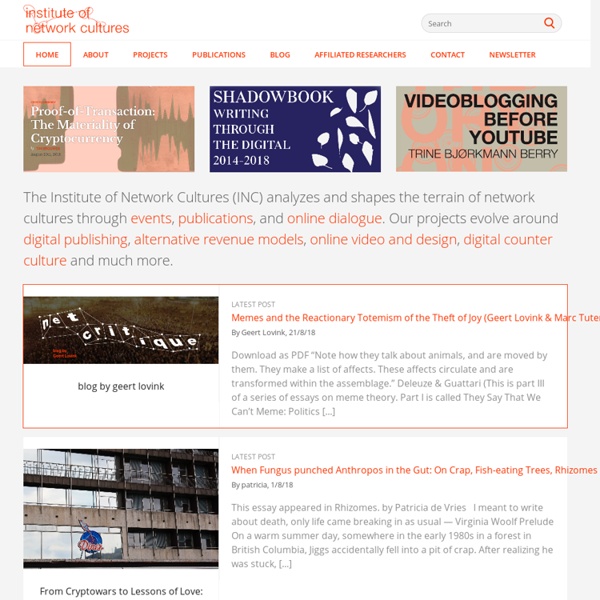
eipcp.net Geert Lovink Geert Lovink (born 1959, Amsterdam) is a Research Professor of Interactive Media at the Hogeschool van Amsterdam (HvA) and a Professor of Media Theory at the European Graduate School. From 2004-2013 he was an Associate Professor of New Media at the University of Amsterdam (UvA).[1] Lovink earned his master's degree in political science at the University of Amsterdam, holds a PhD from the University of Melbourne and has been a postdoctoral fellow at the University of Queensland.[2] Lovink is the founding director of the Institute of Network Cultures, whose goals are to explore, document and feed the potential for socio-economical change of the new media field through events, publications and open dialogue.[3] As theorist, activist and net critic, Lovink has made an effort in helping to shape the development of the web. Activities[edit] Since the early eighties, Lovink has been involved in a range of different projects and initiatives in the field of new media. Theories[edit] Projects[edit]
Filmtipp ǀ "Die dunkle Seite der Wikipedia" Filmtipp Wikipedia ist an sich eine tolle Sache. Markus Fiedler stellte jedoch auch vermachtet-autoritäre, intransparente Strukturen sowie Parteilichkeit fest Die meisten von uns dürften das Online-Lexikon Wikipedia des Öfteren benutzen. Das umfangreiche Nachschlagewerk ist ja an und für sich eine schöne Sache. Dem Filmemacher Markus Fiedler – Biologielehrer von Beruf – hat sich akribisch mit Wikipedia befaßt. Der „Fall“ Dr. Markus Fiedlers Dokumentarfilm „Die dunkle Seite der Wikipedia“ arbeitet sich besonders am „Fall“ des Wikipedia-Artikels über den Schweizer Historiker und Friedensforschers Dr. Fiedler machte mit Wikipedia eine ungute Erfahrung. Wikipedia keineswegs seriös und überparteilich Mittels seiner umfangreichen Recherchen kam Markus Fiedler zu dem Schluss, dass Wikipedia keineswegs durchgängig seriös und überparteilich ist. Wikipedia hat also eine „dunkle Seite“. Den Versuch dies aufzuklären macht der Film „Die dunkel Seite der Wikipedia“.
The Stanford University InfoLab What Is the Social in Social Media? - Journal #40 December 2012 Headlines, 2012: “Next time you’re hiring, forget personality tests, just check out the applicant’s Facebook profile instead.” – “Stephanie Watanabe spent nearly four hours Thursday night unfriending about 700 of her Facebook friends—and she isn’t done yet” – “Facebook apology or jail time: Ohio man gets to choose” – “Study: Facebook users getting less friendly” – “Women tend to have stronger feelings regarding who has access to their personal information” (Mary Madden) – “All dressed up and no place to go” (Wall Street Journal) – “I’m making more of an effort to be social these days, because I don’t want to be alone, and I want to meet people” (Cindy Sherman) – “30 percent posted updates that met the American Psychiatric Association’s criteria for a symptom of depression, reporting feelings of worthlessness or hopelessness, insomnia or sleeping too much, and difficulty concentrating” – Control your patients: “Do you hire someone in the clinic to look at Facebook all day?” Dr.
open Culture unlimiteD @dmytri | Venture Communist. Miscommunications Technologist. untitled Les acteurs de l'univers SAS© Les acteurs de l'univers SAS© created by sasreference www.sasreference.com ^^^ Hide Description ^^^ Advertisements Categorized Markers view locations on separate page Build This Map Map Settings Share / Export Login to add to this map: Login Sign Up Working... To link to this map use this url: ... or use this to link directly to the selected marker: ... or use this to link directly to the current view: Add points: by clicking: (just click on the map) Comments (0) Add A Comment Map Overview Legend Do you know someone planning a wedding or are you getting married? Les acteurs de l'univers SAS© www.sasreference.com : Club des utilisateurs SAS, ville de Québec www.clubsasquebec.ca : Société SAS France à Lyon www.sas.com/france/lyon : Formation STID - Statistique et Traitement de l'Information Décisionelle Formation en deux ans après le bac incluant des cours de SAS. : Société SAS France à Nantes Implantation des bureaux SAS à Nantes www.sas.com/offices/europe/france/nantes : Centre Hospitalier Régional et Universitaire