What is a volcano?
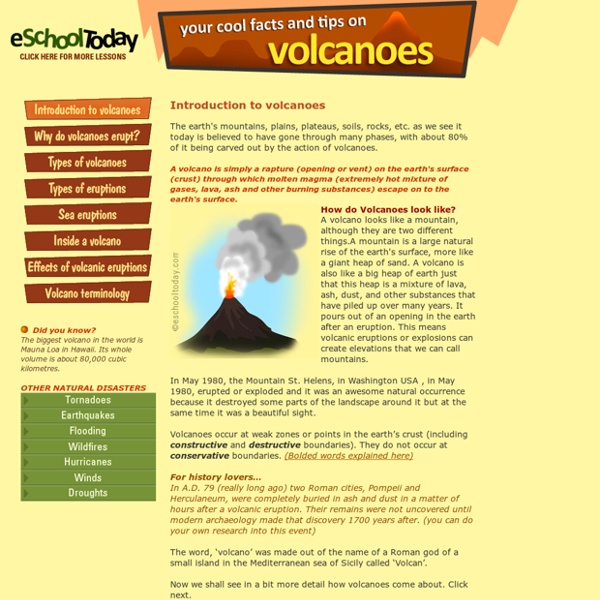
Introduction to volcanoes The earth's mountains, plains, plateaus, soils, rocks, etc. as we see it today is believed to have gone through many phases, with about 80% of it being carved out by the action of volcanoes. A volcano is simply a rapture (opening or vent) on the earth's surface (crust) through which molten magma (extremely hot mixture of gases, lava, ash and other burning substances) escape on to the earth's surface. How do Volcanoes look like? In May 1980, the Mountain St. Volcanoes occur at weak zones or points in the earth’s crust (including constructive and destructive boundaries). For history lovers… In A.D. 79 (really long ago) two Roman cities, Pompeii and Herculaneum, were completely buried in ash and dust in a matter of hours after a volcanic eruption. The word, ‘volcano’ was made out of the name of a Roman god of a small island in the Mediterranean sea of Sicily called ‘Volcan’. Now we shall see in a bit more detail how volcanoes come about.
Quiz Whiz: Volcanoes
Back Next Quiz Whiz: What's on the Menu? Previous Quiz Whiz: The Moon Games Quiz Whiz: Volcanoes See how much you know about explosive mountains known as volcanoes. More Games African Animals Maze Game Quick Play Arctic Animal Memory Action Arctic Fox Snowboarding Animals Beaver Badminton Dive Deeper Hurricanes 101 - Ep. 3 More Freaky Forces of Nature Auroras, Snow Rollers, and Other Freakiness! Earthquake Lightning Tornado Many cave-dwelling fish don’t have eyes. More Curious Facts Volcanoes 101 - Ep. 13 More Giant's Causeway - Ep. 12 More Tornadoes 101 - Ep. 2 Hurricane Dolphin Diving x Show Link
Volcano Tidbit
What is an Earthquake
Introduction to Earthquakes & Tsunamis Turn on the TV or read the newspapers and almost always there is something devastating happening somewhere as a result of sheer nature's power. Examples of such natural occurrences are hurricanes, tornados, wildfires, volcanic eruptions, flooding, earthquakes and tsunamis. These are usually not caused directly by humans, but their effects live with us for a long time. In this lesson we shall look at one of such natural occurrences...earthquakes! What is an Earthquake? Simply, earthquakes are the rumblings, shaking or rolling of the earth's surface. Earthquakes come in many forms. Foreshocks, Mainshocks and Aftershocks: Sometimes, there are smaller shocks that occur before (foreshock) and after (aftershock) a main earthquake (mainshock). Earthquakes are also called temblors. It is important to understand the earth’s makeup to help understand earthquakes better. The Mantle is semi-molten rock, also called magma.
Weather Wiz Kids weather information for kids
Volcanoes (Volcanoes are not associated with weather, but instead are natural disasters.) What is a volcano?A volcano is a mountain that opens downward to a pool of molten rock below the surface of the earth. When pressure builds up, eruptions occur. Click Here to learn more about volcanoes from USGS. How are volcanoes formed? What are plate tectonics? Click Here to learn more about plate tectonics and the drifting of our continents. How many volcanoes are there? What are the different types of volcanoes? What is the difference between lava and magma? Why does lava take a long time to cool down? What is a pyroclastic flow? What is lahar? What is pumice? What is the largest active volcano? What is the Ring of Fire? When did Mount St. Click Here for more info on Mount St. Click Here to see an animation of an earthquake and the resulting tsunami. Know the Lingo MAGMA - Magma is the liquid rock inside a volcano.LAVA - Lava is the liquid rock (magma) that flows out of a volcano. Volcano Safety Tips
Sitman, Jennifer / Volcanoes
Volcano Tidbit - A volcano is an opening in Earth's surface through which melted rock, hot gases, rock fragments, and ash burst forth, or erupt. - A violent eruption can release rivers of red- hot molten rock, hissing jets of poisonous gas, curling clouds of thick gray ash, and explosions of scorched rock. How do such mountains of fire form? - Volcanoes come from Earth's hot interior. - Under pressure from the weight of surrounding rock, the magma melts or forces a channel into weak or cracked rock above it. - After an eruption, a volcano usually collapses into a bowl-shaped mouth called a crater. What about volcanic mountains? - Many of the mountains in the Andes chain in South America are volcanoes. - Volcanic mountains can form at different types of boundaries. - Volcanic mountains can form away from late boundaries as well. Different classes of volcanoes and volcanic cones. Shield Volcanoes - form when a lot of lava flows smoothly from a vent and spreads out to cover a wide area.
Earth Facts and Information
Three main types of volcanic material
Related:
Related: