

Hurricane Irma: All you need to know - CBBC Newsround Image copyright AFP PHOTO / NOAA/RAMMB Hurricane Irma is making its way across the Atlantic Ocean, heading towards the Caribbean and the southern United States. Hurricanes are tropical storms that form over the North Atlantic Ocean and Northeast Pacific. Hurricane Irma has winds of 175 mph and has been upgraded to a category five hurricane - that's the highest category. Category five hurricanes have winds of 157 mph or higher and will damage buildings, trees and power poles. Media playback is unsupported on your device Hurricane warnings have been given on many of the islands in the Caribbean. Image copyright Reuters The island of Puerto Rico has declared a state of emergency. Emergency shelters are being opened up and schools have been closed. One supermarket manager said: "People have been buying a lot in preparation for the arrival of the hurricane." "Lots of canned food, cooked dishes, canned fish, paper towels, cleaning products, cakes, lots of cakes, and water, of course."
ANVILL | National Virtual Language Lab ANVILL (A National Virtual Language Lab) is a speech-based toolbox for language teachers. Like the language lab console of old, it's focused on the practice of oral/aural language, but at its core are very modern web-based audio and video tools from duber dot com and the University of Oregon: Voiceboards, LiveChat, and Quizzes and Surveys. Our newest tool, TCast, allows teachers to record and place audio or video files anywhere in a lesson--in 3 easy steps. Each of these tools really opens up the scope and sequence of lessons centered around spoken language tasks. Creating media-rich lessons in ANVILL is simple and straightforward. ANVILL is aimed at both teachers in traditional face-to-face situations as well as at those who are doing distance or hybrid courses. ANVILL is a research project of the Yamada Language Center at the University of Oregon.
Free Text To Speech Reader. Online & Unlimited with Natural Sounding Voices. 30 utilisations créatives de Padlet | E-pédagogie, web2.0 un exemple de Padlet Padlet est un outil que je trouve un peu magique. Lucie Renard a publié début août 2017 un billet sur les utilisations pédagogiques de Padlet dans le blog bookwidgets.com. Sujet du billet : comment utiliser Padlet dans votre classe? Ce billet de Lucie Renard m’a paru si utile et concret que je me borne à le traduire ici de façon un peu libre pour les non anglophones (ou pour les fainéants comme moi) Traduction du billet original : Qu’est-ce que Padlet? Padlet peut être utilisé par les étudiants et par les enseignants. Quiconque ouvre u n tableau de Padlet sur son smartphone ou son ordinateur peut consulter ce que tout le monde a écrit sur le tableau. Comment utiliser Padlet? L’utilisation de Padlet en classe est facile. Vous créez un compte et créez votre premier tableau. Une fois que cela est fait, vous devez créer un tableau pour vos élèves. Le partage d’un tableau Padlet est facile ; Choisissez un QRcode ou un lien. On peut le faire de plusieurs façons : 1. Vidéos drôles
Travailler en îlots Nous profitons de la sortie du livre de Marie Rivoire sur le travail en îlots pour lancer une discussion sur les conditions d’un travail de groupes réussi. Deux réactions à ce livre sont à découvrir : une recension élogieuse, par Raoul Pantanella. Et le document à charge contre ce mode de travail, d’un groupe de chercheurs, Christian Puren, Maria-Alice Médioni, Eddy Sebahi. Et vous, qu’en pensez-vous ? Nous souhaitons que ce soit l’occasion de nous poser cette question : à quelles conditions le travail par groupes peut-il être efficace et faire progresser tous les élèves ? L’est-il même réellement ? Travailler en îlots bonifiés pour la réussite de tous Marie Rivoire, Génération 5, Chambéry, 2012 Recension par Raoul Pantanella Elle prend en compte dans sa méthode, deux tendances profondes que l’on peut observer chez les élèves. Les notes et le jeu Une pédagogie de groupe bien organisée • Les élèves se placent librement et par affinité, à quatre ou cinq autour d’un « îlot ». Raoul Pantanella
Your missions. Extract from"A Message to the Grassroots" speech (November 10,1963) Detroit, Michigan by Malcolm X. You don’t have a peaceful revolution. A revolution is bloody. When you want a nation, that’s called nationalism. Video Lesson: Mr. Bean – Tim's Free English Lesson Plans Follow me on twitter Just a quick note… Before you use these materials… We’ve created a new podcast aimed at B2+ level English students and teachers alike. You can listen for free at our SoundCloud page below. This is a video lesson based around the video “Mr. Kids and lower levels The aim of this lesson plan is to practice holiday vocabulary (clothes and items that go in a suitcase) and some basic grammar structure. Project a picture of a suitcase on to the board (or draw one) and ask “What do you put in your suitcase when you go on holiday?” toothbrushtoothpasteswimming shorts/trunkstowelunderpantscan of baked beanscloth/flannelsoapbooksuitcasetrousersshortsshoesteddy bearscissors You could also use this quizlet set to go over clothes vocabulary. If children are old enough to write, put them in pairs and hand out post-it-notes and a pencil to each pair. Mr. in his suitcase. Higher levels – video dictations Objects: Verbs:
Practical tips By Opal Dunn, educational consultant and author Introduction Young children learn English differently from most adults. Planned English sessions You can plan regular sessions which will usually take place: at home on regular days for about ten to twenty minutes adjusted to fit your child’s increasing English ability and ability to concentrate as a planned programme that reviews and builds on known activities and introduces new ones. Short English sessions These are more informal and can take place: any place – in the car, at bathtime, in a supermarket queue any time in response to a mood or special experience. As your child’s English ability increases, short English sessions tend to occur more frequently. Planning English sessions Programmes should follow the same structure each time, as knowing what to expect lightens stress and enables children to concentrate their efforts on picking up English. Basic programme English corner or English table Ideas for activities Crafts Family activities
11 Drawings to Remember English Rules Forever | Clark and Miller Have you ever had a problem that you just couldn’t solve for ages? Then suddenly someone says one word, or just shows you one simple picture, and you get that “aha” moment — you suddenly understand everything? Well, over the many, many years I’ve been teaching English, I’ve found that some simple images can help explain rules in English that cause so many problems for people. Hopefully, they’ll help you, too. So here are some of my most effective little pictures to help you remember English rules. Forever! Maybe. In, on or at for place? I’ve actually talked about this in a previous post, but it’s good to see it in a different way. Usually (but not always), we use: “In” when it’s 3-dimensional I’m in this really dark room and I can’t get out. “On” when it’s a straight line I’ve been on this road for about 8 hours and I still can’t get off it. “At” when we feel like it’s a point on a map I’ll meet you at the station. That’s why we can have one person saying, “Are you at the station yet?” A or the? OK.
tubequizard The Science of Awkwardness Vsauce Vocabulary in contextPeople & society18 items Academic Word List (sublist 1) Preparing for IELTS? Emma Watson's Harry Potter Outtake Jimmy Kimmel Live Vocabulary in contextEntertainment20 items Frequently used verbs. The art of asking | Amanda Palmer Grammar for listenersTalks & interviews17 items 'Would' for past repeated actions and habits. My stroke of insight | Jill Bolte Taylor Grammar for listenersTalks & interviews13 items Present Continuous Watch the story of how Jill Bolte Taylor realized she was having a stroke and type phrases in Present Continuous. The art of misdirection | Apollo Robbins Grammar for listenersTalks & interviews12 items Questions. Vocabulary in contextFilm & animation25 items Watch this moving animated story and fill the gaps with up to 6 'basic' (A1) words. The Bookmobile StoryCorps Grammar for listenersFilm & animation43 items Past verb forms: telling stories. The Amazing iPad Magician TheEllenShow Vocabulary in contextEntertainment23 items
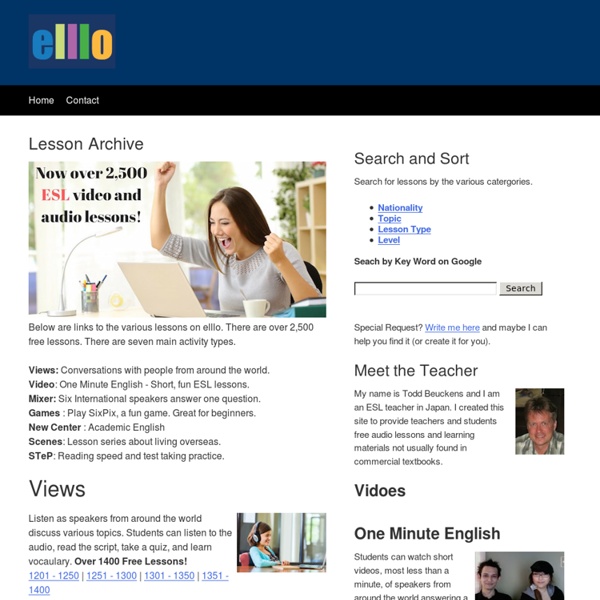
7 lifesaving websites for EFL teacher | That is Evil! I already made one list of my favourite websites months ago, but there are so many great things you find while websurfing that I’ll probably make more of such sets. Also, it can be easily seen that I love making lists. Being a DoS I happen to be a “victim” of non-English language teachers complaining that English teachers “have it easy”. Well, I have to admit that’s quite true… So let’s use some of the great sources we may find online – and here’s my present top seven: 1 Twinkl I’ve already written about some features that are great for teaching English (Spring Poems – lesson plan and Twinkl Imagine), especially communication. 2 Truetube It’s one of the websites my fellow teacher showed me (thanks, Krzysiek!) 3 Elllo When we’re talking about accents and listening, I have to admit Elllo is top of the tops. 4 Lyrics training Students usually like learning a language by listening to music. 5 Busy Teacher 6 Flo-Joe 7 Film-English Enjoy! Like this: Like Loading...
Teaching Resources | Instruction, Classroom Management, Study Skills & Special Education A Nation Still at Risk: Real Education Reform Needed Now In 1983 the landmark publication of the report A Nation at Risk seemed to shake our nation from its slumber regarding the scary truth about education in America. It detailed how there were serious problems in schools in this country and recommended fixes for what ailed schools. Unfortunately, twenty-eight years later there are still many things that are wrong in education, ... Rated: +3 Should Students Be Able to Grade Their Teachers?
Adele's ESL Corner - Your free online English language website Reading from Scratch - Spelling Rules ENGLISH SPELLING RULES Short and Long Vowels 1. To spell a short vowel sound, only one letter is needed: at red it hot up 2. maid, made, but madder; dine, diner, but dinner. Spelling the Sound /k/ This sound can be spelled in any one of four ways: 1. c 2. cc 3. k 4. ck 1. 2. 3. (Boring examples? 4. 5. (Forget about yak. The letter, k, follows any other sound: The Sound, /j/ The sound, /j/ is spelled in three ways: j ge and dge. 1. 2. 2. The Sound, /ch/ The sound /ch/ has two spellings: tch after a short vowel, ch anywhere else: Exceptions: Which, rich, much, such, touch, bachelor, attach, sandwich, and ostrich. The Sound, /kw/ This sound is ALWAYS spelled with the letters, qu, never anything else. Using -le Words ending in -le, such as little, require care. Odds and Ends 1. Adding Endings There are two kinds of suffixes, those that begin with a vowel and those that begin with a consonant. 1. 2. 3. Note that this doubling is not done if the accent is not on the last syllable. 4. 5. /sh/ 1. 2. 3. 4.