

The Drought Fighter - Craftsmanship Magazine Topics: Climate Change, Drought, Farming, Fertility, Food, Organic Agriculture, Science, Soil Health, Urban Farming Locations: California, Sebastopol Materials: Bugs, Carbon, Compost, Plants, Soil Masters: Paul Kaiser: Drought Fighter Could a controversial farmer in California have found the most effective way to grow food in a warming world? By TODD OPPENHEIMER On Singing Frogs Farm, a relatively minuscule, 8-acre operation in Sebastopol, California, Paul Kaiser says he is grossing more than $100,000 an acre just by harvesting vegetables. One afternoon last March, on a small vegetable farm that Paul Kaiser runs in a particularly chilly valley in Sebastopol, California, a group of agriculture specialists gathered around a four-foot steel pole. The group successfully repeated the exercise, over and over—for photo ops, and to be sure that Kaiser really had accomplished the various feats he talks about, which he does almost incessantly these days. This is a big deal. “What creates life?”
rainwater harvesting printable version of this factsheet (pdf) the simplest way to collect rainwater is in a water butt, with a diverter in the downpipe table 1: above are the average annual rainfall figures for the last 30 years; use these figures in conjunction with table 2 below to find the volume of water you can expect to collect source: Met Office table 2: expected volumes of water collected in cubic metres can be found by checking your average rainfall (see table 1 above) against your roof area source: Environment Agency rainsava: can be insterted into your downpipe (round or square) to divert rainwater into a water butt; available online or from garden centres
The heifer rearing system | RuralNI The RuralNI website is no longer a website in its own right. It has become part of the DARD website. We have moved most of the content from RuralNI across to the new DARD website and you should be able to find what you are looking for by clicking on the link below: www.dardni.gov.uk For access to DARD Online Services go to the new DARD website and click on the green Online Services link at the top of the page. Services like APHIS Online and Online Maps are unaffected by this change. Most of the content of RuralNI has been moved to the “Farming & Countryside” section which you can access by clicking on the link in the Explore DARD section on the right hand side of the DARD homepage.
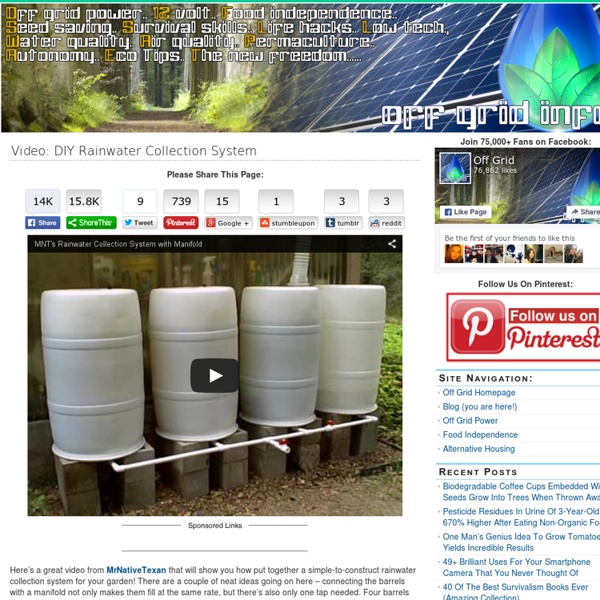
Rainwater Harvesting Basics Ironically, water use in developed countries often is highest in the places where rain falls the least. Rainwater harvesting is one easy and low tech solution in reducing domestic water use. How to utilize rain water The easiest rainwater source is that which falls in our gardens. Proper placement of plants, trees, and water collection areas can turn the site into a water efficient capture system. Store the rain in cisterns and barrels An obvious source of rainwater collection is the roof. Indoor use All around the world it’s becoming more common for people to use rainwater indoors for non-potable uses.
Emergency Water Purification Hurricane Katrina Materials Do not try to use water that has floating material in it, water that has any odor, or water that has a dark color. These are all indications that the water is significantly contaminated and may be dangerous no matter what you do to filter it or kill bacteria. On the other hand, a little dirt in the water can be cleaned out easily and won't hurt anyone. If the water is cloudy, the first thing to do is take out as much of the dirt as possible. Once water is filtered, it is fine for using to clean things like clothing and floors. Once you have reasonably clean water, it has to be treated before it is safe to drink. Water should be boiled for at least 3 to 5 minutes to sanitize it. Boiled water tends to taste flat because there is no air in it. Boiling requires that there be a source of fuel and a safe way to store the water while it cools. The biggest problem with boiling for water treatment is that you can't treat very much water at a time.
The 16 Best Healthy, Edible Plants to Grow Indoors From farmers’ markets and Community Supported Agriculture, to urban farms and rooftop gardens, to produce delivery services, more and more people across the U.S. are embracing farm-fresh food. And for good reason: Locally grown produce tends to be better for the environment and for local communities than its store-bought counterparts. Growing food at home also ensures that growers know exactly where their food comes from and how it was grown (no need to worry about deceptive food labeling). If you’re not whipping out the pruning shears yet, consider this: Learning new skills is good for our brains. Luckily, you don’t need to be a farmer (or even live near a farm) in order to reap the benefits of home-grown produce. If you have a sunny window (or two, or five) and a bit of extra time on your hands, then you’re capable of growing your own food right at home. General Growing Tips Fruits and Veggies Photo: Alpha 1. 2. 3. 4. How to Harvest: Most lemons will ripen in six to nine months. 5. 6. 7.
Alnarp Cleanwater Technology Greywater: What is it, and Why is it Awesome? Confession: I'm kind of a simpleton when it comes to plumbing. Only in recent years has it occurred to me to ask questions like, where does toilet water go when I flush? And how is it suddenly replaced with clean water? And sinks, and washing machines, and showers for that matter- what happens to all my own waste water? Is it magic? Since that first realization of my ignorance regarding all things waste water, I've tried my best to learn a little more about plumbing. Enter off-grid water recycling systems! What is greywater? Greywater refers to waste water that is relatively harmless and can thus be reused for a variety of purposes. Usually, the term encompasses dishwater, laundry water and shower water. I got some great biodegradable soaps for Christmas, and am excited to eventually set up my own grey water irrigation system! How is it reused? Greywater is typically used for irrigation- most people direct their grey water into gardens or mulch pits.
17 Apart: Growing Celery Indoors: Never Buy Celery Again Remember when we tested and shared how to grow onions indefinitely last week? Well, at the same time, we've been testing out another little indoor gardening project first gleaned from Pinterest that we're excited to share the successes of today — regrowing celery from it's base. We've figured out how to literally re-grow organic celery from the base of the bunch we bought from the store a couple weeks ago. I swear, we must have been living under a rock all these years or just not be that resourceful when it comes to food, but we're having more fun learning all these new little tips and tricks as we dive deeper into trying to grow more of our own food. This project is almost as simple as the onion growing project — simply chop the celery stalks from the base of the celery you bought from the store and use as you normally would. We let our celery base hang out in the saucer of water for right around one week, give or take. Update 2: Here's how we are looking at almost 3-4 weeks of growth:
The Rainwater Harvesting Community :: About the Team All proceeds generated by the site through sponsors is used to build awareness and support the website through direct research and new articles. If you are interested in writing an article for the website, please drop us a note. We gladly welcome articles, but please no product endorsements. The HarvestH2o Team Doug Pushard founded HarvestH2o.com over 10 years ago as a personal expression of his interest in the subject of rainwater catchment and water conservation. Doug, designs and works with home-owners and local contractors to install small-to-large residential water management systems. Doug also peforms Rainwater System Healthchecks on existing systems as well as performing onsite water audits, both indoors and outdoors. Doug is an ARCSA Accredited Professional and an ex-Board member the American Rainwater Catchment System Association (ARCSA) and was the co-chair for the ARCSA National Conference for 2008, 2009 and 2010. Christian Sarkar was convinced by Doug that this is a good idea.
Grow Fresh Vegetables Year Round Without A Garden Did you know that you can have a source of fresh vegetables that are available all year long without the need of a grocery store or garden? Read on to find out more… For those of you that may one day have to live exclusively off of your food storage, have you ever wondered what to do about the lack of fresh vegetables? Well if you’ve taken my advice and stored a year’s supply of grains and legumes, you already have an excellent source of fresh vegetables all year long – in your sprouted seeds! Seeds are nature’s miracles. The process of sprouting takes a carbohydrate rich food source and turns it into a “live” food rich in vitamins, minerals, proteins and beneficial enzymes and on top of that is healthier than commercially grown vegetables! Here’s the process: How to Grow Sprouts CAUTION: Be aware that potato and tomato sprouts are poisonous. Referencing the sprouting chart below, measure out the required amount of seed. Sprouting Chart
Self watering vertical garden with recycled water bottles The green wall is composed by 72 water bottles cut and placed upside-down on a wooden shelf. Two independent water reservoir are present: the main is placed on the side of the building and composed by eight 200 liters barrels linked together, for collecting rain water. The second one is composed by three plastic "new jersey" street barriers, that can contain 80 - 100 liters each, placed under the shelf. The circulating system is composed by two 12v pumps, powered by a hybrid power system, a vawt turbine in conjunction with two 10w pv panels. Energy is stored in a 12v car battery via charge controller and a timer regulate the watering cycle (at this moment the set up is 1 min at 7 am and 1 minute at 7 pm. Water is pumped from second reservoir to the top of the shelf, into a PVC pipe ( Dia 4 cm) where i drilled eighteen 3 mm holes (one for each planter of the first row).