

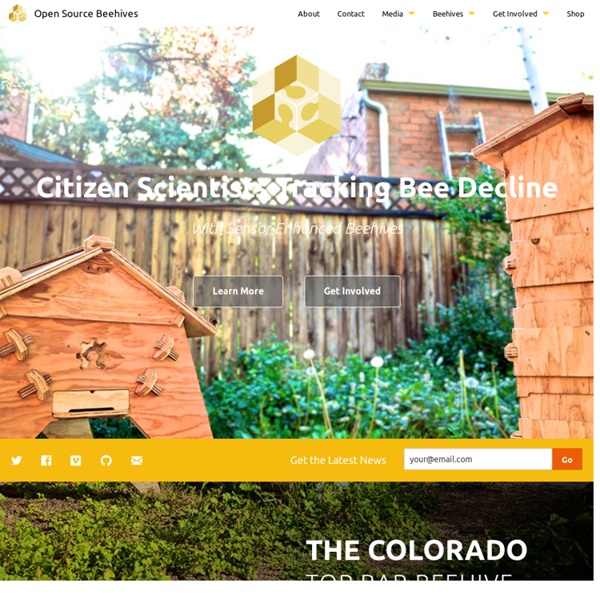
FabHub - Digital Fabrication Hub Open-source beehives developed to tackle Colony Collapse Disorder Bee colonies are in decline worldwide. As Gizmag reported previously, this is a growing problem, and a number of theories and solutions are being explored. A team of eco-technologists from Europe and the US has come together to engineer a collaborative response to the problem, an open-source hive that can help house, track and understand the cycles movements of these vital members of the eco-system. View all The campaign The open-source beehive project was launched on Indiegogo last month and has managed to generate more than twice its original funding goal. Backers can opt to download the plans to create two different styles of hives via CNC fabrication (the different hive models can be "printed" using a single standard sheet of plywood in about 30 minutes), or choose a pre-fabricated flat-pack hive. Assuming all goes without a hitch, delivery is estimated to start as early as this month. Sensory awareness A collaborative approach Sources: Open-Source Beehive project, Indiegogo Share
Hash oil Closeup image of a drop of hash oil on the end of a needle. Hash oil (also known as dabs, shatter, or earwax) is a resinous matrix of cannabinoids obtained from the cannabis plant by solvent extraction.[1] Hash oil is the most potent of three main cannabis products, which are herb (marijuana), resin (hashish), and oil (hash oil).[2] THC contents[edit] Reported THC contents vary between sources. Usage[edit] Hash oil can be consumed in various ways, including smoking, vaporization, orally[5] or topically.[6] Typically, it is vaporized in what is known as a "rig", a small water pipe designed for hash oil vaporization. Manufacturing[edit] Hash oil is a cannabis product obtained by separating resins from cannabis buds by solvent extraction.[7] The most common form of hash oil is made by passing butane gas through a tube filled with cannabis plant matter. Other solvents commonly used are hexane, isopropyl alcohol, ethanol, and CO2 (dry ice). Potential for explosions[edit] Legality[edit] Italy[edit]
Limão-cravo Origem: Wikipédia, a enciclopédia livre. O limão-cravo, fruta do limoeiro-cravo, é uma fruta cítrica também conhecida no Brasil sob os nomes comuns de limão-rosa, limão-cavalo, limão-egua, limão-francês, limão-capeta, limão-china e limão-vinagre.[1] É chamado limão-galego em algumas regiões do Brasil, como Minas Gerais, o interior de Rio de Janeiro, o Espírito Santo, o Pará...[2] (Em outras partes do Brasil, limão-galego é o nome comum de uma lima ácida, de casca fina e esverdeada-amarelada.) O limão-cravo é um fruto redondo, ligeiramente achatado, mas irregular, quase disforme. A casca, de cor verde-amarelada ou amarela, toma uma forte cor alaranjada na maturação, mas tem manchas e uma aparência grosseira, e é suscetível ao ataque de fungos e doenças. Origem[editar | editar código-fonte] Usos[editar | editar código-fonte] O suco do limão-cravo serve como tempero e refresco, mas é pouco comercializado.[5] As folhas são usadas como tempero. Referências
25 Places That Look Not Normal, But Are Actually Real ~ Travelust 88 25 Places That Look Not Normal, But Are Actually Real 1. Mt. Roraima, Venezuela 2. 3. 4. 5. 6. 7. 8. 9. 10. 11. 12. 13. 14. 15. 16. 17. 18. 19. 20. 21. 22. 23. 24. 25. Namibia's Coastal Parks - Behind the Lens: Photograph or Painting? While on assignment in Namibia for National Geographic magazine, Frans Lanting captured this surreal landscape image in a location called Dead Vlei. Due to the nature of the lighting in the frame, the photograph appears almost like a painting. We asked Lanting to take a few moments away from his current assignment in Africa to answer readers' questions about the photograph. From Shay Mordo: Absolutely amazing composition! Lanting: Here's a short summary about the making of the photo. Photograph by Frans Lanting Krist: Our photographers do extensive planning, often selecting specific locations before they even set foot in the field, and in this case Frans was fortunate to have his wife, Chris Eckstrom, helping with research and logistics. From Ana Paula: What is it that appears white in the orange background? Lanting: The sand dune is dotted with white grasses. From Cathy Cory: What editing did you do to this image and what software did you use?
World's Most Beautiful Trees Photography The Portland Japanese Garden is a traditional Japanese garden occupying 5.5 acres (22,000 m²), located within Washington Park in the west hills of Portland, Oregon, USA. Photo by: unknown Huge 750 years old sequoia tree, California. Photo by: Michael Nichols Kiss under a cherry blossom tree. Photo by: Korri Crowley Yellow autumn in Central Park, New York. Natural tree tunnel, California. This is not a painting, dead trees park, Namibia. Amazing angel oak tree, Charleston. Black roots on red leaves. Most beautiful wisteria tree in the world. Sagano bamboo forest, Kyoto, Japan. Jacaranda trees in bloom, South Africa. Beautiful cherry blossom road.
NaturaLista · Huizache (Acacia farnesiana) Descripción de Ver en Wikipedia (ES) → La Acacia farnesiana, comúnmente conocida como Espinillo blanco, es así nombrada debido a las numerosas espinas distribuidas a lo largo de sus ramas, es conocido también como Huisache o Huizache o Vinorama. Recientemente ha sido considerada un sinónimo de Vachellia farnesiana. Descripción[editar] Frutos maduros Semillas Ilustración Forma. Copa / Hojas. Tronco / Ramas. Flor(es). Fruto(s). Semilla(s). Distribución y hábitat[editar] La especie es originaria de América tropical, desde el sur de Estados Unidos (Florida, Luisiana, Texas y California) hasta Brasil y Colombia y Perú,[5] y fue traída a Europa en los años 1600 desde Santo Domingo por los Jesuitas. La planta ha sido recientemente llevada a muchas nuevas ubicaciones por mano del hombre, y es seria maleza en Fiyi. Es planta poca exigente en cuanto al suelo, pero prospera bien en los secos, salinos y aún sódicos. Importancia y usos[editar] Adhesivo [exudado (látex)]. Aromatizante [flor]. Etimología