

Food Forests: All-You-Can-Eat and Coming to a City Near You Consider it a modern take on the legendary tale of Johnny Appleseed. Vancouver, B.C., has announced plans to plant food forests, with over 150,000 fruit and nut trees on city streets, in parks, and on city-owned lands in the next eight years, reports the Vancouver Sun . At the moment, the city has about 600 fruit and nut trees on city streets, and another 425 can be found in the city's parks, community gardens, and pocket orchards. "Street trees play an important role in helping Vancouver adapt to climate change, manage stormwater run-off, support biodiversity, and even provide food," Mayor Gregor Robertson said in a statement about the food forests to the city's council last week. It's that last factor that matters to hunger advocates: Fruit and nut trees are basically free food forests. Food banks are practically synonymous with processed, prepackaged food—and for good reason: It doesn't spoil; it's easy to transport, and it's cheap to buy. Related Stories on TakePart:
Walipini and Aquapini Planting and Harvesting Open Source Details for Duplication Please: It’s Not a Fairytale: Seattle to Build Nation’s First Food Forest | TakePart - News, Culture, Videos and Photos That Make the World Better Seattle’s vision of an urban food oasis is going forward. A seven-acre plot of land in the city’s Beacon Hill neighborhood will be planted with hundreds of different kinds of edibles: walnut and chestnut trees; blueberry and raspberry bushes; fruit trees, including apples and pears; exotics like pineapple, yuzu citrus, guava, persimmons, honeyberries, and lingonberries; herbs; and more. All will be available for public plucking to anyone who wanders into the city’s first food forest. “This is totally innovative, and has never been done before in a public park,” Margarett Harrison, lead landscape architect for the Beacon Food Forest project, tells TakePart. The concept of a food forest certainly pushes the envelope on urban agriculture and is grounded in the concept of permaculture, which means it will be perennial and self-sustaining, like a forest is in the wild. That the plan came together at all is remarkable on its own. MORE: Amazing Apple Powered Lamp
Edible Forest Gardens Hoop House Open Source Hub As part of One Community’s four-phase strategy and global change methodology, we’ve created the following page for open source project-launch blueprinting affordable and large-scale hoop houses that will be constructed as part of our large-scale gardening strategy that, when combined with beginning the One Community food forest, is Phase I of the planting component of our food infrastructure. Phase II will be construction of larger and more permanent food structures. We will use hoop houses to expand both our early and late growing seasons by establishing seedlings earlier in the spring and growing a second fall crop of leafy greens. This will provide a more efficient, affordable, and effective production plan than simply growing outdoors and in the aquapinis and walipinis. Foods that will do well in hoop houses include potatoes, onions, beets, carrots, tomatoes, cabbage, etc. This page in Italian This open source hub includes the following sections:
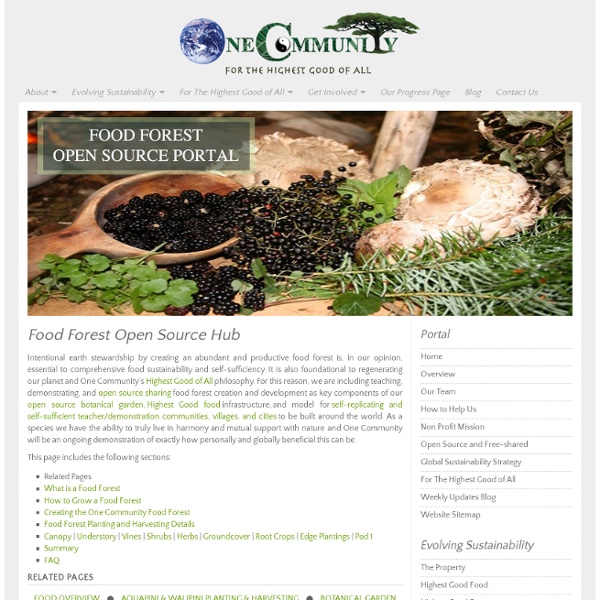
Food Forest Open Source Hub :: What | Why | How As a species we have the ability to truly live in harmony and mutual support with nature. This open source hub (and all the associated pages) will continue to evolve indefinitely as an ongoing demonstration of how to do that through food forest creation. It includes the following sections: A food forest is, as the name implies, a forest of food. The goal of this gardening and land management system is to mimic a woodland ecosystem with companion planting of edible trees, shrubs, perennials and annuals grown in a succession of layers. Fruit and nut trees are usually the canopy/overstory, while below is the understory of berry shrubs and edible ground plantings. Food forests mimic nature, are outstanding examples of earth stewardship, and arguably the most natural and sustainable food production method available. Creating the One Community food forest will begin in the first year and continue indefinitely through a process we will share in complete detail here. (Bb) = BAMBOO (Tr) – TREES
Micro Forest Garden Following on from designing a microforest garden recently, it was time to realise the design! Harris led the charge, helped by forest garden interns Minoru and Kelly, as well as all the students of the forest garden design course. This micro forest garden was to be established on a very compacted piece of ground that had formerly been a road. Yikes. As with many plantings on this crazy patch of land of ours (read: everywhere except the creekflat), it was time to get out the crowbar to dig the holes… but it all turned out splendidly! Conceptual group design for the microforest garden, done during the course by students The final design. The site, shortly after it ceased being a road in Spring 2011… A year later, during the microforest garden install… Paths and beds in, it’s time for the plantathon The particular parameters of this site include that, in a heavy rain event, there is a large amount of surface runoff due to the compaction uphill. But who knows what the future will bring.
Large-scale Soil Amendment: Surveying |Site Selection | Preparation | Swales This page is the large-scale soil amendment strategy page. It covers soil amendment for improving 3 acres of low-quality soil, enough space to grow sufficient food to feed 100 people within 1 year. As we arrive on the property and start preparing it, this page will evolve with open source videos, updated labor investment details, cost analysis details, and all other specifics needed to duplicate our efforts. It contains the following sections: RELATED PAGES (click individual icons for complete pages) The One Community soil amendment strategy from our horticulturalist and botanist prepares a property of below-average soil to become a successful growing environment. Ideally, the initial soil amendment and property preparation team will begin with 15-18 people including 2 permaculturalists, a general contractor, an architect, a civil engineer, a survey team, a soil scientist, a hydrologist, a botanist, and a horticulturalist. Composting The next key ingredient is oxygen.
Grow a 100-Year-Old Self-Sustainable Food Forest in Your Backyard in Just 10 Years Do you dream of a mini-forest in your backyard? What would you need? A minimum of 100 sq. m. plot. Most of the world we live in today was once forest, our natural habitat for millions of years. Now surrounded by cities and agriculture, humans are no longer living in their “natural” habitat, argues a forest-building engineer named Shubhendu Sharma. But we can recreate little chunks of that habitat in just ten years our own backyards, workplaces and public spaces, he explains in the Ted Talk below: Shubhendu Sharma was an industrial engineer for Toyota hired to offset some of the carbon emissions of the company’s factories. His solution was to plant mini forests right next door. Sharma’s forests grow 10 times faster, are 100 times more biodiverse and 30 times more lush than typical reforestation projects. He used his model for manufacturing as many cars as possible per square feet of factory space and applied it to growing trees. “We start with soil. You can follow us on Instagram HERE
El Pilar Forest Garden Network En trädgård på skogens villkor De partners vi arbetar med finns nedan. Expandera var och en för att se hur de behandlar dina data. Du kan invända mot databehandling med berättigat intresse per leverantör. Privacy policy: Purposes (Samtyck): Lagra och/eller få åtkomst till information på en enhetVälja grundläggande annonserVälja personanpassade annonserMäta annonsprestandaUtveckla och förbättra produkterSpeciella syften: Säkerställa säkerhet, förhindra bedrägerier samt felsökning/korrigeringTekniskt levererad annons eller innehållFeatures: Länka olika enheterSpeciella funktioner: Använda exakta uppgifter om geografisk positioneringLäsa av enhetens egenskaper aktivt för identifiering Privacy policy: Privacy policy: Privacy policy: Privacy policy: Privacy policy: Speciella syften: