

One With the Desert par Kendrick Bangs Kellogg Je vous présente cette incroyable habitation située dans le désert californien, un très bel exemple d’architecture moderne adaptée à son environnement. Nous devons cette maison à l’architecte Kendrick Bangs Kellogg et au décorateur Jean Vugrin. Le dessin organique de cette habitation est réalisé avec du béton, de l’acier, du verre et du cuivre qui permettent au projet de se fondre le plus possible dans les rochers et ce paysage désertique. Pour info, vous pouvez vous procurer cette maison hors-norme pour 3 millions de dollars. Photos © Lance Gerber et Nuvue Interactive Pin It Pin It Pin It Pin It Pin It Lyon perraches : monument végétal pour parking souterrain Le nouveau parking lyonnais Perrache-Archives La Confluence vient de remporter le Prix Spécial du Jury de l’EPA (European Parking Association) dont le congrès s’est tenu les 14, 15 et 16 septembre à Turin en présence de tous les intervenants européens du métier du stationnement. Le parc Perrache-Archives La Confluence, construit par l'opérateur privé Q-Park France, 2e opérateur national de stationnement ( 600 salariés ) est situé au coeur du quartier Lyon-Confluence et à proximité de la gare de Perrache, et a pour particularité d’être orné de 2 murs végétaux monumentaux créés par le botaniste mondialement réputé, Patrick Blanc, à qui l'on doit déjà la façade végétale du Musée Branly, à Paris. Situé sous la place des Archives (premier espace public créé dans le cadre du projet Lyon Confluence), à proximité de la gare de Lyon Perrache, le parking compte 649 places, dont 13 réservées aux personnes à mobilité réduite, réparties sur 8 niveaux. Un monument végétal en sous-sol de 260 m2
The Oasis of Aboukir green wall by Patrick Blanc for Paris Design Week Patrick Blanc, the inventor of living walls, has completed his latest vertical garden, covering the side of a five-storey Parisian block with waves of 7600 plants (+ slideshow). L'Oasis D'Aboukir (the Oasis of Aboukir) is a 25-metre-high green wall by botanist and researcher Patrick Blanc, which covers a building facade in the second arrondissement of the city. The wall features plants from 237 different species and appears to grow up the facade in diagonal waves. It was planted in the spring and covers the previously raw concrete facade on the corner of Aboukir Street and Petits Carreaux street. "I am very happy to contribute to the welfare and environmental consciousness of the inhabitants of a historic district in the heart of Paris," said Blanc, who has been creating green walls for more than 30 years. The installation will be officially opened on Tuesday to coincide with Paris Design Week, which runs from 9 to 15 September. See more green walls »See more sustainable design »
Shiberu Ban, Architecte japonais contemporain Shigeru Ban est né en 1957 à Tokyo. Il étudie d'abord au SCI-Arc (1977-1980) à Los Angeles, puis à la Cooper Union School of Architecture à New York de 1980 à 1982 et obtient son diplôme en 1984. De retour au Japon, il débute sa carrière à l'Atelier d'Arata Isozaki avant de fonder son agence en 1985. Son travail est aussitôt remarqué, et la scénographie saisissante qu'il réalise pour l'Exposition Emilio Ambasz à l'Axis Gallery (Tokyo, 1985) entièrement conçue à partir de tubes de carton, attire l'attention. Le carton répond aux contraintes des situations d’urgence, mais Shigeru Ban va aussi l’utiliser dans ses expérimentations sur la maison. Ses tubes de carton ont également été employés pour la réalisation du Pavillon japonais Paper Tube Structure 13 conçu avec le concours du Professeur Frei Otto à l'occasion de l'exposition universelle de Hanovre en 2000. Son maître Arata Isozaki parle de lui en ces termes:
7 Futuristic floating cities that could save humanity | Inhabitat - Green Design, Innovation, Architecture, Green Building Floating cities may seem like utopian sci-fi, but autonomous ocean settlements could become reality as early as 2020, says The Seasteading Institute. The forward-thinking organization recently launched the Floating City Project—an architectural design contest that seeks innovative designs for sustainable floating cities. Seasteaders posit that these aquatic communities could be the solutions to many societal issues, such as overpopulation and threats of rising sea levels. In honor of this new ocean frontier and the ambitious design contest, we’ve rounded up seven incredible eco-friendly floating city designs that we could call home someday soon . Prefab self-sustaining floating city by AT Design Office As the world’s most populous nation, China has serious concerns about overcrowding in its cities. Noah’s Ark by Aleksandar Joksimovic and Jelena Nikolic X SEA TY by X-TU X SEA TY is a lush floating city designed by X-TU that cleans the air with carbon-absorbing technologies.
Le paysage - espace-art-college Représentation d’un site, naturel ou construit, réel ou imaginaire, avec ou sans personnages, quelle que soit la technique artistique utilisée (dessin, peinture, bas-relief, photographie, etc.). Qu’est-ce qu’un paysage ? Un paysage en peinture est un tableau représentant la nature où les figures (d’hommes ou d’animaux) et les constructions ne sont que des accessoires. Le genre paysage peut revêtir différentes formes : Il peut être historique, c'est-à-dire intégrer des éléments de l’Histoire dans sa composition, retracer un grand fait historique (les batailles napoléoniennes par exemple) ; il peut aussi être idéalisé et montrer la nature sous un aspect imaginé, rêvé par le prisme (l'intermédiaire) de l’œil de l’artiste. Quand on parle de paysage autonome, on désigne un tableau qui se revendique comme peinture de paysage en tant que tel, sans scène historiée. Ignoré dans la Grèce antique, le paysage appartient, à Rome, au genre décoratif. voir les réalisations des élèves
Projet | T4deliriousny's Blog - Naturel/Artificiel Sommaire - L’artificiel comme seul moyen d’exprimer le naturel L’homme admire la nature qui le dépasse. I. - Artificiel pour exprimer le naturel : Cosney Island selon Rem Koolhaas - L’eden comme référence : jardin comme paradis dans l’art - Le jardin un espace autre : Hétérotopies de Foucault II. - Artificiel pour exprimer le naturel : Evolution du projet de Cosney Island - L’homme et les Parcs - « Conversassions paysagères »: Architecture, quel rapport avec le paysage? - Notre double : J. - La nature une possibiliter d’habiter l’infini : Thoreau - Quelles traces peut laisser un paysagiste : Mortamais - Le jardin en mouvement : Gilles Clément - De la nature au sacré : Maîtriser pour sublimer - La Villette par Rem Koolhaas/OMA : projet : Quand le parc devient la metaphore du gratte-ciel III. - Bilan demi parcours - En pleine nature : Nature face à la ville, quel comportement urbain? - Stockholm : Ville s’adapte à la nature en la respectant - Opéra Oslo : Composer avec la nature IV. De la Nature au sacré
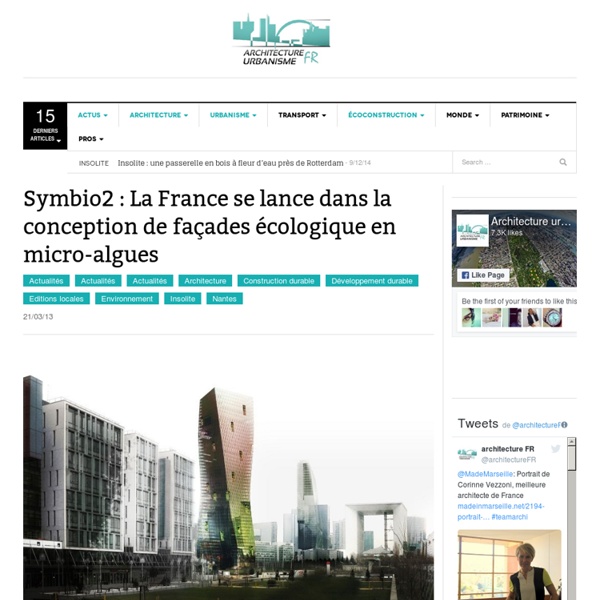
X SEA TY is a Carbon-Absorbing, Algae-Producing Floating City | Inhabitat - Green Design, Innovation, Architecture, Green Building X SEA TY is a floating, algae-producing city concept based on the principles of sharing, networking resources, and ecological symbiosis. The proposal, by X-TU, works to absorb carbon from the atmosphere and pump out fresh oxygen to improve air and ocean quality. Growing according to the needs of the people, an X SEA TY would be covered in photosynthetic algae to produce biofuels. The self-sufficient cities could also provide for their inhabitants and also work to clean up the environment making this a beyond-sustainable living development. X SEA TY is a proposed floating city that works to clean up the cities by transforming them from carbon dioxide-polluting environments by exploiting biochemical energy algae. The cities are assembled like bee hives as needed to meet demands and can be built anywhere and even moved. Images ©X-TU
six contenders announced for the international garden festival feb 24, 2014 six contenders announced for the international garden festival six contenders announced for the international garden festivalall images courtesy of the international garden festival out of approximately 300 proposals from 35 differnt countries, six design firms have been selected to have their projects realized at the international garden festival in canada. in the 15th edition of this exhibition, the winning entries are representing their respective homelands from canada, south korea, spain, switzerland, and the united states. in eastern quebec, les jardins de métis and the adjacent reford gardens are the popular site for this competition which merges the disciplines among architecture, landscape architecture, design and art. a dialogue between conservation, tradition, and innovation is a recursive theme in each proposal. ‘rotunda’ by citylaboratory ‘cone garden’ by livescape flipped upside-down the bright cones are positioned in many way ‘afterburn’ by civilian projects
T4deliriousny's Blog - Naturel/Artificiel | Just another WordPress.com weblog EmQuartier, Bangkok | Mur Vegetal Patrick Blanc Rain Forest Chandelier, EmQuartier, Bangkok, work in progress, transparency of the Nephrolepis falcata fern fronds, 6th April 2015 Patrick Blanc looking at his Rainforest Chandelier after two years of growth, Emquartier, Bangkok, March 2017
Terreform ONE (Open Network Ecology) New York City Bienvenue sur Mur Vegetal Patrick Blanc | Mur Vegetal Patrick Blanc Des plantes pour transformer les déchets en énergie ? Demain la Ville Pour l’urbaniste Mitchell Joachim, dans la ville de demain, les arbres feront partie de la structure des maisons. Copyright : Mitchell Joachim / TerreformONE Mitchell Joachim en est persuadé : dans les centre-ville du futur, on ne trouvera plus d’églises mais des plantes géantes, capables de recycler les déchets en énergie. À la tête de l’agence Terreform ONE, cet urbaniste explore les différents moyens d’utiliser la nature pour répondre aux défis grands défis de la ville de demain. Il imagine ainsi pouvoir recycler nos déchets pour en faire des matériaux de construction. Un article à découvrir sur le site britannique du magazine Wired