

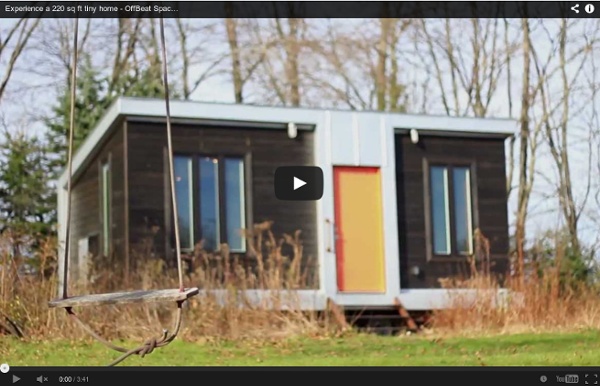
How a talented architect makes an RV look like a charming cabin in the woods The tiny house movement has become a big thing as more and more people try to live with a smaller financial, environmental and physical footprint. As Alek Lisefski noted in his Tiny Project, it's about less house and more life. It's also about laws, that regulate what can go down a road, what can go on a property under zoning bylaws, what code it gets built under. That's why so many of the tiny houses are under 8'-6" wide and weigh less than 10,000 pounds, so that they can go down the road towed by a private car and be classed as an Recreational Vehicle, or RV. Historically, people would take their little RVs and go to RV parks, where they remain on their chassis but get hooked up to water and sewer. © Escape/ Canoe Bay 400 square feet doesn't sound like much but it's bigger than many one bedroom apartments; you can build a really nice little house at that size. ESCAPE was conceived as a high quality cottage, not an RV. Kelly Davis has designed the un-trailer that anyone could love.
relaxshacksDOTcom's channel Upload Subscription preferences Loading... Working... relaxshacksDOTcom Channel Trailer- Dude builds Forts, Tiny Houses, Cabins, Tree Houses 14,298 views 3 months ago So, Youtube keep's bugging me saying I should have some sort of channel trailer.... so here you go.... short, simple, and a slight overview of what I/we do.... Related channels on YouTube Bart Steve Ramsey Kirsten Dirksen wranglerstar IntenseAngler SPACEStv Sign in to add this to Watch Later Add to
Shotgun Shack: Mortgage-Free In 320 sq. ft Gold Thread Tiny House Molecule Tiny Homes: House 4 Super modern South African tiny house is bright and green I have often complained that a lot of tiny houses, being modelled on larger houses that get the shrink-ray, are designed for cuteness instead of practicality, with their tiny lofts that peak in the middle. Perhaps instead of using a traditional house as a model, designers should be looking more at learning from more modern designs like Airstream trailers or boats. That's why the INDAWO / lifePOD is so interesting. This design by the South African team of Collaborate000 architects, and product designers Dokter and Missses is super modern, and very much a product of its climate. © Brett Rubin The INDAWO / lifePOD is a lifestyle and design intervention that affords home owners a comfortable, functional experience inside a small space; to live in confluence with the needs of the planet now and in the future .... “Living smaller will save you money in the long run; it could also make you happier.” © Pod Indawo
Benefits Of Living In A Tiny House In Canada May 7, 2013 | Posted in Tiny Houses | By Joanne Tiny Houses are becoming more and more popular around the world and in Canada. Many people are realizing that a big house isn’t all it’s cracked up to be. What Has Brought Us Here Tiny houses are gaining popularity all across Canada. Even though the size of the average family in Canada has decreased over the past 50-60 years, the average size of a Canadian house has increased almost three times. We are now seeing a shift in the other direction. When most people think of a small house, they think of a cabin in the woods or a cottage by the lake. More recently, with the financial problems that Canadians are facing, the uncertain job security, and the increasing living expenses – they are looking towards these smaller sized homes as their main living space. Your Footprint on the Environment As the environment gets more attention, we begin to look at our ecological footprint. How Small Can you go in Canada? DIY Construction of your Tiny Home
Tiny Houses designed by Jay Shafer | Four Lights Tiny House Company During the past eighteen years, I’ve refined my designs to create some of the best small homes available. All of our front-gable houses* of 120 square feet or smaller have been configured to fit between the wheel wells of a standard car hauler, which means that: Their construction is much easier and more affordable.It’s possible to build the homes on wheels or on a foundation, and move from one surface to the other.Each home now has 8 times as much insulation and an unbroken waterproof membrane where the wells once were. I’ve also managed to get rid of all the collar beams that obstructed the cathedral ceilings of my dwellings. The simplified interior has allowed for 6’ 6” ceilings under all lofts and (for the first time in any of my finished layouts) a full-length bed downstairs. Not-Quite-So-Tiny I’ve also designed some slightly larger houses that range from about 280 (plus another 250 for prospective loft space) to 380 square feet (plus 350 for loft space). RV or Not RV? Jay Shafer
Living Big In A Tiny House Archive Building a Tiny Off-Grid Cabin in New Mexico By Kevin Stevens A few years ago we purchased some vacant land in northern New Mexico. We chose that area based on a number of factors. Site Location and Solar Power Our parcel of land is a bit under 42 acres and nearly all the land around us is uninhabited grazing land. I designed all of our cabin’s lighting needs to be met with 12 volt DC based LED’s. Challenges with Building the Cabin Building in a remote location has some added challenges that many take for granted. Cooking, Water and Heat In a conventional home, the turning of a knob may bring life to a cook stove using natural gas or electricity at 220 volts. All of our water is brought in using 5 gallon Nalgene jugs. Our cabin is passive solar by design and when the winter sun is shining, the wood stove is not usually required. A Work in Progress The initial building process had us “dried in” after a months work, but I still have a ways to go on a lot of the smaller details. Kevin Stevens writes for Networx.com.
Itty Bitty House Company Designs & Builds Insanely Livable Tiny House Recently I found out about a new tiny house builder. I ran into their video tour on YouTube and saw that the house is for sale for $55,000 on Tiny House Listings. You’ll get the complete tour of the house below. Andrew Gilcheck is the man behind Itty Bitty House Company. The tiny home you’ll see here has a relatively large porch and is completely non-toxic. On the outside it’s all solid cedar siding, trim, and decking. The roof is metal and the windows are all full crank-out casement while the others are crank out awning style windows. Photo Courtesy of Itty Bitty House Company The front door is fully insulated wood with a double pane fully insulated glass window. The porch light uses an LED bulb, as well as all of the other lights in the home. It has an upstairs sleeping loft with a king-sized bed and a wide awning window. There’s another matching window directly across to provide a cross-flow ventilation throughout the house. Going Inside the Itty Bitty House The Kitchen The Bathroom
Tiny House – Jessica Helgerson Interior Design This little house is where Jessica and her family have been living for the last several years. It sits on a five-acre property on Sauvie Island, an agricultural island on the Columbia River 15 minutes north of Portland. The house is an interesting experiment in reduction and reuse not only because it is only 540 square feet or because it was remodeled using nearly exclusively reclaimed materials, but because the building itself is now being recycled for the fourth time. It was first built in the early 1940s as part of Vanport Village; a quickly erected development built to house shipyard workers. When Vanport Village flooded in 1948 this particular little house was floated down the river to Sauvie Island, where it became the goose-check station. Years later it was remodeled to become a rental house. When Jessica and Yianni bought the property in late 2008, they decided to remodel it without adding to the existing footprint.