

Futurist.com: Futurist Speaker Glen Hiemstra | This is the blog of Glen Hiemstra, futurist speaker, keynote speaker, futurist consultant, and founder of futurist.com Mike Walsh The Benefits of Social Media for Businesses The benefits of social media give businesses a new way to interact with customers. It’s no longer enough that a strong marketing initiative will turn consumers into customers. Your business needs to create strategies that link the customer experience with the technologies and systems required to deliver the right content at the right time. Customers are complicated. All businesses, whether big or small, should go to the trouble of finding ways to connect with customers to turn them from passive reactors to advocates. The future of social media offers many exciting, new opportunities for businesses to interact with their customers. Image: mypokcik /Shutterstock
The personal blog of Futurist Thomas Frey » Blog Archive » 12 Laws of the Future 12 Laws of the Future For several decades now I have been contemplating our relationship with the future. Many of my colleagues think of me as that crazy guy who assigns human attributes to this thing we call the future. On occasion you can hear me uttering phrases like, “I know it’s going to be a great day because the future is clearly happy with me today.” Or, “no, that’s not a good idea because the future is probably going to push it off a cliff.” At one point I even tried to convince my wife that the future wanted me to buy a new car, but she wasn’t buying it. So why is it so important to study the future? The Physics of Time Vs the Physics of the Future “As physicists, we believe the separation between past, present, and future is only an illusion, although a convincing one.” – Albert Einstein From everything I’ve studied, past observers have focused on the concept of the future as being a consequence of time, rather than a stand-alone force of nature. The History of the Future 1.) 1. 2.
Matthias Horx This is intended as a short overview of our work and our personal ideas and beliefs about futurism and trend research. As well as an introduction what we think futurism is, there is a summary of main speech topics, interesting quotes, book tips and some examples of our company's published trend research in English. A live experiment with smart technologies. New energy concepts and family lifestyles of the 21st century. Grand opening: 2010. www.zukunftshaus.at World Design Cities Summit 23-24 February 2010 How will the cities of the future look? >> Read more (PDF-File, Korean language) If the browser does not display the content correctly, please use Adobe Reader to open the file. Throwing fear overboard. Matthias Horx sees the current economic crisis as a productive process for a necessary change in the economy, politics and society. Read more >>> Dec. 29th, 2009 deutschewelleenglisch Matthias Horx: "The Futurist's Paradox" Is it really good to know the future? Read the introduction and more --->
The Dos & Don'ts Of Social Media For Business Have you ever engaged in a conversation online where someone bluntly told you exactly what you could and could not do in social media? If so, you know that doing that is a one way street that pretty much always leads to a dead end. I am of course not saying you should abandon your social media manners, I am just saying that if it wasn’t for creativity, we would have social media at all. For a business, social media is a vital part of networking and marketing. However, it would be rude and obnoxious to say that social media is all about marketing. An infographic called The Dos And Don’ts Of Social Media For Business, presented by The Steel Method, has a few sound pieces of advice that might help you initially understand how social media for business works. Scan through these simple tips, and get to know them for a while through simple networking on your social media platforms. (Click To Enlarge)
MediaFuturist Jamais Cascio (Open the Future) Q: What’s your best advice to social media managers? A: Stop talking about social media inShare192 I recently presented at Microstrategy’s iCommerce Summit in Amsterdam on the importance of looking inside to improve how to engage on the outside. Following the event, I was invited to join Peter Gentsch of Big, Michael Buck of Dell, and Andreas Bock of Telekom. The conversation explored the importance of rethinking how businesses approach social media. Rather than driving social media strategies based on just clever ideas, campaigns, soft KPIs, and intangible results, I shared the importance of focusing on the bigger picture. I’m often asked what advice do I have for social media strategists and managers. Executives don’t think about tools they think about results. The takeaway is to think about social media, mobile, web, as a holistic digital strategy that drives desired experiences and outcomes. Welcome to the era of tangible where business value and outcomes are factored into digital strategy and prioritization.
Thierry Gaudin Un article de Wikipédia, l'encyclopédie libre. Pour les articles homonymes, voir Gaudin. Thierry Gaudin Il est principalement connu en France pour deux livres : L'Écoute des silences, les institutions contre l'innovation (1978, [3]) et 2100, Récit du prochain siècle (1990). Il s'attache à montrer que la mutation contemporaine n'est pas assimilable à un nouvel avatar de la révolution industrielle mais doit être comprise comme un véritable changement de civilisation. Biographie[modifier | modifier le code] Né le 15 mai 1940, Thierry Gaudin est Ingénieur Général des Mines, président de « Prospective 2100 » [1], docteur en Sciences de l'Information et de la communication. Depuis 1993 : Création de Prospective 2100, association internationale ayant pour objectif de préparer des programmes planétaires pour le 21e siècle, publications d'ouvrages sur la Prospective et l'Innovation, conférences et interventions dans les milieux industriels, expertises pour la commission européenne.
Adam Gordon (Future Savvy) 62% of 12 to 15-year-olds own a smartphone : infographic I find it fascinating to look at habits of children who have grown up in the digital age or really now, with social media. So I found the recently published Ofcom child media usage survey interesting as it looked at the habits children are displaying in terms of their media consumption. The numbers aren't surprising nor is the move away from traditional TV viewing with only 17% of 12 to 15-year-olds saying they would miss TV if they didn't have it. Most parents I know are showing their kids Elmo videos on YouTube and I've scarily seen an increase of pretend laptops, iPhones and iPads, for the under 3s to play with so they don't break mummy's shiny new iPhone 5. Crab Creative have put together this handy infographic outlining some key stats from the report. Are marketers looking this far into the future and trying to tap into the youth market before they become adults?
Autrans 2004 (2e partie) : Thierry Gaudin, les enjeux de la société cognitive Par Daniel Kaplan le 25/03/04 | 2 commentaires | 1,894 lectures | Impression Thierry Gaudin ( prospectiviste, président de Prospective 2100 ( a impressionné l’auditoire des dernières rencontres d’Autrans lors de sa conférence inaugurale. En mettant en perspective les questions de bien communs publics, de coopération et d’appropriation sociale, il a proposé quelques thèmes de réflexion qui devraient nous accompagner longtemps : celui de la société de la reconnaissance (plutôt que de la connaissance), celui de la place des “communs” et de la propriété intellectuelle et celui des “crises” passées et à venir de la société de la connaissance.Ce compte rendu fait suite à celui que nous avons consacré à Christian Huitema, également intervenant aux rencontres 2004 d’Autrans. Voir aussi sur le site d’Autrans Cet article a également été traduit en Espagnol pour le site Tendencias 21. Sommaire Inquiétudes sur l’évolution de l’espèce humaine Sur ces mêmes sujets
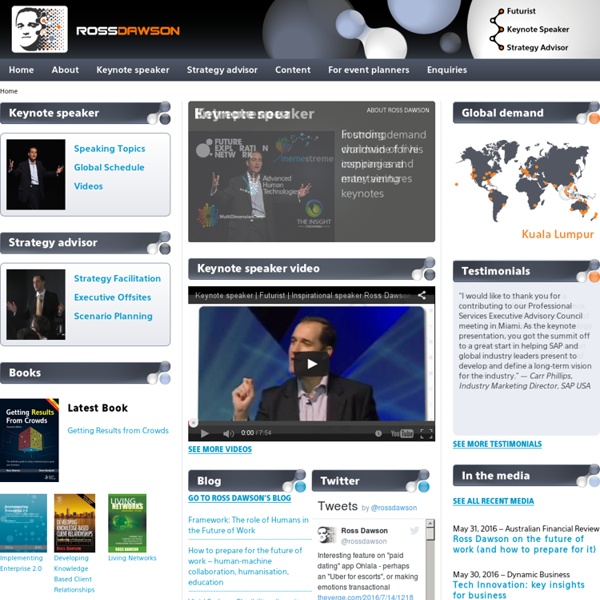
Ross Dawson Ross Dawson (b 1962) is an Australian author, futurist, entrepreneur and former stockbroker.[1] Best known for his 2002 book 'Living Networks' which predicted the social networking revolution, Dawson founded the futures think tank Future Exploration Network and consults on digital futures to various big organisations such as Ernst & Young, Macquarie Bank, Microsoft and News Corp. Named by Digital Media magazine as one of the 40 biggest players in Australia's digital age,[2] Dawson graduated from Bristol University with a B.Sc (Hons) and from Macquarie University with a Grad.Dip in Applied Finance. Dawson regularly gives keynote addresses on digital media futures and his 'Future of Media Reports' have a readership in the tens of thousands. Dawson is married to Sydney jewellery designer Victoria Buckley and the couple have two young daughters. Books[edit] References[edit]