

Learning Theories Every Teacher should Know about Have you ever asked yourself what learning theories you know about and which ones you feel more connected to and apply in your teaching ? Generally speaking, theories inform and guide practice in any content area and a learning theory is a set of concepts on how people learn. It is more or less an investigation of the strategies and the underlying cognitive processes involved in learning. The educational field abounds in learning theories to the extent that it becomes hard to draw clear boundaries between some of them. courtesy of edudemic
How 21st Century Thinking Is Just Different How 21st Century Thinking Is Just Different by Terry Heick This content is proudly sponsored by The Institute for the Habits of Mind, promoting the development of personal thinking habits in 21st century learners. In an era dominated by constant information and the desire to be social, should the tone of thinking for students be different? After all, this is the world of Google. In this world full of information abundance, our minds are constantly challenged to react to data, and often in a way that doesn’t just observe, but interprets. As a result, the tone of thinking can end up uncertain or whimsical, timid or arrogant, sycophant or idolizing–and so, devoid of connections and interdependence. The nature of social media rests on identity as much as anything else—forcing subjectivity on everything through likes, retweets, shares, and pins. But this takes new habits. Information Abundance Persisting. Managing impulsivity. Responding with awe. Questioning. Innovating. Thinking interdependently.
Fun, Flow, and Fiero: Reflections on Week 1 of the Games Based Learning MOOC | Remixing College English As mentioned in my last post, I am planning to gamify next Fall’s first-semester FYC course, using Interactive Fiction (IF) and the multiplayer classroom model. The decision to do so came completely independently of a new MOOC that started this past week that focuses on Games Based Learning (GBL). I had not intended to take this MOOC, since I had already signed up for another MOOC that would overlap with it. Case in point: the three concepts we covered during the first week are fun, flow, and fiero. Fun Learning doesn’t have to be fun. Hard fun doesn’t always feel like fun, though sometimes it can. Flow Flow is, according to Mihaly Csikszentmihalyi, the secret to happiness. It turns out that you can design “play” along something called an engagement curve, which basically means that (as a game designer) you present challenges to people in roughly the order they’re equipped to handle them. If you’re an educator, then this game-designer language probably sounds very familiar. Fiero
What should every teacher in the 21st century know and be able to do? What should every teacher in the 21st century know and be able to do? That’s an interesting question. The original blog post was written a year ago by Med Kharbach in Educators Technology and re-posted by Terry Heick, from TeachThought. This blog has taken on a life of its own over the last year. It’s been used in several digital literacy courses in universities around the States and Canada and also been published in printed journals. 36 Things Every 21st Century Teacher Should Be Able To Do: 1. Whether you choose a text message, email, social media message, Skype session, or a Google+ Hangouts depends on who you need to communicate with and why—purpose and audience. 2. Email won’t always work. 3. Hit the Print Screen button near your number pad on a keyboard on Windows. 4. Know what it means to be Rick Roll’d, the difference between a fail and an epic fail, why Steve is a scumbag, and who sad Keannu is. 5. Not everyone loves technology. An RT as an olive branch. 6. 7. 8. 9. 10. 11. 12.
Schools shift from textbooks to tablets - US News & World Report By PHILIP ELLIOTT, Associated Press WASHINGTON (AP) — Well before the cleanup from Superstorm Sandy was in full swing, students could read about the weather system that slammed the East Coast in their textbooks. Welcome to the new digital bookcase, where traditional ink-and-paper textbooks have given way to iPads and book bags are getting lighter. Publishers update students' books almost instantly with the latest events or research. "We must use technology to empower teachers and improve the way students learn," said Joel Klein, a former New York City schools' chief who now leads News Corp.' News Corp. introduced their Amplify tablet during a breakfast Wednesday at the South by Southwest conference in Austin, Texas. Orders placed by June 30 will be ready for the start of the school year in the fall, officials at Rupert Murdoch's company said, adding yet another platform for schools to consider. Putting a device in every student's hand is not a pie-in-the-sky dream.
NCSU Research Shows Video Games Might be Useful for Grandma | North Carolina Health News Video games can challenge a player’s responses, concentration and creativity. They also might keep their an older player’s brain limber. It’s not every psychology professor who could coax his grandma into playing World of Warcraft, an online fantasy game. But a few years ago, that’s exactly what Jason Allaire, PhD did when he found himself hanging out with his grandmother, who was then 75. Photo credit: Anne McLaughlin. “After she was done playing she said, ‘My brain is tired,’” said Allaire, a researcher at N.C. Allaire, a longtime fan of video games decided that digital games – computer, phone, handheld devices, or consoles like Nintendo Wii – were a good tool to measure cognition and memory in the elderly. “They had more positive emotions and lower rates of depression,” said Allaire. He said two-thirds of those polled said they played digital games at least once per month, but often more frequently. “Digital games are a great way to do that.”
Edina Tech Camp You are invited to participate in the 2012 Edina Tech Camp Below you will find over 35 classes either online or face to face to engage you in integrating technology into your classroom. $250 Stipend for Student Learning Experience If you choose to complete 9 hours of face to face training at tech camp or one of the online classes develop a student learning project to implement into your classroom and have a face to face meeting with your technology integration specialist you will earn a $250 stipend. In order to earn the stipend you need to... 2. 3. 4. *You may only earn one stipend per summer. Everyone is welcome to sign up for Tech Camp regardless of the stipend. Registration Process Online Courses run June 11th- August 1st August 13-16th *There is a "My Schedule" document attached at the bottom of the page for your planning and scheduling. Monday, August 13, 2012 Tuesday, August 14, 2012 Wednesday, August 15, 2012 Thursday, August 16, 2012 Also... These classes are free to Edina employees.
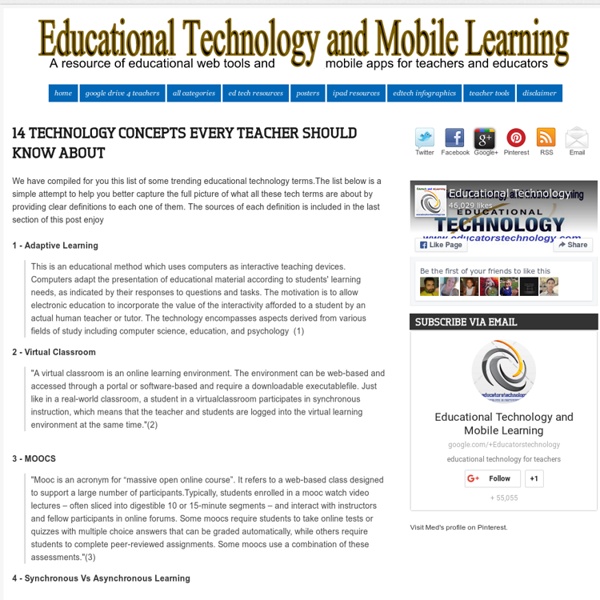
6 Learning Methods Every 21st Century Teacher should Know After writing about the 14 techy concepts every teacher should know about, Educational Technology and Mobile Learning is providing you with a list of learning methods together with their definitions. Knowing about these methods and employing them in your classroom will definitely make a difference in your teaching practics. Check them out below and share with us what you think of them. Enjoy1-Inquiry-Based LearningThis is a learning process that is based on inquiry or asking questions. Through asking challenging questions learners get intrinsically motivated to start delving deeper to find answers for these questions and in doing so they are exploring new avenues of knowledge and insight.As you can see in the graphic below inquiry-based learning is a cyclical learning process composed of many different stages starting with asking questions and results in asking more questions. Watch this video learn more about inquiry-based learning 1. 2. 3. and encouraging one another. 4. skills. 5.
Kuato teaches kids to code via Hakitzu educational game | GamesBeat Not all players are the same! Join GamesBeat's Dean Takahashi for a free webinar on April 29th that will explore why players leave Free to Play games and how you can change this. Sign up here. Kuato Studios has launched its first code-teaching game, Hakitzu: Code of the Warrior, as a title on the Apple iPad. Hakitzu is a mobile-strategy game where two robots square off against each other on a grid. San Francisco-based Kuato wants to “gamify” education, or use game mechanics to get kids interested in non-game applications such as learning computers. “We are focused on making coding fun,” said Frank Meehan (pictured right), the chief executive of San Francisco and London-based Kuato, in an interview with GamesBeat. To create the program, Kuato conducted research at schools throughout the U.S. and United Kingdom.The researchers found that students said they were eager for learning tools that were graphically rich, interactive, and challenging. Kuato set out to make a series of games.
Workshop Activities for Technology Integration Hands-on lessons and activities you can adapt for discussion and exploration in your technology integration workshops. Now that you've established the basics of technology integration, you're ready to explore. On this page, you will find a wide range of activities that will get workshop participants thinking and talking about the best ways to integrate technology into everyday lessons: These activities are grouped by topic, grade level, and subject area so they can be easily incorporated into a workshop with varied participants. All of the tools used are free or have free versions. Activity One: Digital Storytelling The purpose of this activity is to give workshop participants a chance to experiment with various grade- and subject-appropriate digital tools that will enable their students to tell a story or relay ideas through multimedia. Back to Top Activity Two: Digital Citizenship Activity Three: Checking for Understanding Activity Four: Creating Screencasts
5 technologies transforming education right now From iPads in classrooms to mobile apps for educators, new technologies are changing how teachers teach and educational institutions are run. Whether they flip the classroom model, blend the learning experience or just make educators' lives easier, lots of innovators are talking about technology and how it is transforming education as we know it. To give you an idea of what's coming, we've turned the spotlight on five technologies that are driving the ed tech revolution. 1. 2. 3. 4. 5. Would you like to see more education news like this in your inbox on a daily basis?
Alternate reality game An alternate reality game (ARG) is an interactive networked narrative that uses the real world as a platform and employs transmedia storytelling to deliver a story that may be altered by players' ideas or actions. The form is defined by intense player involvement with a story that takes place in real time and evolves according to players' responses. Subsequently, it is shaped by characters that are actively controlled by the game's designers, as opposed to being controlled by artificial intelligence as in a computer or console video game. Players interact directly with characters in the game, solve plot-based challenges and puzzles, and collaborate as a community to analyze the story and coordinate real-life and online activities. ARGs generally use multimedia, such as telephones, email and mail but rely on the Internet as the central binding medium. Definition[edit] Unique terminology[edit] Among the terms essential to understand discussions about ARGs are: Computer/console/video games.
How to Design a Beautiful iPad Lesson: This is a beautiful lesson designed and presented by Rob Miller on Scrib. What I really like about this series of activities is that it allows the students or in Rob's case his teachers to articulate their own learning. It is never about a single app. It is the combination of apps that allow the learners to meet the learning outcomes. The other great thing about this lesson is the beautifully designed yet simple instructions built by Rob. I would like to thank Rob for sharing this resource. This series of activities has got me thinking about a whole range of tasks that I now want to design and share with my own students.
Hard Fun By Seymour Papert I have had a lot of flack from people who read this column (and other things I have written) as advocating taking the hard work and discipline out of learning. I don't blame them. I am a critic of the ways in which traditional school forces kids to learn and most attempts to introduce a more engaging, less coercive curriculum do indeed end up taking the guts out of the learning. But it is not fair to hold me guilty by association. My whole career in education has been devoted to finding kinds of work that will harness the passion of the learner to the hard work needed to master difficult material and acquire habits of self-discipline. Way back in the mid-eighties a first grader gave me a nugget of language that helps. Once I was alerted to the concept of "hard fun" I began listening for it and heard it over and over. The phrase "pleasure of writing" makes me pause. How do we make writing become hard fun?