

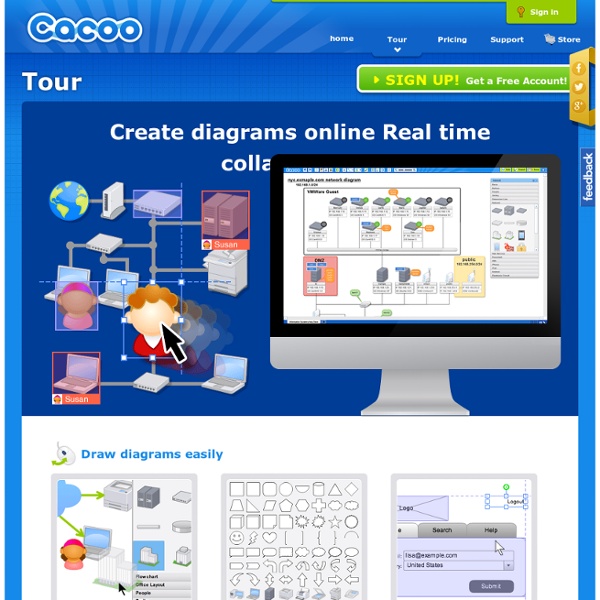
Creately Launch[edit] Cinergix, a Melbourne, Australia based start-up founded by Chandika Jayasundara, Nick Foster and Charanjit Singh. Creately first announced its visual collaboration platform in September 2008 at DEMO fall 08 as a private beta version. Creately was made commercially available to the public in September 2009[2] with a unique "Pay What You Want"[3] price. Creately Products[edit] Although Creately entered the market as web based diagram software it has expanded their product range to include desktop software and diagram plugins for some popular platforms. Creately is also available in Chrome web store and Google app marketplace. Awards and Accolades[edit] Top 10 apps in Asia 2010Silver medal in National Best Quality Software Awards References[edit] External links[edit] Official website See also[edit]
LucidChart History[edit] In December 2008, Lucid Software Inc., a startup based in Salt Lake City, Utah, first announced its Lucidchart visual collaboration platform as a public beta version.[1] The current major revision of Lucidchart was released on 31 July 2010.[2] "Lucidchart is a graphically-rich web application that makes working on a diagram with your entire team a simple matter. The tool is effectively an online alternative to Microsoft Visio." In April 2010, Lucidchart became available in the Google Apps Marketplace.[8] In December 2010, Lucidchart was included as a featured application in the launch of the Chrome Web Store, where it became the top paid application.[5][9] In July 2011, Lucid Software announced it had raised US$1M in seed funding from 500 Startups, 2M Companies, K9 Ventures, and other angel investors.[3] In summer 2013, Lucid released its Chrome Packaged App to the Chrome Web Store, which allowed users to work offline and sync their documents. Features[edit] Integration[edit]
Mind42 Mind42 is an online mind mapping application that allows users to visualize their thinking using the proven[1] mind mapping method. The name refers to the collaborative features of the product, and is intended to be pronounced like "mind for two. Features[edit] The developer provides the full feature set of Mind42 free of charge, including:[4] Ability to insert images from URLs (i.e. images hosted at another site, such as ImageShack or Picasa Web Albums);URL links to external websites;Real-time collaboration and editing, utilizing the Google Talk gadget;[5]Mind map size limited only by available RAM and processing power;The optional ability to publicly publish mind maps or keep them private;The ability to add notes to branches;[6]Export to Freemind, Mindmanager, Mind42 XML, PDF, image and rich text;[6]Import from Freemind, Mindmanager, Mind42 XML.[6] Criticisms[edit] See also[edit] References[edit] External links[edit]
MindManager Commercial mind mapping software MindManager is a commercial mind mapping software application developed by Mindjet. The software provides ways for users to visualize information in mind maps and flowcharts. MindManager can be used to manage projects, organize information, and for brainstorming. As of December 2015[update], Mindjet had approximately two million users,[3] including notable customers such as Coca-Cola, Disney, IBM, and Wal-Mart.[4] MindManager provides ways for users to visualize information using mind maps, and with the release of MindManager 2016 for Windows, now includes flowchart and concept map creation tools. The software that became MindManager was originally developed by Mike Jetter in the mid-1990s while he was recovering from a bone marrow transplant to treat leukemia. In September 2012, the Mindjet company combined all of its software, including MindManager, Mindjet Connect, and its mobile offerings into a single product, also called Mindjet.[18] [edit]
MindMeister MindMeister is an online mind mapping software that allows its users to visualize their thinking.[1] Mindmeister was founded by MeisterLabs GmbH, a Munich, DEU-based company in February 2007. MeisterLabs GmbH was founded by Till Vollmer and Michael Hollauf, and has offices in Vienna, Austria as well.[2] Based on the freemium model, MindMeister provides users three free fully featured maps, but charges a subscription fee for additional maps. In March 2010, MindMeister debuted as one of the original partners selected by Google to take part in the launch of the Google Apps Marketplace[3] Awards[edit] See also[edit] References[edit] External links[edit] Mindomo Mindomo is an online mind map Software where users can create, view and share mind maps in their browser.[1] Mindomo is offering the basic services for free, while charging for advanced features. Unregistered users can view the mind maps, while registered users are permitted to create and share mind maps. The free version limits the number of private maps to three and disables some special features like spell checking. Mindomo was first available in February 2007. Mindomo also has a desktop version based on the Adobe Air runtime. See also[edit] References[edit] External links[edit]
Mind42.com - Collaborative mind mapping in your browser Free online mind mapping software | MAPMYself (Mapul) Welcome to Glinkr Visual Thinking Evolution A mind map is a diagram used to represent words, ideas, tasks, or other items linked to and arranged around a central key word or idea. Especially in British English, the terms spidergram and spidergraph are more common,[1] but they can cause confusion with the term spider diagram used in mathematics and logic. Mind maps are used to generate, visualize, structure, and classify ideas, and as an aid to studying and organizing information, solving problems, making decisions, and writing. The elements of a given mind map are arranged intuitively according to the importance of the concepts, and are classified into groupings, branches, or areas, with the goal of representing semantic or other connections between portions of information. Mind maps may also aid recall of existing memories. By presenting ideas in a radial, graphical, non-linear manner, mind maps encourage a brainstorming approach to planning and organizational tasks. Reference: wikipedia
Documents Lucidchart no longer supports Microsoft Edge Legacy, but it does support the new Chromium-based Microsoft Edge. Read below to learn how to update your browser Update your browser. Your browser is outdated and no longer supported by Lucidchart. We suggest installing or updating to one of the browsers below. Recommended Click to install Chrome Other Options Click to install Firefox Click to install Safari Click to install the new Chromium-based Edge