

m.actualitte L'institut amériain de haute éducation Virginia Tech a publié les résultats d'une récente étude au sujet de l'influence de la littérature féminine sur l'estime de soi et le rapport au corps des lectrices. Et selon les observations relevées, le genre ne serait pas aussi psychologiquement inoffensif qu'il semble à première vue. Il pourrait avoir un effet sur la manière dont les femmes appréhendent leur poids ou encore la perception de leur propre attractivité sexuelle. La « chick lit », une question de santé publique ? Creative Commons (cc by 2.0) Selon l'Oxford English Dictionary, la « chick lit » désigne la littérature qui s'adresse avant tout aux femmes. En somme, l'observatoire idéal pour la recherche sur les liens entre représentations textuelles de l'esthétique du corps, de son poids ou du sentiment d'attractivité sexuelle.
Gender Equality and Picture Books | ThinkBannedThoughts Blog I got a tweet from a friend last week that lit all kinds of lightbulbs in my head. It was a simple – but very rare – tweet. Reading for Gender Equality. So many thoughts hit my head all at once. The loudest was that this was the first time I’d ever been asked that by someone with a son, or sons. I get asked all the time to recommend books to parents of daughters in order to promote the ideal of gender equality. It filled my heart – because that is where it starts, with parents. Then I thought of this amazing blog post by male author, Robert J. What he realized in that moment was that his whole life, he had been shielded from seeing women as people just like him. Is it safe? One of the solutions he proposes is for parents of sons to get past this weird idea that boys can only relate to stories about boys. But a book/movie with all girls!?! It turns out that this is easier said than done as a brief stroll of my daughter’s book shelf reminded me. Because Kids is Kids. Like this: Like Loading...
Contemporary fiction: The death of chick lit? IT WAS fun at the start, like every romance. But ten years on, the bloom is off the “chick lit” rose. This sparkly slice of women's fiction has more or less officially expired. Reports abound from either side of the Atlantic: publishers rebuff new titles; supermarkets barely stock them; authors can no longer make it pay. Sophie Kinsella, the reigning queen of light amusing urban romance, must feel a little like Mark Twain. She ain't dead yet: her newest novel, "I've Got Your Number", is a current top seller on British fiction charts. A decade after "Bridget Jones's Diary" and "Confessions of a Shopaholic" unleashed a tsunami of stiletto heels, chick lit isn't as much dead as transformed. “The term assumes the subjects covered are light, but actually that's not necessarily true. “It's moving on from young women having trouble with their boyfriends and their hair. The original appeal of these books, mostly featuring feisty, single young professional women, has not changed much either.
SharpReading - Cutting Edge Reading Strategy Instruction Teaching Reading Comprehension Strategies Our professional development in Reading comes in three formats 1. Online Teacher Training We have distilled our 10 years of action research with trainee teachers into an web-based training programme. Twelve months of small step, at-your-own pace learning with weekly tutorials, video modelling and supporting resources. 2. 3. What's SHARP about SharpReading? SIMPLICITY - Please! A SharpReading programme is underwhelmingly easy to implement, lite on paper work but gets impressive results. * start with a piece of text * they unpack it * you respond to what they come up withA one page planning and assessment template is all you need. HABITS - What do habits have to do with becoming a better reader?. Learning to read is all about habitualising the use of mental strategies. AUTONOMY - SharpReaders transfer the skills into their personal reading. The outcome of our instruction must be the independent and automatic use of these strategies or we are wasting our time.
LANGLADE Gérard - Le rendez-vous des Lettres Qui fabrique le texte ? : le texte du lecteur - Supports scolaires, ressources numériques et sujets lecteurs Professeur d’université en langue et littérature françaises, Université Toulouse2-Le Mirail. Professeur en langue et littérature françaises depuis 2000 à l’Université Toulouse2-Le Mirail, Gérard Langlade anime le programme « La fabrique du lecteur, du spectateur et de l’auditeur face au processus de création », au sein du Laboratoire LLA CREATIS ( M. Table ronde 1 : Qui fabrique le texte ? Résumé : Parler métaphoriquement de « texte du lecteur » ne consiste pas à nier l’existence du « texte de l’œuvre » ni à réduire l’importance créatrice de l’auteur mais à attirer l’attention sur l’activité des lecteurs empiriques dans l’actualisation et la reconfiguration des œuvres. Une telle hypothèse engendre au moins trois interrogations qui orienteront la communication : Bibliographie sélective 2011 : Le texte du lecteur, tomes I et II (dir. M.
Kids' Book Review: Teachers' Notes & Lesson Plans Due to the upkeep of this list of teacher/librarians' notes and lesson plans, and the fact that links often break or change, we will only be adding sporadically to the list when notes/plans directly come to hand. In light of this, we have included publisher links to a vast amount of teaching resources, below, which will help you in your search for fabulous teaching material. Every effort is made to provide accurate links, however, if the publisher/book/author website changes or deletes them, some links could appear broken here. Do let us know if you find a broken link so we can delete it from the page. If you are looking for a certain book that is not featured here, we recommend searching the publisher website for the book in question, googling the title along with either 'teaching notes' or 'lesson plans', or contacting the publisher directly to ask if there are any notes available. EK Books Teaching Notes Teaching Notes The Five Mile Press News, book lists Teaching notes and resources.
About | THIS IS DAHLIA'S BLOG My work — which has taken the form of books, articles, concerts, and installations — can be found across mass/mainstream, critical/academic, and emergent/underground channels. Sometimes my intention is to critique and suggest, other times to arouse and entertain, yet others to transform and advance. In the past, my performances involved singing in an all-girl punk band, then as a solo dance-music artist, but now my theatricality is reserved for the classroom, where I teach undergraduates about art, culture, literature, and film. After years of living in Berlin, Tel Aviv, and New York City, I currently reside in Los Angeles, which affords me the space (literal and figurative) to invent and imagine what’s next for myself and the world around me. My books, Queen of Hearts, Seduce Me, Breathe With Me, I’ve Been a Naughty Girl, and Lovergirl, are available on Amazon. More information can be found on my Facebook page. Main photo by Sh Sadler. Thanks for reading. Like this: Like Loading...
Best Kids' Books Ever | Book Depository 23%off 15%off 16%off 14%off 17%off 26%off 18%off 12%off 19%off 29%off 22%off 20%off 13%off 25%off 27%off 33%off 28%off 24%off 11%off 21%off 10%off 35%off 31%off 32%off 103 Things to Do Before/During/After Reading Pantomime Act out a scene you choose or the class calls out to you while up there. Dramatic monologue Create a monologue for a character in a scene. What are they thinking/feeling at that moment? Why? Dramatic monologue Check out Reading Rockets' new summer website, Start with a Book. Interview with Adele Broadbent Name: Adele Broadbent Date of birth: 17 April 1968 Place of birth: Napier Now living in: Napier What is your favourite food? I love anything caramel! Do you have a nickname and, if so, what is it? I have had several nicknames — some good — some bad — but thankfully, none that have stuck. What was your most embarrassing moment? I have lots and lots of those, but my most embarrassing ‘stage’ was turning from a tomboy into a girl. How do you relax? I enjoy watching movies when I get the time. Who inspired you when you were little? My parents gave me my love of books and reading and I had some really cool teachers at Intermediate. What were you like at school? I was always the smallest in my class, but probably talked the most! What was your favourite/most hated subject at school? My favourite subjects were English and Art and I was hopeless at Maths and Science. What was the book you most loved as a child? Which person from the past would you most like to meet? Why did you want to be a writer?
Reading Without Tears: Use the iPad to Encourage Reluctant Readers By Emily | October 18, 2012 | 2 comments If your child has a meltdown when it’s time to “drop everything and read,” consider using the iPad to build good reading habits and to help your child find content that interest him. Of course parents can tell a child that “there’s no iPad until you’ve done your reading.” Look for apps which, while they aren’t books, still require reading. Make reading more like a game. Work more reading into a child’s play time. Track a child’s progress. Do you have a reluctant reader at home? Photo courtesy of Flickr user Creative Donkey.
Who wrote answers for the book? Bear Grylls – Is it OK to eat a worm?Alain de Botton – How are dreams made?Jessica Ennis – How do you get into the Olympics?Richard Dawkins – Are we all related?Miranda Hart – Why are the grown-ups in charge? Plus: jokes from some of our favourite comedians including Stephen Fry, Sarah Millican, Robert Webb, Jack Whitehall and Sandi Toksvig.
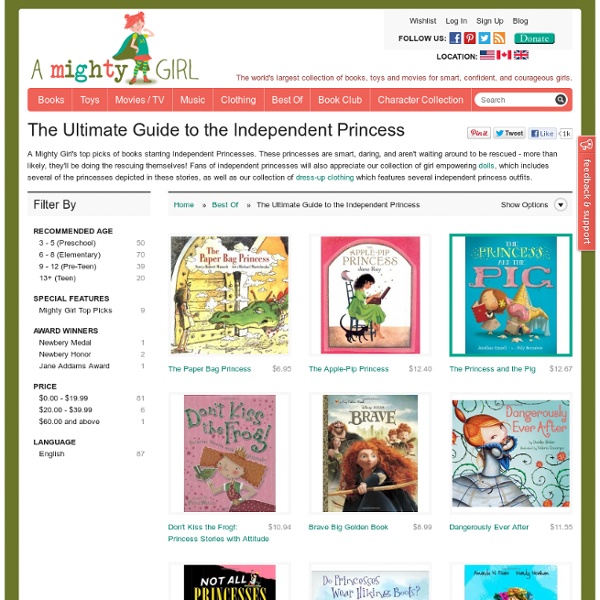
This website, which sells an array of books for young girls to teenagers, concentrate on the concept of ''anti-princess''. They sell titles such as ''Dangerously ever after'' or ''Not all princesses dress in pink''. From what I can see, their educational mission is to offer a wide variety of role models for little girls in books. In a way, they're encouraging diversity from an early age, which is awesome. This concept is refreshing, that's for sure, but it's leaving me perplex, since I've grown up thinking all girls wanted to be princesses. The role and characteristics of a young girl was always well defined (too well defined, maybe?) but now it's starting to change.These days, a lot of people are trying to make their own revolution by pushing the gender limits, and I'm curious about the impact of that way of thought for the future. by patriciaparent Feb 27