

Facebook's Eerie Goal: Why Timeline Changes Everything For those out of the loop, Facebook just introduced the Timeline at its recent F8 Conference. Besides the obvious changes in aesthetics thanks to the Sofa acquisition, Timeline alters everything from the purpose of the Facebook profile, to the way Facebook is pushing users to rethink their own privacy. TechCrunch recently published an article about Why The Timeline Changes Nothing. Well, they’re wrong. The timeline changes everything. What’s Changed: Enter Timeline: Your Facebook profile is now a landing page, quickly displaying what’s important in a way that compromises About.me‘s purpose. Timeline also marks a change in the way Facebook rolls out redesigns. An Eerie Goal? The most important change, in my opinion, is how Timeline is a major step towards Zuckerburg’s vision: highly public information. For older users, information that was previously buried in the past is now easily accessible and stalker friendly. Let’s take this even further. Imagining Dystopia For A Moment…
How to (Actually) Delete Your Facebook Account Facebook may have recently reached the 750 million user mark, but not every single one of the social networking giant’s members are necessarily in it for the long haul. Whether because of a concern about privacy, a need to tame their digital distractions or for some other reason, many users would prefer to leave the site and shut down their profile for good. The trouble is, Facebook really, really doesn’t want you to leave. Rather than providing users with an easily accessible “delete” button in their account settings, they instead offer the option to “deactivate” one’s profile, which essentially makes it disappear until one log back in, at which point the profile is restored as though nothing ever happened. As anybody who’s attempted to deactive their Facebook profile knows, the company throws up yet another small roadblock by piling on a massive guilt trip in which they display pictures of friends and family and emphasize just how badly all of those people will miss you.
It’s the end of the web as we know it « Adrian Short 25 September 2011 When you own a domain you’re a first class citizen of the web. A householder and landowner. What you can do on your own website is only very broadly constrained by law and convention. If you use a paid-for web service at someone else’s domain you’re a tenant. When you use a free web service you’re the underclass. The conclusion here should be obvious: if you really care about your site you need to run it on your own domain. But it’s no longer that simple. Anyone who’s ever run a website knows that building the site is one thing, getting people to use it is quite another. Traffic used to come from three places: the real world (print advertising, business cards, word of mouth, etc.), search engines and inbound links. Social networks have changed all that. Not so long ago you had to be on MySpace if you were an up-and-coming band. Many of the most valuable conversations around technology and many other fields happen on Twitter. This is where I draw the line.
Facebook is gaslighting the web. We can fix it. Facebook has moved from merely being a walled garden into openly attacking its users' ability and willingness to navigate the rest of the web. The evidence that this is true even for sites which embrace Facebook technologies is overwhelming, and the net result is that Facebook is gaslighting users into believing that visiting the web is dangerous or threatening. In this post I intend to not only document the practices which enable this attack, but to also propose a remedy. 1. You Cannot Bring Your Content In To Facebook This warning appeared on Facebook two weeks ago to advise publishers (including this site) that syndicate their content to Facebook Notes via RSS that the capability would be removed starting tomorrow. 2. Over at CNET, Molly Wood made a powerful case against the proliferation of Facebook apps that enable ongoing, automated sharing of behavior data after only a single approval from a user. 3. How to Address This Attack Further Reading
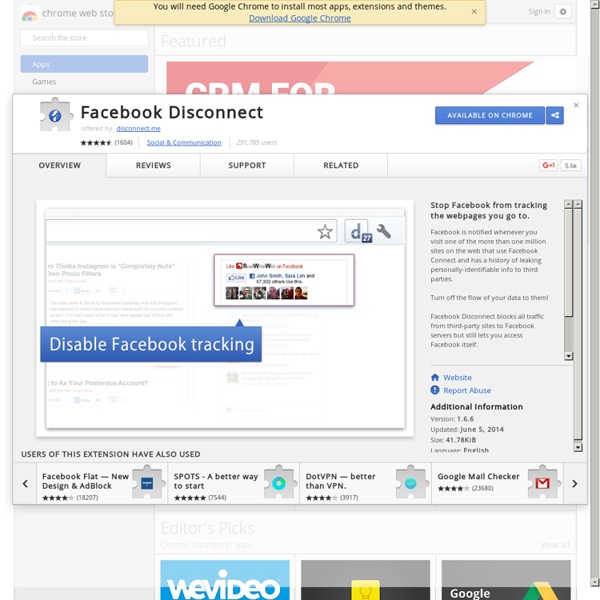
Facebook tracks what you do online, even when you’re logged out Updated 10pm Pacific with comments from Facebook. Entrepreneur and hacker Nik Cubrilovic reports that Facebook can track the web pages you visit even when you are logged out of Facebook. According to Cubrilovic’s tests, Facebook merely alters its tracking cookies when you log out, rather than deleting them. Your account information and other unique identifiable tokens are still present in these cookies, which means that any time you visit a web page with a Facebook button or widget, your browser is still sending personally identifiable information back to Facebook. “With my browser logged out of Facebook, whenever I visit any page with a Facebook like button, or share button, or any other widget, the information, including my account ID, is still being sent to Facebook,” Cubrilovic wrote. “They definitely have the information stored,” Cubrilovic told VentureBeat in an interview today. Cubrilovic’s claims are based on his analysis of HTTP headers sent by browsers to Facebook.com.
Katya's Non-Profit Marketing Blog Tue, December 11 2012 Filed under: Social Media • There’s been a huge amount of chatter online about Facebook changes that nonprofits and companies say have harmed their engagement efforts on the social network - and an equal amount of information refuting that claim. I have been wanting to write a post clarifying matters, but after spending a month reading countless articles on both sides of the argument, I wasn’t sure what to believe. Learn more about John here. Katya: Could you explain in plain English how Facebook updates work and what supporters see? John: When a page publishes an update (photos, videos, text only updates, links), some of the people who have liked that page will see that update in their newsfeed. In other words, liking a page does not guarantee that a user will see updates from that Page in their newsfeed. Katya: What is organic reach and what is the Edgerank algorithm? Edgerank is Facebook’s algorithm that determines what is published is each user’s newsfeed. 1. 1.
Nik Cubrilovic Blog - Logging out of Facebook is not enough Important Update: Facebook has responded and issued a fix for this issue. See the follow up blog post "Facebook Fixes Logout Issue, Explains Cookies" Dave Winer wrote a timely piece this morning about how Facebook is scaring him since the new API allows applications to post status items to your Facebook timeline without a users intervention. It is an extension of Facebook Instant and they call it frictionless sharing. The privacy concern here is that because you no longer have to explicitly opt-in to share an item, you may accidentally share a page or an event that you did not intend others to see. The advice is to log out of Facebook. Here is what is happening, as viewed by the HTTP headers on requests to facebook.com. Note: I have both fudged the values of each cookie and added line wraps for legibility Cookie: datr=tdnZTOt21HOTpRkRzS-6tjKP; lu=ggIZeheqTLbjoZ5Wgg; openid_p=101045999; c_user=500011111; sct=1316000000; xs=2%3A99105e8977f92ec58696cf73dd4a32f7; act=1311234574586%2F0
Facebook Is Growing Through Risky Business | Wired Business It’s easy to get caught up in Facebook’s new earnings numbers; revenue and adjusted profits spiked impressively in the first quarter, and mobile business boomed. But if you listen closely to what Facebook executives say as they release those stats, it’s clear the social network has set down a risky path that banks on following users ever more closely and selling to advertisers ever more aggressively. In first-quarter financials released yesterday, Facebook said revenue rose 38 percent to $1.46 billion and that mobile advertising climbed to 30 percent of ad revenue from 25 percent of ad revenue in the prior quarter; analysts had expected revenue growth of just 36 percent. Adjusted earnings, meanwhile, were 12 cents per share, flat compared to last year and below analysts’ estimates of 13 cents per share. Then they talked about change. So Facebook is moving to meet both camps, and doing so with impressive speed. Take mobile advertising.
Gov't may track all UK Facebook traffic | Security Threats The UK government is considering the mass surveillance and retention of all user communications on social-networking sites including Facebook, MySpace, and Bebo. Home Office security minister Vernon Coaker said on Monday that the EU Data Retention Directive, under which ISPs must store communications data for 12 months, does not go far enough. Communications such as those on social networking sites and instant messaging could also be monitored, he said. "Social-networking sites, such as MySpace or Bebo, are not covered by the directive," said Coaker, speaking at a meeting of the House of Commons Fourth Delegated Legislation Committee. "That is one reason why the government are looking at what we should do about the Intercept Modernisation Programme, because there are certain aspects of communications which are not covered by the directive." Deep packet inspection, the second strand of the IMP, involves intercepting and examining the contents of all data packets that flow over a network.
How I Made Something Go Viral Facebook Is For Old People So my girlfriend points out a picture on Facebook of a rich friend on a plane with her dog and I’m reading the comments…and I see that of the wife of a famous movie producer, whose story was told in “Vanity Fair.” That’s when it hit. The above inspiration didn’t take place in a vacuum. Your whole life is useful information. It was 6:35 PM and I had to leave for dinner at 7:30 and I hadn’t yet taken a shower. Yes, I can write that fast. Furthermore, I can write this fast and this cogently because I’ve been doing it for so long. Was minimal. Don’t judge the success of your project instantly. Furthermore, don’t honor the initial feedback, which tends to be knee-jerk. Sign-ups to my mailing list were growing in leaps and bounds. Then I read my Twitter feed. Barry’s a prominent Wall Street guru. And Barry’s audience is different from mine. The Boy Genius Report posted my e-mail. Allthingsd.com posted a quote from the article. The article was really damn good. So…