

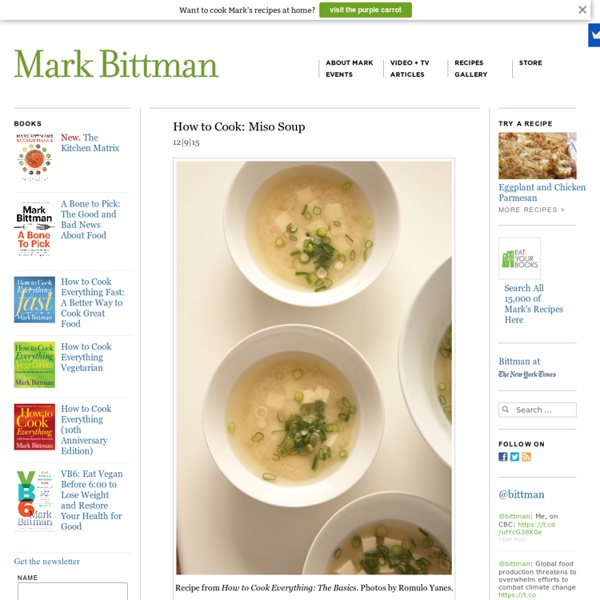
Mark Bittman A Taste of Spring How to ease the transition from cold- to hot-weather cooking. April 13, 2014, Sunday A Cappuccino for Public Safety Infrastructure problems can lead to catastrophes, yet the cost of preventing them would amount to only a few dollars a day. April 9, 2014, Wednesday Butter Is Back The real villains in our diet are sugar and ultra-processed foods. March 26, 2014, Wednesday Some Progress on Eating and Health Let’s be thankful for the decline in obesity rates, curbs on food marketing and transparency in packaged food — and then let’s push for more. March 5, 2014, Wednesday A Busman’s Honeymoon On a trip through France and Northern Italy, my new wife and I learned that “sophisticated” cooking did not have to mean “complicated.” February 23, 2014, Sunday A Valentine for Restaurant Workers Because of something called tipped minimum wage, many servers are dependent — way too dependent — on the largesse of their customers. February 14, 2014, Friday Just Say No February 5, 2014, Wednesday
Les nouveaux bistrotiers Timides et modestes, les Français Nicolas Scheidt et Nicolas Darnauguilhem ont importé, à Bruxelles, une cuisine bistrotière gastronomique tout à la fois créative et conscientisée. Entretien: Hubert Heyrendt & Laura Centrella ILS NE PARTAGENT PAS SEULEMENT le même prénom, Nicolas Darnauguilhem et Nicolas Scheidt partagent une même philosophie de la cuisine. Darnauguilhem a œuvré dans le 1er resto bio de Genève, ouvert en 1986. Une liberté qui fait partie intégrante de leur projet de resto. De la même génération, ces deux garnements ont en commun une même approche conscientisée de la cuisine, mettant notamment l’accent sur la saisonnalité des produits. “Un menu unique qui change tous les jours, c’est une liberté que l’on s’octroie”, précise Darnauguilhem. Rester abordable (une quarantaine d’euros pour un menu dégustation) fait, en effet, partie intégrante du concept du “Neptune” et de “La Buvette”. Ph.: J-C Guillaume
On Food - Mark Bittman Blog Mark Bittman: Food Matters Bio Mark Bittman Mark Bittman writes (mostly) about food for the Times Opinion pages, and is The Magazine’s lead food columnist. He is the author of “VB6: Eat Vegan Before 6:00” and “How To Cook Everything.” To download this program become a Front Row member. ZOOM IN: Learn more with related books and additional materials. Encyclopædia Britannica Article vegetarianism Theory or practice of eating only plants. vegetarianism on britannica.com © 2010 Encyclopædia Britannica, Inc.
Improved Conditions for Florida Tomato-Harvest Workers Mass-produced tomatoes have become redder, more tender and slightly more flavorful than the crunchy orange “cello-wrapped” specimens of a couple of decades ago, but the lives of the workers who grow and pick them haven’t improved much since Edward R. Murrow’s revealing and deservedly famous Harvest of Shame report of 1960, which contained the infamous quote, “We used to own our slaves; now we just rent them.” But bit by bit things have improved some, a story that’s told in detail and with insight and compassion by Barry Estabrook in his new book, “Tomatoland.” We can actually help them improve further. A third of our fresh tomatoes are grown in Florida, and much of that production is concentrated around Immokalee (rhymes with “broccoli”), a town that sits near the edge of the great “river of grass,” or the Everglades, the draining of which began in the late 19th century, thus setting the stage for industrial agriculture. The tomato fields of Immokalee are vast and surreal.
Fixing Our Food Problem Nothing affects public health in the United States more than food. Gun violence kills tens of thousands of Americans a year. Heart disease, cancer, stroke and diabetes kill more than a million people a year — nearly half of all deaths — and diet is a root cause of many of those diseases. And the root of that dangerous diet is our system of hyper-industrial agriculture, the kind that uses 10 times as much energy as it produces. We must figure out a way to un-invent this food system. How do we do that? This seems like a good day to step back a bit and suggest something that’s sometimes difficult to accept. Patience. We can only dismantle this system little by little, and slowly. Well-cared-for animals will necessarily be more expensive, which means we’ll eat fewer of them; that’s a win-win. Activists who took on these issues had in common a clear series of demands and a sense that the work was ongoing. Yet before we can assess our progress, we must state our goals.