

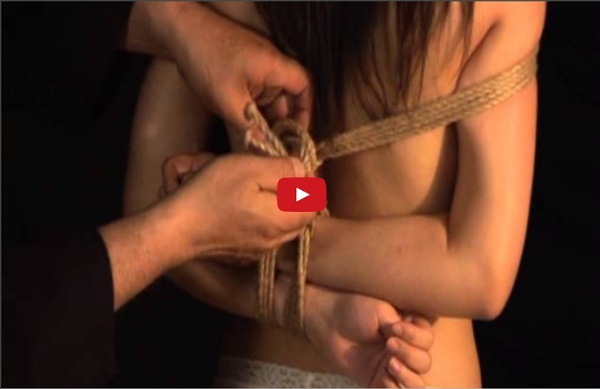
Hon Kikkou Hon Kikkou Tortoise Shell Advanced Rope Lesson by Tatu (c) 2001, Revised 2007 Model - "yumi" Photos by Quietmstr (c) 2005 Tatu Publications This is probably one of the loveliest designs to learn. It is my favorite to tie. Notice the design between the breasts. It is called a "Hon Kikkou". Please Note: Unfortunately the word "kikkou" has been misused in the west to describe diamond shaped patterns on the body which would more accurately be called a "hishi". All content & design © 1995-2020, TPPI and its affiliates and assigns and licensors, unless otherwise noted. "DsARts", "The Academy of DsARts", "Academy of D/s Arts, Japanese Rope ARt, and "The ARt of Geisha", "The Geisha Files", "The Way of Rope" are copyright titles, logos and signatures of TPPI. Unauthorized use is a willful infringement upon my rights under 17 U.S.C. All Models are at least 21 years old.
Crash Restraint When attaching support lines to a harness for suspension, I use a novel method that people frequently ask me about, and I've been meaning to document for a long time. Serendipitously, I ran into Kali from Kink Academy a few months ago at Wicked Grounds, and she asked me to film some instructional videos for them on suspension -- so I managed to slip this in there, and they've graciously agreed to allow me to use screenshots from those videos to illustrate a blog post here. This method was inspired by the Tatu hitch , during a Fetlife discussion whose details are now murky in my memory -- in any case credit is due both Tatu and Jack Elfrink for making me aware of that knot, upon which this is based. Things needing names, and this technique using the first half of a Tatu hitch, I suppose we could call it the half-Tatu hitch. Thanks also to Mecha-Kate for modeling for these. The full video version, in two parts, is here and here on Kink Academy. Single Point Attachment, with Carabiner
KinkyClover » Rope Space – Programmed Preconceptions Rope Space – Programmed Preconceptions Rope at the moment seems to be the new black. This is a wonderful thing. There are events popping up all over the country, most recently we have one in Nottingham, all these places for rope enthusiasts to get their kink on. With the increase of rope bondage there is more tying in clubs and at different events. From observation, online forums, discussions at munches, peer rope events and workshops, it appears there is a general expectation for rope bottoms to space. I felt like writing this blog to assure those who find it difficult to space in rope, that there is nothing wrong with not spacing. There is no formula with rope bondage, you can not negotiate a tie with a rope top and decide by x point in the tie you will be ‘gone to the happy rope place’, it just doesn’t work like that. I appreciate I am different to everyone else too, and I tend to view spacing in rope as a very intimate thing. Music; Music is such a powerful tool combined with rope.
KinkyClover » Nerve and Circulation Problems Nerve and Circulation Problems I think the two most common and often misunderstood problems in rope are circulation and nerve problems and more importantly how to spot the differences between them. It is not always simple, but here are a few points to guide towards what the problem could be. I am not a medical professional, everything written here is my opinion or given to me by medical professionals regarding my own injuries. The three factors in the causing of nerve problems are, position, pressure and duration. So I guess the next question would be, what do nerve tingles feel like? If you have tingles or numbness in part of your hand it is definitely time to be untied, you can always be tied up again but best to be safe rather than sorry. While circulation gets a lot of attention it is not an immediate danger, change of arm colour will differ from person to person, I tend to change colour quite quickly and know my body well enough to know when its time to come down. Clover X x
Vector Forces | ropebook Vector forces become apparent whenever there is an internal angle greater than 0° between two or more rigging components or anchorage points. For ease of explanation, a vector force is typically trying to pull horizontally as well as vertically. This has a multiplying effect on the loads that are felt at the anchor points and likewise the tension exerted within the rigging equipment, be it ropes, slings, strops or chains. The effects of vector forces must always be taken into account when undertaking rigging tasks to ensure that these forces do not exceed the safe working load capacity of the equipment, components and anchor devices used within the system. Force is an influence that has both magnitude and direction, it is usually given in the dynamic unit of Newtons (N). For ease of explanation we have used kilograms on this page. The Basics In the situation illustrated to the right, the weight of the load = 100kg. The Ideal Angle The 'OK' Angle The Critical Angle The Calculations Where:
Nerve and Circulation Problems | RopeTopia I think the two most common and often misunderstood problems in rope are circulation and nerve problems and more importantly how to spot the differences between them. It is not always simple, but here are a few points to guide towards what the problem could be. I am not a medical professional, everything written here is my opinion or given to me by medical professionals regarding my own injuries. If you have an injury my best advice is to seek medical advice for your injury. The three factors in the causing of nerve problems are, position, pressure and duration. So I guess the next question would be, what do nerve tingles feel like? If you have tingles or numbness in part of your hand it is definitely time to be untied, you can always be tied up again but best to be safe rather than sorry. Having said that, circulation problems are not something to be ignored, it is a warning sign which needs to be acted upon. Not everyone gets tingles, a few tips for your rope top to check in on you is;
Carabiners, Part 3 - Properties The point of this mini-series on carabiners is to understand how different aspects and qualities of a carabiner affect its usefulness in technical rescue rigging. We addressed materials and design in the first two entries. Today we are going to address a variety of other properties that should be considered when selecting a carabiner for a particular job. A number of properties, in addition to material and design, determine the suitability to specific tasks and compatibility with other equipment. Main axis strength. Gate strength. Gate-opening dimension. Size. Certification. CE and ANSI require a minimal main axis strength of 22 kN (4,946 lbs). While it is easy to see that small “toy” carabiners are very different creatures from their heftier big brothers.