How About a Clean Break – with Israel? by Philip Giraldi
Back in 1996, a group of leading neoconservatives led by Richard Perle drafted a memorandum for then (as now) Israeli Prime Minister Benjamin Netanyahu, recommending that Israel adopt a more aggressive and assertive policy towards its neighbors. They called it a "Clean Break" to suggest that it would be a major shift in policy. Today, as American foreign policy looks more like a shipwreck than a victory lap, there is perhaps a need for a Clean Break by Washington. As the relationship with Tel Aviv has an impact far beyond Israel’s size and importance it should, ironically, be the first element in the foreign policy disaster that is examined. Many Americans who indulge in the mainstream media believe that Israel is a close friend and ally to the United States and that when it is criticized the complaints are often unfair and might even in some cases be motivated by anti-Semitism. Looking at the Middle East region objectively, one has to question Washington’s actions.
Some Internet-Use Tracking Firms to Reveal What They Know
Obama on Egypt
Against Transparency
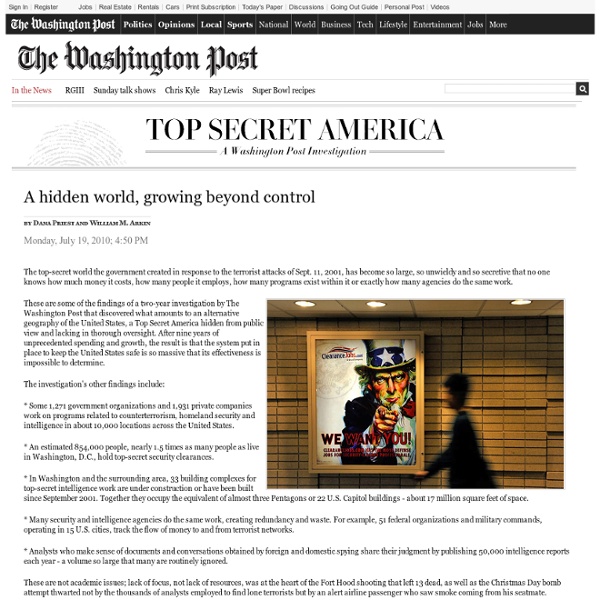
Against Transparency In 2006, the Sunlight Foundation launched a campaign to get members of Congress to post their daily calendars on the Internet. "The Punch-Clock Campaign" collected pledges from ninety-two candidates for Congress, and one of them was elected. In any case, the momentum was on her side. And not just in politics. How could anyone be against transparency? The naked transparency movement marries the power of network technology to the radical decline in the cost of collecting, storing, and distributing data. The most obvious examples of this new responsibility for disclosure are data about the legislative process: the demand, now backed by the White House, that bills be posted to the Internet at least twenty-four hours before they are voted upon, or that video of legislative hearings and floor debate be freed from the proprietary control of one (easily disciplined) entity such as C-SPAN. Without a doubt, the vast majority of these transparency projects make sense.
Palin Criticizes Obama on Egypt
SANTA BARBARA, Calif. — As Sarah Palin delivered a weekend address here, paying tribute to Ronald Reagan on the centennial of his birth, she directed a forceful line of criticism at President Obama and his administration, though she did not mention the crisis in Egypt. But in a subsequent television interview, she took Mr. Obama to task for his handling of the matter. “It’s a difficult situation,” Ms. The early-morning phone call that Ms. Three years later, Mrs. In an interview with David Brody of the Christian Broadcasting Network, Ms. This is a transcript, provided by the network, of Ms. “And nobody yet has, nobody yet has explained to the American public what they know, and surely they know more than the rest of us know who it is who will be taking the place of Mubarak and no, not, not real enthused about what it is that that’s being done on a national level and from D.C. in regards to understanding all the situation there in Egypt. She spoke exclusively to Mr.
Why no one cares about privacy anymore | Politics and Law
Google co-founder Sergey Brin adores the company's social network called Google Buzz . We know this because an engineer working five feet from Brin used Google Buzz to say so. "I just finished eating dinner with Sergey and four other Buzz engineers in one of Google's cafes," engineer John Costigan wrote a day after the Twitter-and-Facebook-esque service was announced. "He was particularly impressed with the smooth launch and the great media response it generated." You might call Brin's enthusiasm premature, especially since privacy criticisms prompted Google to make a series of quick changes a few days later. But a funny thing happened on the way to the courthouse: relatively few Google Buzz users seem to mind. My hunch is that Google Buzz will continue to grow because, after nearly a decade of social-networking experiences (its great-granddaddy, Friendster, started in early 2002), Internet users have grown accustomed to informational exhibitionism. --Richard Posner, federal judge
The Indictment For Torture Filed Against George W. Bush (Part One: The Facts)
Just two weeks ago, as former US President George W. Bush was preparing to make his first visit to Europe since the publication, last November, of his biography Decision Points, the Center for Constitutional Rights in New York, and the Berlin-based European Center for Constitutional and Human Rights, with support from the International Federation for Human Rights (FIDH), reminded the former President that he was a torturer — who, in addition, had openly bragged in his book that he had authorized the torture of “high-value detainees” in the “War on Terror” — and that, as a result, they would be filing a criminal complaint (an “indictment for torture”) in Switzerland, prior to the former President’s arrival for a meeting on February 12. According to the requirements of the UN Convention Against Torture (to which both the US and Switzerland are signatories), this might well have led to his arrest. As I explained in a recent article, George W. A. 1. 2. 3. 4. B. 5. 6. 7. 8. 9. 10. 11. 12.
HADOPI pour les nuls : explications et contournements
Vendredi 3 avril 2009, l’assemblée nationale a adopté la loi "Création et Internet", avec seulement 16 députés dans l’hémicycle. Pourtant ce texte risque, s’il est appliqué, d’apporter de profondes modifications au web français tel que nous le connaissons. Cette loi instaure entre autres la "riposte graduée", qui en cas de téléchargement illégal, après l’envoi de 2 avertissements, prévoit la coupure de la connexion internet de l’abonné contrevenant. La plupart des arguments qui s’opposent à cette loi étant assez techniques, je vais tenter d’expliquer certains éléments de fonctionnement du net qui sont utiles pour les comprendres, puis j’aborderai point par point les éléments de la loi qui selon moi sont problématiques. Tout d’abord pour qu’il y ait sanction, il faut qu’il y ait constatation d’une infraction. L’IP (qui signifie « Internet Protocol ») est en effet le point d’entrée sur la toile. Contournement : La chasse est ouverte : la collecte des IPs. Contournement :
US: Iran scared of the will of its people
The White House Spokesman Robert Gibbs US: Iran scared of the will of its people The United States pivoted from delight at Egypt’s revolt to hiking political pressure on arch-foe Iran Friday, charging that the leadership in Tehran was 'scared of the will of its people.' The White House said that Iranian leaders should give their people the same chance to express their will as Egyptians seized for themselves -- and noted that instead, Tehran had threatened to kill any protesters. Iran’s government was 'quite frankly scared of the will of its people,' White House spokesman Robert Gibbs said, hinting that protests that had erupted in Egypt could spread to Iran. 'We know that what they really are scared of is exactly what might happen,' Gibbs said as Egyptians celebrated their revolt, which came on the 32nd anniversary of the Islamic revolution in Iran on February 11, 1979. 'The Iranian nation is your friend and it is your right to freely choose your path.