

New technology for land mine detection In Colombia, large areas are teeming with mines that are almost impossible to detect with traditional methods. In collaboration with partners from South America, engineers at the German Ruhr-Universität Bochum and Technical University Ilmenau are developing a new mine clearance technology, based on ground penetrating radar. In the long run, they are aiming at creating a handheld device that will detect different mine types on rough terrain without fail and which can be used in the same way as metal detectors. The Ruhr-Universität's science magazine Rubin has published a detailed report on the project. In Colombia, large areas are teeming with mines. In collaboration with partners from South America, engineers at the Ruhr-Universität Bochum and Technical University Ilmenau are developing an advanced method for humanitarian mine clearance in Colombia, which is based on ground penetrating radar technology. Land mines almost impossible to detect with traditional methods
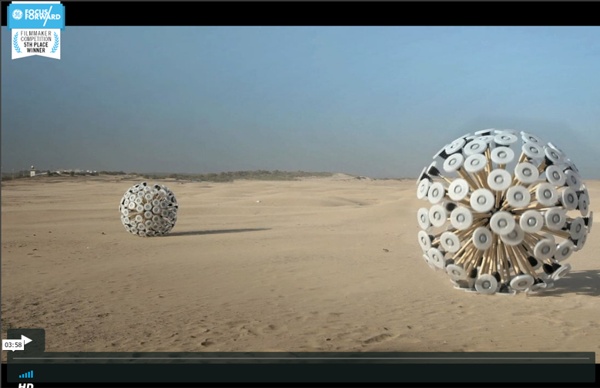
Moep - Crib Chair Combo by Dirk Ploos van Amstel Babe Rocker This multifunctional furniture piece combines crib and rocking chair into one singular rocking unit. It’s effective in getting sleepy babies to bed and helps acclimate them to being in a crib. When the young one outgrows the crib, the side unit converts to a magazine rack, giving new life to the chair. Better yet, it’s easy to assemble- 12 screws and 2 ropes later and you have the perfect addition to the nursery that’s great for new parents. Designer: Dirk Ploos van Amstel Humans Invent | The Official Sharp Blog My eyes open the next set of posts... Electromagnetic waves used to detonate landmines A team of Colombian and Swiss scientists has developed a device to remotely detonate improvised explosive devices (IEDs) using electromagnetic waves. IEDs, so-called roadside bombs, kill and mutilate hundreds of thousands of people every year in conflict zones in countries including Colombia, Afghanistan “Colombia has one of the highest mine casualty rates in the world,” Nicolas Mora, a Colombian postgraduate research student at the Federal Institute of Technology in Lausanne (EPFL), told swissinfo.ch. “IEDs are installed by guerrillas to stop the army from moving forward. They are typically placed on jungle roads but these are places where people are living, going to school or hospital.” Between 2005-2010 in Colombia, roadside bombs and unexploded ordinance killed 1,000 people annually; a third of the victims were civilians. IEDS are made primarily of plastic to avoid being uncovered by conventional metal detectors. Successful tests Wide interest Links
Electrolux Aeroball – Air Filter System by Jan Ankiersztajn Significantly Fresher Air The Aeroball is a great way to filter air and get rid of odors. Tiny bubble-like balls hover and float in the air, cleansing it of impurities and offensive smells. The scented varieties dispense fragrance and enhance the mood. Designer: Jan Ankiersztajn Pen/stylus made from MAGNETS. POLAR PEN - both tool and toy by Andrew Gardner This modular pen will inspire you at work, school or home. If you enjoy tinkering with things or are fascinated with the power of magnets, then this product is for you. We have found many fun and functional ways of using the POLAR Pen and we are really excited to see what you will come up with. Polar comes in two high quality finishes: Pure Silver, purer than sterling (product will tarnish if left unused, any silver polish will restore finish) and 24 Karat Gold, an elegant deep yellow. Using the silver and gold magnets POLAR lends itself very well to the concept of modular customization; the ability to transform a standard product into something different and unique. Magnets Components There are four unique components excluding the magnets: Cap, Clip, Tip and Stylus. Rubber Components Stylus rubber tip - The stylus tip has been sourced from a leader in stylus tip technology. Silicone rubber tip protector - This component gets inserted into the top magnet in the cap. Features/Tuturials
Meet the Giant Rats That Are Sniffing out Landmines African giant pouched rats—huge, cat-size rodents native to central Africa—have bad vision but an extraordinary sense of smell. This makes them perfect candidates for discovering hidden landmines by sniffing out the explosive TNT. Even decades after conflict, explosive remnants of war linger in the earth, maiming and killing thousands of people who stumble across them each year. In 2013, mines and other buried explosives caused 3,308 casualties worldwide—down from 4,325 in 2012, according to the 2014 Landmine Monitor report. Finding these hidden explosives is challenging and dangerous: People with metal detectors not only risk their lives, they work slowly, stopping to investigate every suspicious ping. Enter APOPO, a Belgian nonprofit that has created an army of TNT-sniffing African giant pouched rats. One rat can search over 2000 square feet (200 square meters) in 20 minutes, an area that could take a human up to four days, APOPO training manager Abdullah Ramadhan says in an email.
Green Lamp by Siesta Lighting Gone Green The latest in a trend of plant lamps (or as I like to call them “plamps”), the Green Lamp features a lattice shade and neck that stems directly out of a soil pot. Plant your favorite vine and watch it creep up to create an organic leaf shade you can trim yourself. A little shabby chic but I kinda love it. Bet you never thought your lamp would need sun! Designer: Siesta
A better way to detect landmines "I'd been to Cambodia. I'd got a very, very unique insight into the horrible thing of mines that take limbs from children. And I'd thought for a long time that – if I possible could – could I maybe change everybody's attitude?" These are the words of Sir Bobby Charlton, the former England and Manchester United footballer, speaking in this film about the science of landmine detection. "There are literally millions of anti-personnel mines in the ground in places where people need to grow food, or need to walk to the nearest well, or simply go about their daily business – shelter under a tree from the Sun," explains Bill Lionheart, a mathematician at the University of Manchester in the UK whose work is supported by Find A Better Way. For example, it is common for landmine clearance teams to use metal detectors to locate the firing pin and metal percussion caps present in many landmines. Similarly, Lionheart's team is developing a form of ground-penetrating radar with multiple sensors.
Electrolux Treat by Amy Mon-Chu Liu Tree + Eat = Treat Treat is a seamless way of storing and managing the leftover food. It employs classic food storage techniques like vacuum sealing and modern remote mobile technology to ensure your food is always consumed fresh. The appliance has a clever and intuitive way of communicating its warning when the food is expiring. It changes its color as the food ages (like the ripening of a fruit!) and then drops down to the carpet below. The Treat is a 2012 Electrolux Design Lab top ten finalist entry. Designer: Amy Mon-Chu Liu Identity - iPhone 5 Case by Ace Display Camera Cleaning iPhone Case Ace’s new Identity case for the iPhone 5 offers simple protection to your iPhone’s vulnerable back camera system. The tabbed, sliding component built into the rigid design easily moves up and down to reveal or hide the cam. Better yet, the inside of the slide has a microfiber surface to wipe away any fingerprint residue or particles to ensure you get a smudge-free pic each time! Designer: Ace Display
Throbber - Inductive Heating Ball by Virang Akhiyaniya Cooking with Balls! This far-out cooking concept of the future called Throbber uses super-compact, induction heating balls operable via a mobile phone, making it a portable solution that can be used on-the-go. The heat induced in the balls is transferred to the food via conduction from the aluminum surface. Just be careful not to accidentally swallow one! Designer: Virang Akhiyaniya