

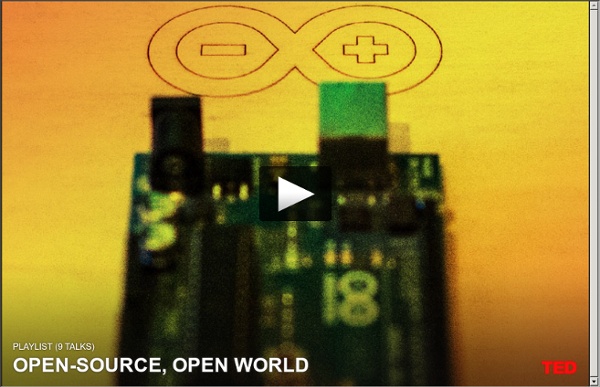
The open source way Open exchange We can learn more from each other when information is open. A free exchange of ideas is critical to creating an environment where people are allowed to learn and use existing information toward creating new ideas. Participation When we are free to collaborate, we create. Rapid prototyping Rapid prototypes can lead to rapid failures, but that leads to better solutions found faster. Meritocracy In a meritocracy, the best ideas win. Community Communities are formed around a common purpose. Mass amateurization Mass amateurization refers to the capabilities that new forms of media have given to non-professionals and the ways in which those non-professionals have applied those capabilities to solve problems (e.g. create and distribute content) that compete with the solutions offered by larger, professional institutions.[1] Mass amateurization is most often associated with Web 2.0 technologies. These technologies include the rise of blogs and citizen journalism, photo and video-sharing services such as Flickr and YouTube, user-generated wikis like Wikipedia, and distributed accommodation services such as Airbnb. While the social web is not the only technology responsible for the rise of mass amateurization, Clay Shirky claims Web 2.0 has allowed amateurs to undertake increasingly complex tasks resulting in accomplishments that would seem daunting within the traditional institutional model. There is no institutional hierarchy in mass amateurization. Background[edit] Clay Shirky History[edit]
Black LGBT Feminist Confronts Dr. Umar Johnson & Gets Schooled On The Black Struggle - Urban Intellectuals Not many in the black community lay down the truth like Dr. Umar Johnson has done over the years. Nevertheless, everyone doesn’t love everything that comes out of his mouth. Fortunately for us, video was captured during a Q&A session where a black LGBT feminist confronted Dr. Her reference to hate speech was one thing for him, but when she attempted to compare the struggles of the LGBT community to the black struggle in this country and around the world, Dr. Dr. From the YouTube Posting: Dr. SOUND OFF: What do you think about the dialog between the LGBT feminist and Dr. PUBLIC NOTE: The opinions expressed in this article are the author's own and do not reflect the view of the Urban Intellectuals, affiliates or partners.
Clay Shirky Clay Shirky (born 1964[2]) is an American writer, consultant and teacher on the social and economic effects of Internet technologies. He has a joint appointment at New York University (NYU) as a Distinguished Writer in Residence at the Arthur L. Carter Journalism Institute and Assistant Arts Professor in the New Media focused graduate Interactive Telecommunications Program (ITP).[3] His courses address, among other things, the interrelated effects of the topology of social networks and technological networks, how our networks shape culture and vice-versa.[4] Education and career[edit] Shirky was the first Professor of New Media in the Media Studies department at Hunter College, where he developed the MFA in Integrated Media Arts program. In the Fall of 2010, Shirky was a visiting Morrow Lecturer at Harvard University's John F. Views[edit] In his book Here Comes Everybody, Shirky explains how he has long spoken in favor of crowdsourcing and collaborative efforts online. [edit]
BBC Radio 4 - Do I Have a Right to Be Forgotten?