

Produit du jour - Société Chimique de France L'Actualité Chimique Société Chimique de France a Antoine-Laurent de Lavoisier (1743-1794) - Azote - Aspirine - Argent - Aluminium - Acide sulfurique - Arsenic - Acétylène - Aspartame, et autres sucrettes… - Amidon - Ammoniac - Adrénaline - Aciers inoxydables - Amphétamines - Antimoine - Acide acétique - Acide oléique - Azoture de sodium - Acide nitrique - Acide chlorhydrique - Aromasine, inhibiteur suicide - Acide méthanoïque - Acétates - Alumine - Acétone - ATP et précurseurs - Aniline - Aoûthyste - ADN - Acide phosphorique - Acide tartrique - Acide citrique - Acide lactique - Acide picrique - ARN - Arômes - Acides phtaliques - Acrylamides - Acides gras b B(Bore) 0(Oxygène) NN(diazote) E(Europium) A(Aluminium) N(Azote) NE(Néon) E(Erbium) - Bisphénol A - Butadiène - Botox & Biotox - Benzène - Baclofène - Barbituriques - Bicarbonate de sodium - Brome - Bore - Batteries - Baryum c d e Eau - Ethylène glycol - E. coli, amie et ennemie - Eau lourde f g h i j k Kevlar l m n o p q r s t u Urée - Uranium v y Yttrium z
Build an Atom - Atomic Structure, Atoms, Atomic Nuclei Topics Atoms Atomic Structure Isotope Symbols Atomic Nuclei Description Build an atom out of protons, neutrons, and electrons, and see how the element, charge, and mass change. Sample Learning Goals Use the number of protons, neutrons, and electrons to draw a model of the atom, identify the element, and determine the mass and charge.Predict how addition or subtraction of a proton, neutron, or electron will change the element, the charge, and the mass.Use the element name, mass, and charge to determine the number of protons, neutrons, and electrons.Define proton, neutron, electron, atom, and ion.Generate an isotopic symbol for an atom, given the number of protons, neutrons, and electrons.
Nylon, Rilsan et Kevlar : La grande aventure des polyamides Article rédigé par Jean-Claude Bernier et Rose Agnès Jacquesy (membres de la Société Chimique de France), édité par Nicolas Lévy (Responsable Editorial CultureSciencesChimie). Tables des Matières 1. Parmi les polymères, les polyamides occupent une place particulière que leur vaut leur popularité due à l’universalité de leurs fibres, qui se traduit par une production ayant avoisiné 6,8 millions de tonnes en 2011. Ils sont obtenus par polycondensation d’un acide aminé ou par ouverture d’un lactame avec 6, 11 ou 12 atomes de carbone (figure 1). Fig. 1 : Les polyamides Les principaux matériaux et fibres à base de polyamides (PA) sont le nylon, le Perlon®, le Rilsan® et le Kevlar®. 2. Le nylon a été découvert par Wallace Hume Carothers, un chimiste formé à Harvard et embauché en 1928 par la société DuPont de Nemours pour diriger un vaste programme de recherches sur la conception de matériaux polymères originaux. (-(C=O)-(CH2)6-(C=O)-NH-(CH2)6-NH-)n 3. Fig. 2 : Synthèse du Rilsan 4. 5. 6.
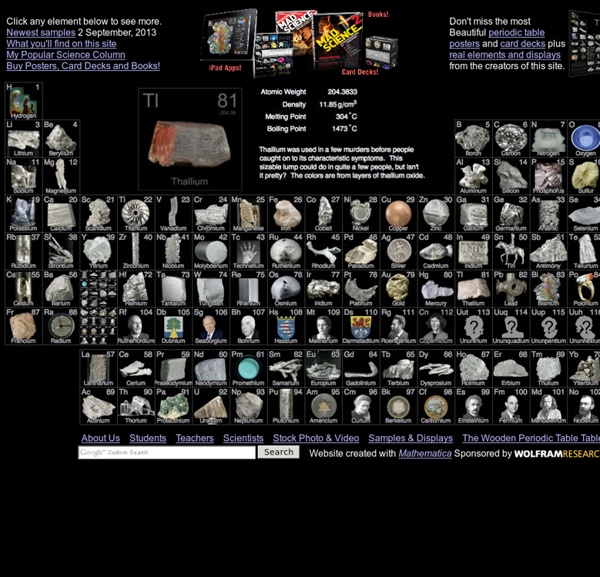
Energy Kids - Periodic Table File Scrub 1 ::::: EK ... periodic_table The periodic table is the most important reference a chemist has because it puts all the known elements into a meaningful pattern. Elements are arranged left to right and top to bottom in order of increasing atomic number. This order generally goes with increasing atomic mass. The different rows of elements are called periods. Learn more about the periodic table and each of the elements on the Los Alamos National Laboratory website. Spelling with Elements Special holliday shipping note: Order by Saturday, Dec 20th for delivery in time for x-mas (except PhotoGlows)! Ignore the 2-3 week shipping notes below, we will do a special last-minute run of everything ordered by the 20th. PhotoGlow banners must be ordered by Dec 15th for x-mas delivery and PhotoGlows over 48" wide cannot be delivered in time. Enter any string of letters and spaces below to see if it can be written in terms of chemical element abbreviations. If you're lucky with your word, name, or phrase, you can order it as a high-quality photographic banner custom-printed with an archival pigment ink printer on heavy-weight satin finish paper. NEW! If you can't find a way to spell what you want, you can always order a copy of my Photographic Periodic Table Poster, from which these images are taken.
Tom Lehrer's "The Elements". A Flash animation by Mike Stanfill, Private Hand The Periodic Table The periodic table of the chemical elements (also periodic table of the elements or just the periodic table) is a tabular display of the chemical elements. Although precursors to this table exist, its invention is generally credited to Russian chemist Dmitri Mendeleev in 1869, who intended the table to illustrate recurring ("periodic") trends in the properties of the elements. The layout of the table has been refined and extended over time, as new elements have been discovered, and new theoretical models have been developed to explain chemical behavior. The periodic table is now ubiquitous within the academic discipline of chemistry, providing a useful framework to classify, systematize, and compare all of the many different forms of chemical behavior. The layout of the periodic table demonstrates recurring ("periodic") chemical properties. As of 2010, the table contains 118 chemical elements whose discoveries have been confirmed.