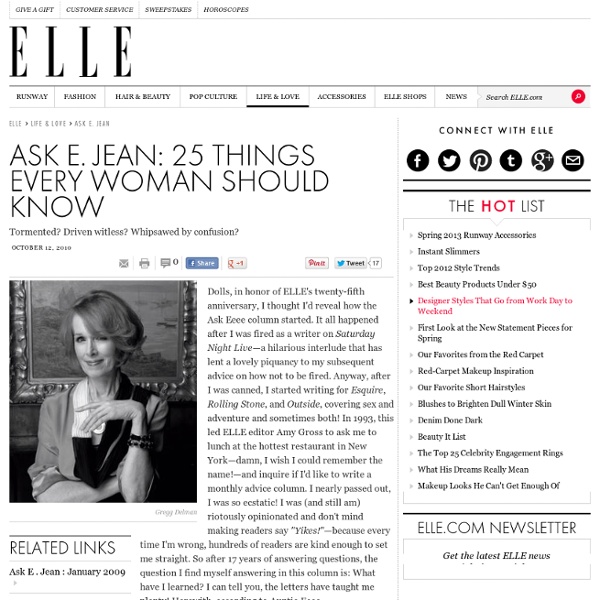
Ask E. Jean: 25 Things Every Woman Should Know - Get More Relationship Advice
Dolls, in honor of ELLE's twenty-fifth anniversary, I thought I'd reveal how the Ask Eeee column started. It all happened after I was fired as a writer on Saturday Night Live—a hilarious interlude that has lent a lovely piquancy to my subsequent advice on how not to be fired. Anyway, after I was canned, I started writing for Esquire, Rolling Stone, and Outside, covering sex and adventure and sometimes both! In 1993, this led ELLE editor Amy Gross to ask me to lunch at the hottest restaurant in New York—damn, I wish I could remember the name! 1. 2. 3. When it comes to sex and love, question (B) has a great way of yanking the blinders off and giving you a clearer picture of what's actually going on. 4. 5. 6. 7.
Underlined Book Quotes Become Clever Illustrations
Bookworm or not, you can't help but enjoy these black and white illustrations of literary quotes by Evan Robertson. The New York-based graphic designer has taken some of the cleverest lines written by famous authors such as William Faulkner and Oscar Wilde and turned them into wonderful posters. These literature-inspired fine art illustrations are currently being sold on Etsy under the name Obvious State. Robertson would see a "little jewel of a sentence" and he'd underline it. Here are 12 of our favorites. Update: Check out more clever illustrations in Part II of this story. Obvious State on Etsy via [Quipsologies], [Huffington Post]
How to Turn Your Life Around - E. Jean Offers Advice on Life and Love on ELLE
Dear E. Jean: Suicide is always in the back of my mind. It's my way out if things get too bad. But now I'm thinking it's something I have to do. I can't find an alternative. Obviously, I don't want to die; I'm only 32. But having no money, not being able to find more work, and never being given a chance—I see it as the only way to end this situation. I have a BA in English (I maintained a 4.0 in my major) and was doing okay working from home as a freelance writer (magazine articles, press releases, website copy, and newsletter articles). When I e-mail the magazine, they act annoyed and tell me to quit asking! Note to readers: When this question came in, of course I was extremely concerned. Dear Everything: Your sufferings are terrible. Make the appointments. 1. 2. 3. 4. Darling, I know you feel lost and that there's only pain. E-mail your questions to e.jean@askejean.com
I'm Ready To Tell This Story Now.
She was my wife. She had this unapologetic, booming laughter. To this day I swear on all that is good in this world that I can hear that laugh in the halls of this house. She couldn't stay in one room for more than a few minutes unless she was watching a really great movie or reading a really good book. She loved art. And throughout all our fights and good nights and struggles and triumphs she was always my one and only. She gave me my boys. They mostly look like her. Plus my youngest has that same zest for life and the finer things. When my sons were almost out of elementary school something changed, albeit slowly. I would find her crying in our bed. It wasn't until she began to scare the boys that I demanded that she get help. "You don't KNOW, Rick!" "No," I said, almost whispered. Then she said something that made me sink to my knees in panic. I cried with her. That night is burned into my mind, into the back of my fucking eyes. Medicines came next. A hiatus from her job after that.
The Benjamin Franklin Effect
The Misconception: You do nice things for the people you like and bad things to the people you hate. The Truth: You grow to like people for whom you do nice things and hate people you harm. Benjamin Franklin knew how to deal with haters. Born in 1706 as the eighth of 17 children to a Massachusetts soap and candlestick maker, the chances Benjamin would go on to become a gentleman, scholar, scientist, statesman, musician, author, publisher and all-around general bad-ass were astronomically low, yet he did just that and more because he was a master of the game of personal politics. Like many people full of drive and intelligence born into a low station, Franklin developed strong people skills and social powers. Franklin’s prospects were dim. At 17, Franklin left Boston and started his own printing business In Philadelphia. As clerk, he could step into a waterfall of data coming out of the nascent government. What exactly happened here? Let’s start with your attitudes. By Fernando Botero
Related:
Related: