

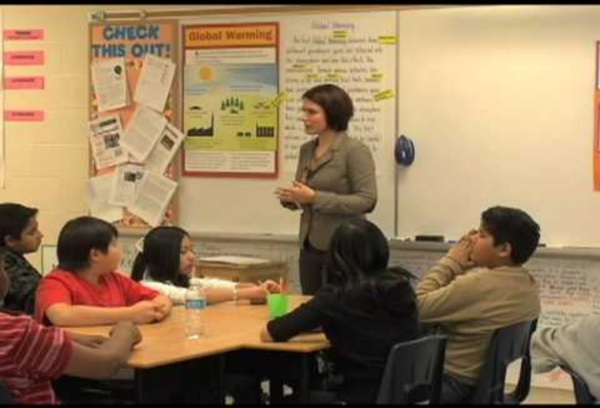
Reciprocal Teaching The Reciprocal Teaching Strategy (Palinscar and Brown, 1984) was developed to help students improve their understanding as they read. It is an interactive strategy where students talk their way through a text in order to understand it better. Students practice the art of predicting, questioning, clarifiying, and summarizing, all of which contribute greatly to comprehension. Websites on Reciprocal Teaching: Reciprocal Teaching Prompt Cards Reading Quest.org: Reciprocal Teaching Reciprocal Teaching Bookmark Reciprocal Teaching Video Clip North Central Regional Education Laboratory: Reciprocal Teaching Adolescent Literacy: Reciprocal Teaching
Pourquoi - L'enseignement réciproque « À prime abord, l’enseignement réciproque a été conçu pour répondre aux besoins des élèves en difficulté au niveau de la lecture. À la suite de plusieurs séances d’enseignement réciproque, les conceptrices, Annemarie Sullivan Palincsar et Ann L. Brown, ont observé une amélioration marquante dans les compétences en compréhension de lecture des élèves à risque. Conséquemment, elles ont déduit que cette approche pédagogique pourrait être bénéfique pour tous les types de lecteurs peu importe le niveau scolaire, la matière étudiée ou le type de regroupement. Plusieurs recherches ont également démontré que cette approche, en plus d’amener les élèves à mieux comprendre ce qu’ils lisent, permet aussi une meilleure rétention. » (Palinscar et Brown, 1984; Palinscar et Klenk, 1991; Ruetzel, Smith et Fawson, 2005) Les objectifs (McLaughlin et Allen, 2009; Pearson, Roehler, Dole et Duffy, 1992) Plus Explorer le processus de mise en application et les stratégies de lecture
Summer 2010 / Reciprocal Teaching Philicia Randolph Jeanice Lewis ". . . what children can do with the assistance of others might be in some sense more indicative of their mental development than what they can do alone." L.S. Vygotsky, Developmental Psychologist (1978) Outline: Introduction Reciprocal Teaching & Comprehension Enhancement and Monitoring in Reading Key Components of Reciprocal Teaching The Role of The Teacher & Student Key Study Findings Educational Implications Conclusion References Introduction Reciprocal teaching is an instructional method designed to use prior knowledge and interactive dialogues to promote comprehension development of children in natural settings. Palincsar & Brown (1984)conceptualize comprehension as a product of three main factors: considerate texts, an overlap between prior knowledge and the content of the text, and those strategies used to enhance and overcome comprehension failures (p. 118). The Role of The Teacher & The Student Reciprocal Teaching Video Key Study Findings Alfasi, M. (1998).
Patti's Teacher's Corner What is Reciprocal Teaching? Reciprocal teaching is an instructional procedure designed to enhance students' comprehension of text. The procedure was designed by Anne Marie Palincsar, from Michigan State University and Anne Brown, from the University of Illinois. It is characterized by: a dialogue between students and teacher, each taking a turn in the role of dialogue leader; "reciprocal": interactions where one person acts in response to the other; structured dialogue using four strategies: questioning, summarizing, clarifying, predicting. Why were these four strategies selected? Each of these strategies helps students to construct meaning from text and monitor their reading to ensure that they are in fact understanding what they read. Summarizing. Questioning. Clarifying. Predicting. How are the four strategies used in a session? The discussion leader generates questions to which the group responds. How are the four strategies introduced to students? References comprehension.
Reciprocal Teaching: A Reading Comprehension Package The intervention package teaches students to use reading comprehension strategies independently, including text prediction, summarization,question generation, and clarification of unknown or unclear content. For effective-teaching tips to use when introducing this strategy, consult the guidelines presented introducing Academic Strategies to Students: A Direct-Instruction Approach. Materials: Overhead transparencies of practice reading passages, transparency markers Student copies of Be a Careful Reader! Preparation: Prepare overheads of sample passages. Step 1: Set aside at least four successive instructional days to introduce students to each of the following comprehension strategies: Day 1: Prediction,Day 2: Summarization ("list main ideas"),Day 3: Question Generation,Day 4: Clarifying. Step 2: After students have been introduced to the key strategies, the group is now ready to apply all four strategies from the Reciprocal Teaching package to a sample reading passage. Jim's Hints
Reciprocal Teaching From Emerging Perspectives on Learning, Teaching and Technology Elizabeth Foster and Becky Rotoloni The University of Georgia Review of Reciprocal Teaching Introduction Mrs. Clark’s third grade class has several students who are reading well below grade level. Mrs. What is Reciprocal Teaching? Reciprocal teaching is a cooperative learning instructional method in which natural dialogue models and reveals learners' thinking processes about a shared learning experience. Reciprocal teaching is based on Vygotsky's theory of the fundamental role of social interaction (dialogue) in the development of cognition. Effective reciprocal teaching lessons include scaffolding, thinking aloud, using cooperative learning, and facilitating metacognition with each step. Whole class introduction or reinforcement of reciprocal teaching is appropriate, but this should serve as opening and closing activity. Mrs. Predicting Vignette Mrs. Mrs. Mrs. We think that: Ms. Mrs. Explanation of Predicting Questioning Vignette
The super 6