

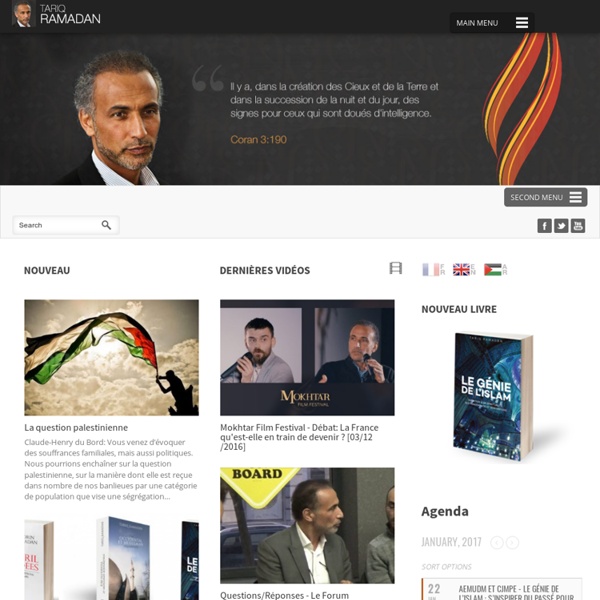
Muslim Scholar Tariq Ramadan: Radical or Reformer? On a recent afternoon, Tariq Ramadan, the outspoken Muslim scholar and professor of contemporary Islamic studies at Oxford University, took the stage at Georgetown University's Gaston Hall. Ramadan stood alongside John Esposito, professor of international affairs and Islamic studies at Georgetown, holding court on "radical reform" in Islam and parrying with a warm, supportive audience. The room was filled with students and others, including women in headscarves, women with bare heads, journalists and professors. Such a gathering might sound relatively unremarkable for the nation's capital, except for this: Tariq Ramadan was banned from the United States for six years, a visa restriction lifted in January by Secretary of State Hillary Clinton. Tariq Ramadan is the most visible, the most loquacious and the most oft-quoted Muslim scholar speaking in the West today. And yet there are those who do not trust him. Ramadan offered an alternative to that despair. Not everyone agrees.
Security In A Box | outils et tactiques de sécurité numérique Tariq Ramadan Tariq Ramadan (Arabic: طارق رمضان; born 26 August 1962) is a Swiss academic and writer. He is also a Professor of Contemporary Islamic Studies in the Faculty of Oriental Studies at Oxford University (Oriental Institute, St Antony's College). He also teaches at the Oxford Faculty of Theology. He is Visiting Professor at the Faculty of Islamic Studies (Qatar), and Director of the Research Centre of Islamic Legislation and Ethics (CILE) (Doha, Qatar).[3] He advocates the study and re-interpretation of Islamic texts, and emphasizes the heterogeneous nature of Western Muslims.[4] Biography[edit] Tariq Ramadan (at table, right) speaking in Oxford. Tariq Ramadan was born in Geneva, Switzerland on 26 August 1962. Tariq Ramadan studied Philosophy and French literature at the Masters level and holds a PhD in Arabic and Islamic studies from the University of Geneva. Ramadan established the Mouvement des Musulmans Suisses (Movement of Swiss Muslims), which engages in various interfaith seminars.
Chomsky: 9/11 - was there an alternative? - Opinion We are approaching the 10th anniversary of the horrendous atrocities of September 11, 2001, which, it is commonly held, changed the world. On May 1, the presumed mastermind of the crime, Osama bin Laden, was assassinated in Pakistan by a team of elite US commandos, Navy SEALs, after he was captured, unarmed and undefended, in Operation Geronimo. A number of analysts have observed that although bin Laden was finally killed, he won some major successes in his war against the US. "He repeatedly asserted that the only way to drive the US from the Muslim world and defeat its satraps was by drawing Americans into a series of small but expensive wars that would ultimately bankrupt them," Eric Margolis writes. "'Bleeding the US,' in his words. That Washington was bent on fulfilling bin Laden’s fervent wishes was evident at once. The first 9/11 Was there an alternative? Unfortunately, it is not a thought experiment. The first 9/11, unlike the second, did not change the world. Crimes of aggression
Islam Islam (/ˈɪslɑːm/;[note 1] Arabic: الإسلام, al-ʾIslām IPA: [ælʔɪsˈlæːm] ( )[note 2]) is a monotheistic and Abrahamic religion articulated by the Qur'an, an Islamic holy book considered by its adherents to be the verbatim word of God (Allāh), and for the vast majority of adherents, also by the teachings and normative example (called the Sunnah and composed of hadith) of Muhammad (c. 570–8 June 632 CE), considered by most of them to be the last prophet of God. An adherent of Islam is called a Muslim. Most Muslims are of two denominations: Sunni (75–90%)[8] or Shia (10–20%).[9] About 13% of Muslims live in Indonesia,[10] the largest Muslim-majority country, 25% in South Asia,[10] 20% in the Middle East,[11] and 15% in Sub-Saharan Africa.[12] Sizable minorities are also found in Europe, China, Russia, and the Americas. Converts and immigrant communities are found in almost every part of the world (see Islam by country). Etymology and meaning Articles of faith God Angels Revelations Prophets
Förlag Islam - Conférences - Cheikh Imran Hosein Nazar La Confiance en Dieu - Sens et bienfaits du Tawakkul 7,50 € La confiance en Dieu (at-tawakkul) est l'une des conditions de la réalisation complète de la foi en Dieu.C'est la représentation concrète de la foi, et l'une des meilleures expressions des coeurs. L'imam Ibn al-Qayyim voyait en elle la moitié de la religion. Il a dit : "La confiance en Dieu est la moitié de la religion, et l'autre moitié c'est le retour vers Dieu." Cette question d'une importance considérable, mérite toute notre attention en raison des confusions qui l'entourent dans l'esprit de beaucoup de gens, dûe à une mauvaise compréhension de la signification de cette expression : placer sa confiance en Dieu, s'en remettre à Dieu (at-tawakkul). Ils considèrent en effet que s'en remetre à Dieu revient à récuser la causalité et négliger les devoirs.
Présentation | Centre Islamique de Genève Le « Centre Islamique de Genève » a la conviction qu'il est temps que tous ceux qui croient en Dieu et à la responsabilité de l'homme envers Lui se rapprochent les uns des autres et réalisent un front unique pour aborder une tâche qui s'impose à tous, mus par la sincère conviction que chacun d'eux sauvegarde ainsi l'existence même de sa religion. Lorsqu'ils sont animés par cette conviction, les croyants adhérant à des religions différentes assument un devoir d'ordre religieux qui les incite à essayer de se comprendre les uns les autres au lieu de se livrer à des polémiques, et à collaborer sur ce qui leur est commun, au lieu de s'attarder sur ce qui les sépare. Tels sont les principes sur lesquels le «Centre» exercera ses activités, aussi bien parmi les Musulmans que dans ses rapports avec des non-Musulmans sincèrement exempts de tout esprit partisan.
Omar Barghouti Omar Barghouti (born 1964) is a founding committee member of the Palestinian Campaign for the Academic and Cultural Boycott of Israel (PACBI). Biography[edit] Barghouti was born in Qatar, grew up in Egypt and later moved to Ramallah (West Bank) as an adult. Views[edit] Barghouti has consistently spoken of Israel as an apartheid state, stating: "From now on, it will be acceptable to compare Israel's apartheid system to its South African predecessor. Barghouti refers to Israeli practices using comparisons to Nazi Germany: "Many of the methods of collective and individual “punishment” meted out to Palestinian civilians at the hands of young, racist, often sadistic and ever impervious Israeli soldiers at the hundreds of checkpoints littering the occupied Palestinian territories are reminiscent of common Nazi practices against the Jews Criticisms[edit] Publications[edit] Barghouti, Omar (2011). See also[edit] References[edit] External links[edit]
Startsida - Konsumentverket ISIS April 5, 2007 We are secular Muslims, and secular persons of Muslim societies. We are believers, doubters, and unbelievers, brought together by a great struggle, not between the West and Islam, but between the free and the unfree. We affirm the inviolable freedom of the individual conscience. We insist upon the separation of religion from state and the observance of universal human rights. We find traditions of liberty, rationality, and tolerance in the rich histories of pre-Islamic and Islamic societies. We see no colonialism, racism, or so-called "Islamaphobia" in submitting Islamic practices to criticism or condemnation when they violate human reason or rights. We call on the governments of the world to We demand the release of Islam from its captivity to the totalitarian ambitions of power-hungry men and the rigid strictures of orthodoxy. We say to Muslim believers: there is a noble future for Islam as a personal faith, not a political doctrine; Endorsed by:
La fondation Lilian Thuram - Accueil Islamic Scholar Imran N Hosein