

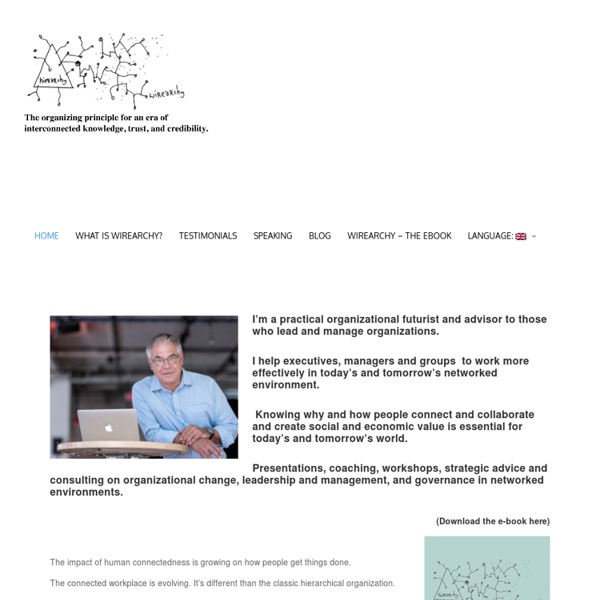
#E20S Jon Husband on the future of work ~ HR to HR 2.0 and Human Capital (HCM) We're onto day 2 of the Enterprise 2.0 conference in Paris. I've already done my session on social talent management and today we're starting off with a slot on the HR perspective on E2.0. The key speaker here is Jon Husband of wirearchy fame who I met for the first time yesterday. Jon doesn't think organisations will become democratic - they exist to get things done. But they would do well to adopt some democratic principles, which makes them more difficult to control. So we need Social Business 2.0? This is supported by effective leadership which is made clearer through an effective structure - hierarchy plus network. The good news is that there are things happening. Eg participative work design - elbow room for decision making etc. So, wow. I can't say I agree with all of it - I think organisations will become more democratic, not just look more democratic, e.g. see WorldBlu.
A Smarter Planet Blog #hypertextual | Organisations, Cultures, 21st Century Un psychopathe à la tête de la CIA Traduit par Résistance 71Chalmers Johnson a appelé la CIA l'armée privée du président. La Rome impériale avait sa garde prétorienne. Elle servait et protégeait l'empereur. Les renégats de la CIA travaillent de la même façon. Ils font même bien plus que cela. Johnson a dit que les présidents américains avaient "un contrôle sans partage sur la CIA, ceci constitue probablement leur seul pouvoir extraordinaire." Cela les préserve et les mets au-dessus des lois et des contrôles. La CIA a cinq missions originales. La cinquième est très vague. Ce mandat a transformé la CIA "en une armée personnelle, secrète et redevable devant personne sauf le président." La CIA est plus active que jamais a dit Johnson. "Son sac à malice est le reflet de la définition de la présidence impériale." Le 8 Mars, des sénateurs renégats ont approuvé John Brennan à la tête de la CIA, ils le firent à 63 pour et 34 contre. Il omit d'expliquer ce qui est le plus important. Il a menti.
Enterprise 2.0 Summit 2013 in 5 keywords The magnificent city of Paris received once again the Enterprise 2.0 Summit, one of the most important events on E2.0 and Social Business. A crowd of practitioners, consultants and some vendor-related folks gathered during two days to share experiences and discuss the current state and future of the transformation of business in a connected world. At the end of day 2 @fredericw tweeted an interesting proposition for attendees: summing up the event in 5 keywords. Hey #e20s fellows, how would you summarize these 2 days in 5 #keywords ? #e20s5w What did you learn?— fredericw (@fredericw) 21 de março de 2013 That proposition is the basis for this blog post as I digest on the last few days. To me this is highly related with Jon Husband‘s definition of a social business as a social system focused on purpose & results and on building capabilities (organizing for adaptability and agility). CHALLENGES According to Thierry de Baillon “we need to rethink organizations. Share this if you like it :) :
THE SECOND COMING — A MANIFESTO By David Gelernter Stewart Brand, David Ditzel, John C. Dvorak, Freeman Dyson, George Dyson, Douglas Rushkoff, Rod Brooks, Lee Smolin, Jaron Lanier, David Farber, Danny Hillis, Vinod Kholsa, John McCarthy on "The Second Coming - A Manifesto" by David Gelernter Marc Hauser, Milford Wolpoff, V.S. Responses to "The Second Coming - A Manifesto" by David Gelernter Stewart Brand: The sequence is clear. David Ditzel: Gelernter is ahead of us all in peering through the fog that we call the future of technology. John C. Feeman Dyson: I suspect that he has a one-sided view of computing. George Dyson: Let us hope that Gelernter's prophecies continue to be fulfilled. Douglas Rushkoff: ...the trick to seeing through today's interfaces — a way of envisioning information architecture that David does effortlessly — involves distinguishing between our modeling systems and the models they build. Jaron Lanier: This reminds of Marx's vision of what should happen after the revolution. From: Stewart Brand Date: June 11, 2000
T. de Baillon Portal:Systems science edit The Systems science Portal Systems are sets of entities, physical or abstract, comprising a whole where each component interacts with or is related to at least one other component and they all serve a common objective. The scientific research field which is engaged in the interdisciplinary study of universal system-based properties of the world is general system theory, systems science and recently systemics. This field investigates the abstract properties of matter and mind, and their organization, searching for concepts and principles which are independent of the specific domain, substance, and type of system, and of the spatial and/or temporal scales of its existence. Systems science can be viewed as ... Systems engineering is an interdisciplinary field of engineering, that focuses on the development and organization of complex artificial systems. edit Selected Systems scientist ...Archive
Social Business News April 17, 2014 Enterprise knowledge goes retail As social platforms create better pathways for knowledge exchange in the workplace, information, as a commodity, is evolving. April 15, 2014 The call center and social engagement Aligning call center and social media teams requires a shared CRM system with a single portal that can manage all engagement channels. Get social with us Connect with us and be the first to know about social business products, news and events. Twitter Discussions, links and alerts Facebook Events, conversations and new connections YouTube Watch what our products can do LinkedIn Join professionals discussing social trends Google + Follow us and get the latest news on social Social Business Insights Blog Read and discuss articles from community leaders Social Business User Group Find a user group near you April 2, 2014 CFOs could be technology evangelists April 2, 2014 Engaging your customers with social software March 20, 2014 Connecting a global workforce
Category:Systems A system is a set of entities, real or abstract, comprising a whole where each component interacts with or is related to at least one other component and they all serve a common objective. For the purpose of organizing articles into categories, there are four major type of system which can reasonably be expected to contain every type of system under its category tree: Physical systems, Biological systems, Social systems, and Conceptual systems. Subcategories This category has the following 7 subcategories, out of 7 total. Pages in category "Systems" The following 25 pages are in this category, out of 25 total. We need to learn how to connect From danah boyd’s presentation at ASTD TechKnowledge 2013, on the future of work: But if you want to prepare people not just for the next job, but for the one after that, you need to help them think through the relationships they have and what they learn from the people around them. Understanding people isn’t just an HR skill for managers. I’ve highlighted the last phrase because this is what social learning is all about; connections. One of the barriers to connecting people is the nature of the JOB, seen as something to be filled by replaceable workers. Work and learning today is all about connecting people. Increasing connections should be a primary business focus.
Main Page - WikipediaPlus Social business and the changing theory of management A manager recently voiced his concerns: “Most employees prefer being told what to do. They are willing to accept being treated like children in exchange for reduced stress. They are also willing to obey authority in exchange for job security.” If we want to meet the challenges of the post-industrial world, this relationship needs to change. The dysfunctional relationship between managers and employees creates a self-fulfilling prophecy and a systemic failure in creative, knowledge-based work. A few researchers have started to dispute the assumption that the present system of management is a fact of life that will always be with us. Luckily, management theory and practice are slowly starting to catch up with the dramatic changes brought about by the loosely coupled, modular nature of creative work and the ideals of social business. A social business does not behave in the way our dominant management thinking assumes. Organizations are always assemblies of interacting people. Like this: