

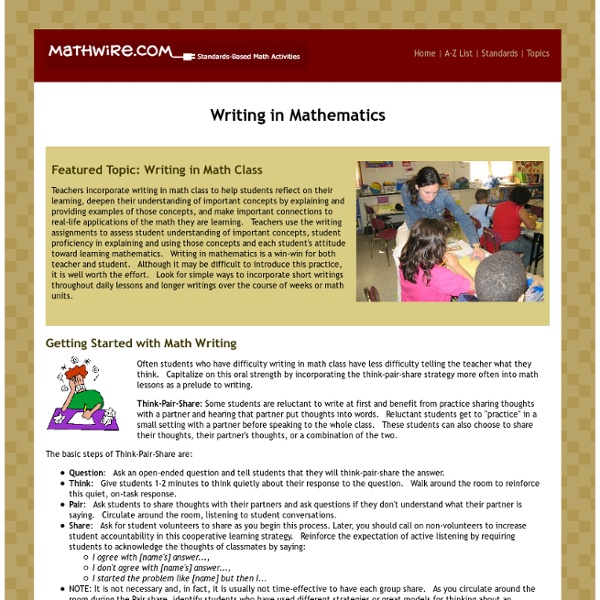
Kay Toliver: Math and Communication Math and Communication by Kay Toliver Before I taught mathematics in grades 7 and 8 at East Harlem Tech, I taught all of the other elementary grades, starting with the first and gradually moving up through each grade, one at a time. It may have been this background which led me to want to use mathematics instruction to develop my students' communication skills, because I saw that, for all students in all grades, communication skills were among the most important abilities that I could help them to develop. Over the years I have learned that there are two sides to this coin. Not only can I use math class to develop children's abilities to speak, read, write and listen, but by stressing these communication activities I am able to be a better mathematics teacher. By encouraging students to speak up in class, to explain their reasoning, and to define the words that we are using, I learn a great deal about how well they understand the lesson. Make it easy for students to speak up.
s Guide Interactive Math Resources Interactive Math Websites, Math Websites for Interactive Whiteboards Interactive Math Websites for Interactive Whiteboards Manipulatives National Library of Virtual Manipulatives Virtual manipulatives related to the NCTM standards. Big Online Calculator Use to teach students how to use a calculator. eManipulatives Base ten blocks, counters, number lines, etc... Interactivate Lots of resources for math lessons. Numbers Wash Line Put numbers in the correct order. Number Recognition Launch the Spaceship Students must click on the correct number to launch a spaceship/ Number Sequence Students pick the correct number to complete a sequence. Two Digit Numbers Students match names of two digit numbers. Numberlines Students guess patterns on the numberline. Odd or Even Students sort numbers as odd or even. Number Track Place numbers in correct order. Caterpillar Ordering and Sequencing Students put number in the correct order to put a caterpillar back together. Spooky Sequences Count by 2, 5, 10 Addition
Using Writing In Mathematic Using Writing In Mathematics This strand provides a developmental model for incorporating writing into a math class. The strand includes specific suggestions for managing journals, developing prompts for writing, and providing students with feedback on their writing. In addition, the site includes two sample lessons for introducing students to important ideas related to writing about their mathematical thinking. Teaching Strategies For Incorporating Writing Into Math Class: Moving From Open-Ended Questions To Math Concepts Starting Out Gently with Affective, Open-Ended Prompts Writing about thinking is challenging. Begin with affective, open-ended questions about students' feelings. Have students write a "mathography"-a paragraph or so in which they describe their feelings about and experiences in math, both in and out of school. Encourage students to keep their pencils moving. Try requiring 20 words per answer, even if they have to copy the same words again to reach 20. 1. 2. 3. 1. 2. 1.
GeoGebra Mathematics and Multimedia GeoGebra Step-by-Step Tutorial Series GeoGebra is a free dynamic mathematics software that can be used to connect algebra, geometry, calculus and other mathematics. It is available in major operating systems particularly Windows, Mac, and Linux. You can download the software in its official website. The GeoGebra Tutorial Series is a collection of more than 50 step by step GeoGebra lessons from beginner to advanced level. The objective of the tutorials is not only to teach how to use the software, but also to suggest how to use GeoGebra in teaching and learning mathematics. Although, it is advisable to follow the tutorial series chronologically, the reader may opt to start on with tutorial of choice since each tutorial is designed to be independent from each other.
Math Tales from the Spring Math Games - from Mangahigh.com Learning Math Through Telling Stories Tuesday, July 3, 2012 From the University of Western Ontario: “Education professor George Gadanidis is attempting to revolutionize the way math is taught in elementary classrooms by applying principles from the world of art. ‘A typical solution to helping kids learn math is making math easy to learn,’ Gadanidis said. ‘But you go watch a movie, if it is easy to learn, you will make predictions for the ending and always be right, [and that's boring]. Gadanidis and his research team developed a framework for approaching typical math problems in an atypical way—lessons are tackled through storytelling, drama and even music. By way of example, he offered a different approach to teaching elementary students infinity, a concept not taught until high school. I love this—borrowing the richness and unexpectedness of art to communicate the wonder of math to kids—and giving them a good story to tell about it.
Math Sites for Kids A+ Math This site has plenty of activities and games to help beginning to intermediate math students improve their skills. Flash cards, concentration games, more. AAA Math Designed for grades K-8, this comprehensive math resource contains hundreds of pages of basic math skills and randomly-created interactive practice activities. Ask Dr. Math This is a huge resource of answers to math questions for elementary to college students. If you have a question not covered, you can ask Dr. Brain Bashers Includes an interesting collection of math, logic, and language puzzles, games, and illusions, separated into easy, medium and hard categories. ChiliMath A great resource that covers key concepts in Algebra, with material that ranges from introductory to advanced. CoolMath.com Have fun while practicing your math through lots of cool games, activities, and animated demonstrations. Figure This! The Fruit Game Can you be the one who takes the last pieces of fruit from the table?
illustrativemathematics Illustrated Standards Count to 100 by ones and by tens. (see illustrations) Count forward beginning from a given number within the known sequence (instead of having to begin at 1). (see illustrations) Write numbers from 0 to 20. Understand the relationship between numbers and quantities; connect counting to cardinality. When counting objects, say the number names in the standard order, pairing each object with one and only one number name and each number name with one and only one object. Understand that the last number name said tells the number of objects counted. Understand that each successive number name refers to a quantity that is one larger. Count to answer “how many?” Identify whether the number of objects in one group is greater than, less than, or equal to the number of objects in another group, e.g., by using matching and counting strategies. Compare two numbers between 1 and 10 presented as written numerals. Fluently add and subtract within 5. Recognize area as additive.
Home | wiris.com Teacher Portal - Sumdog's free maths games Sumdog > Sumdog's features > Games Sumdog's maths games are all free to play, whether you're at home or in school. (Why are they free?). Most of Sumdog's games are multiplayer - which means you can choose to play against other Sumdog users around the world. Although the games are all different, they all have one thing in common: you need to answer maths questions to make progress. Each game can be used to practise any of Sumdog's topics - so you never need to be bored while practising your maths! Pop Tune A creative game, where up to 4 players work together to make beautiful music. Drag the correct answer onto the grid to place your notes - and hear the tune coming together as you play! More about Pop Tune... | Play Pop Tune Bunny Hop It's a race through the house to reach a patch of juicy carrots, with up to four hungry rabbits taking part. Answer correctly to make your bunny faster... but watch out for the hazards along the way! More about Bunny Hop... | Play Bunny Hop Tower Climber Street Racer
Free Math Worksheets Home Page | Skills Workshop