

Notification 3G avec Push Over Dimanche, 07 Avril 2013 06:00 Domotics Pour que votre maison puisse vous notifier les derniers évènements marquants, vous devez utiliser le push 3G qui va vous permettre d'afficher un message personnalisé sur votre smartphone. Le push 3G est un message qui ressemble à un SMS, sauf qu'il est gratuit car il est envoyé via le forfait data de votre téléphone. Pour profiter des notifications 3G, il y a différentes solutions que je vous ai présenté à travers mes articles. Mais aujourd'hui, je voulais vous parler de Pushover que je n'ai jamais présenté. PushOver est disponible sur Android et sur iOS. Pushover est malheureusement pas gratuit. Pour envoyer un message push, vous avez différentes solutions. La deuxième est un bout de code PHP facile à reprendre dans vos scripts Utilisez pushover ? Vous n'avez pas compris un point ? Vous avez aimé cet article ?
IBM Bluemix Docs 0 results for your search {0} results The Bluemix search didn't find any matches for your search query. By default, when multiple keywords are included in your search string, the Bluemix search uses an AND operator between the keywords. You can use operators to refine your searches: To search for pages that have one of two or more terms, include OR (capitalized) between the terms. Wildcards Use an asterisk (*) in a search string as a placeholder for any missing or wildcard words in a phrase. Quotations Use quotation marks to search for an exact word or set of words (for example, "command line interface"). Still have questions? Pushover Dernière application de notre série de tests, Pushover est une solution de "push" pour smartphones et tablettes sous Android et iOS, donc compatible iPhone et iPad. Cette particularité en ravira plus d'un parmi vous, car je sais que beaucoup de personnes utilisant la domotique ont un iPhone, par exemple. Comme nous venons de le voir, Pushover existe donc pour Android mais également pour iOS. On découvre alors certaines fonctionnalités que n'ont pas les autres applis de push. Dans les écrans suivants, on peut voir la page d'affichage des notifications. Concernant la syntaxe de la requête, on notera malheureusement que Pushover nécessite un POST et une connexion sécurisée, alors que l'IPX ne sait faire que du GET.
Ajouter des notifications Push à l’application Apache Cordova à l’aide d’Azure Mobile Apps | Microsoft Docs Vue d’ensemble Dans ce didacticiel, vous ajoutez des notifications Push au projet [Démarrage rapide Apache Cordova] afin qu'une notification Push soit envoyée chaque fois qu'un enregistrement est inséré. Si vous n’utilisez pas le projet de serveur du démarrage rapide téléchargé, vous devrez ajouter le package d’extension de notification Push. Consultez Fonctionnement avec le Kit de développement logiciel (SDK) du serveur principal .NET pour Azure Mobile Apps pour plus d’informations. Configuration requise Ce didacticiel est dédié aux applications Apache Cordova développées dans Visual Studio 2015 et s’exécutant sur l’Émulateur Google Android, un appareil Android, Windows ou iOS. Pour suivre ce didacticiel, vous avez besoin des éléments suivants : Un PC avec Visual Studio Community 2015 ou version ultérieure.Visual Studio Tools pour Apache Cordova.Un compte Azure actif.Un projet Démarrage rapide Apache Cordova .Un compte Google avec une adresse électronique vérifiée. Remarque Étapes suivantes
Sending Push Notifications from RPi using Pushover :: Shared Memory Dump My Raspberry Pi has been humming along for quit some time now. Next thing to add to the project is a mechanism to send notifications when certain events occur (sudden increase/drop in temperature, etc.). Probably the simplest method for sending these type of notifications would probably be via email, but I don't like it. I would rather implement some sort of push notifications. I am already using Pushover to have IFTTT send notifications from several services to my mobile devices. You might also use Twitter for instance. The FAQ contains sample code for numerous programming languages (PHP, Python, etc.) and even command line examples on how to send notifications using the Pushover service. You can Register your application on the following page over at Pushover and complete the form presented When your application is created a API Token/Key is presented. NOTE: Every application allows you to send 7500 notifications per month (counter resets on the 1st of the month). python --version
iOS - Analytics for Apps This section contains documentation on how to integrate in-app notifications into your iOS application. To add our framework to your app: Get the FBNotifications.framework from one of the following sources: CocoaPods, GitHub, the latest Facebook SDK.Drag & Drop FBNotifications.framework into your project.Add FBNotifications.framework to the linking phase of your app target.Add MobileCoreServices.framework and ImageIO.framework to linked frameworks list. In-app notifications are delivered in a remote notification payload to the client. You can also add the ability to receive and display in-app notifications in your app delegate: Objective-C Swift
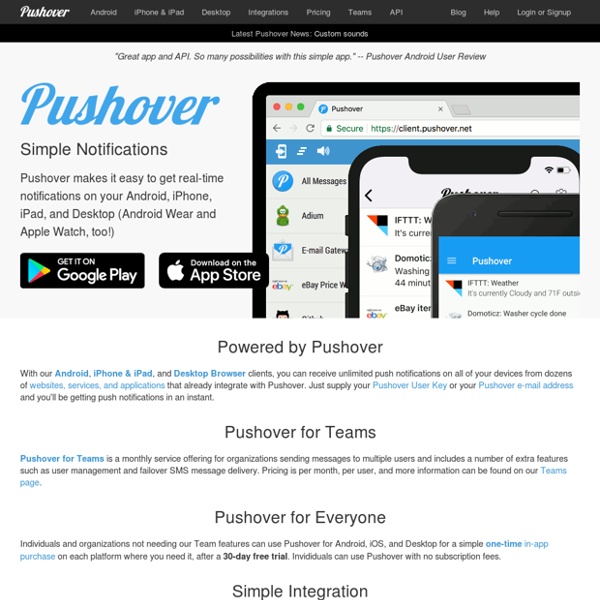
API Pushover uses a simple REST API to receive messages from your application and send them to devices running our device clients. To simplify the user registration process and usage of our API, there are no complicated out-of-band authentication mechanisms or per-call signing libraries required, such as OAuth. HTTP libraries available in just about every language, or even from the command line, can be used without any custom modules or extra dependencies needed. See our FAQ for examples in different programming languages. Register your application, set its name and upload an icon, and get an API token in return. That's it. Need help using our API or found an error in the documentation? Application Registration To get started pushing notifications from your application, plugin, web service, server, or anything else, you'll first need to register it (a free process) to get an API token. Example Application API Token: KzGDORePK8gMaC0QOYAMyEEuzJnyUi Users, Groups, and Devices Pushing Messages
android - FireBase push notification using cordova Synology Pushover notifications :: Styxit blog 10 May 2014 Recently I became the owner of a Synology DS214+. Since my HTPC was running out of space and consuming a lot of power, a Nas with lots of storage seemed right. It was all self explanatory and after some reseach i was able to get NZBget, Sickbeard, Couchpotato and HTPC-Manager running exacly the way i wanted. In DSM5 (the Synology controlpanel) there are a lot of options to configure and play-around with. The notification methods Synology has buildt-in to notify you are; email, sms, msn, skype and phone push notifications using the DsFinder app for your phone. At the moment Pushover is a popular application to recieve notifications on your mobile device(s) and can be used by many third party applications. Time to get my hands dirty I wanted to find a way to Let the Synology send my push messages to pushover. The solotion i came up with was actually very easy, i just didn’t look in the right place. Do it yourself (configuration) Register Pushover application 1. 2. 1. 2. 3. 4. 5.
cordova-plugin-facebook-push-campaign The phonegap wrapper around the new Facebook Push Notifications/In-App Notifications platform The phonegap wrapper around the new Facebook Push Notifications/In-App Notifications platform. This is just an addon to thecordova-plugin-facebook4 so please follow the steps found on their page on how ton install and use it. *Note: Facebook's platform is still in Beta so be mindful before using it in production. Dependencies Facebook IOS SDK v4.13.0 and up. Installation # install cordova-plugin-facebook4 cordova plugin add --variable APP_ID="{your app id}" --variable APP_NAME="{you app name}" # install cordova-plugin-facebook-push-campaign cordova plugin add Usage // wait for device to be ready window.document.addEventListener('deviceready', function() { // initiate the push plugin. pushPlugin .init({ ios: { badge: 'true', sound: 'true', alert: 'true', clearBadge: 'true',
simplepush SimplePush server for node A node implementation of the SimplePush protocol. You'll need node.js and npm installed first. To install from github: git clone cd . If you want persistant storage, you'll need redis installed on your system also. To start the SimplePush server, run: node index.js To run the examples, start the AppServer: node examples/appserver.js Then run the client: node examples/client.js var client = new SimplePUshClient(options) Options may include: pushServer: the WebSocket URL of the SimplePush server the client should connect touaid: a unique UserAgent ID. client.init(cb) Arguments: cb: fired once the client connects and completes the handshake client.register(cb) cb: callback called with three arguments: An error if any, or nullA response object with channelID and pushEndpoint keysA channel object that can receive push notifications. client.register(function(err, reply, channel) { console.log('Channel ID', reply.channelID);