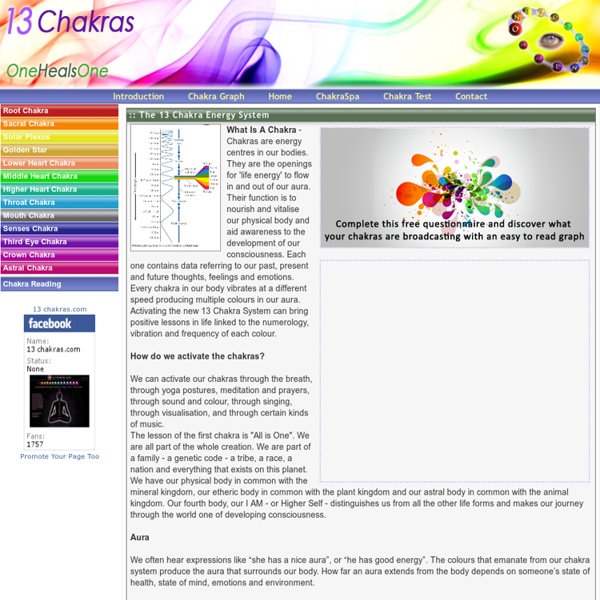
The 13 Chakra System
The Subtle Body: An Encyclopedia of Your Energetic Anatomy - Cyndi Dale
Ayurveda
Ayurveda (Sanskrit Āyurveda आयुर्वेद, "life-knowledge"; English pronunciation /ˌaɪ.ərˈveɪdə/[1]) or Ayurvedic medicine is a system of traditional medicine native to the Indian subcontinent and a form of alternative medicine. The oldest known Ayurvedic texts are the Suśrutha Saṃhitā and the Charaka Saṃhitā. These Classical Sanskrit texts are among the foundational and formally compiled works of Ayurveda. Charak By the medieval period, Ayurvedic practitioners developed a number of medicinal preparations and surgical procedures for the treatment of various ailments.[2] Practices that are derived from Ayurvedic medicine are regarded as part of complementary and alternative medicine,[3] and along with Siddha Medicine and Traditional Chinese medicine, forms the basis for systems medicine.[4] Eight components of Ayurveda[edit] Principles and terminology[edit] Several philosophers in India combined religion and traditional medicine—notable examples being that of Hinduism and Ayurveda. History[edit]
AYURVEDIC NUTRITION - Ayurveda E-learning courses - ayurvedic diets training : learn ayurvedic diet and study ayurvedic medecine! distance learning courses online, ayurvedic training
Chakra
From an 1899 Yoga manuscript in the Braj Bhasa language. Their name derives from the Sanskrit word for "wheel" or "turning", but in the yogic context a better translation of the word is 'vortex or whirlpool'.[1][note 1] The concept of chakra features in tantric and yogic traditions of Hinduism and Buddhism. Etymology[edit] Sanskrit chakra derives from the Proto-Indo-European *kʷekʷlos; its cognates include Greek kuklos, Lithuanian kaklas, Tocharian B kokale, and English "wheel," as well as "circle" and "cycle".[2] M. "Circle," used in a variety of senses, symbolising endless rotation of shakti.A circle of people. The linguist Jorma Koivulehto wrote (2001) of the annual Finnish Kekri celebration, having borrowed the word from early Indo-Aryan Languages.[5] History[edit] Characteristics[edit] The texts and teachings present different numbers of chakras. "In fact, there is no "standard" system of the chakras. The following features are common: Use in religious traditions[edit] Hindu Tantra[edit]
Related:
Related:

