
background preloader

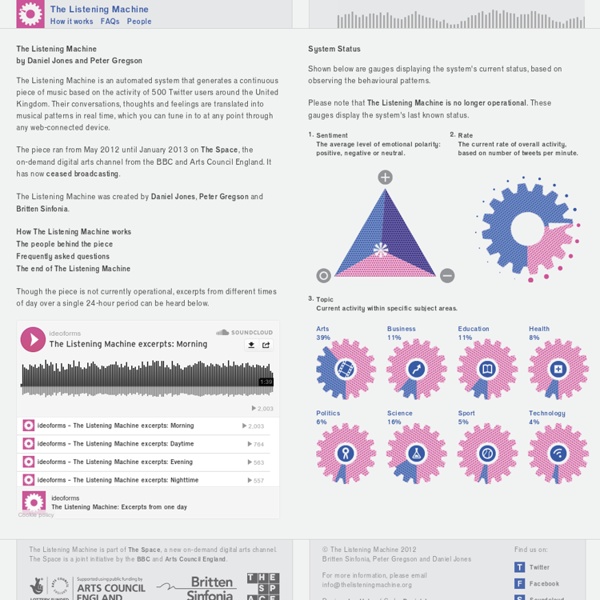
The Listening Machine

The Listening Machine

aM laboratory Adventures in 3D Sound! Edgar Choueiri knows how things work; he’s a rocket scientist — officially, the Director of Princeton University's Electric Propulsion and Plasma Dynamics Laboratory. If NASA ever sends a person to Mars, Choueiri’s research probably will have played a role. But Kurt Andersen visited his lab recently to get a taste of the future right now. Unlike surround sound and other elaborate hardwiring, his breakthrough consists of a software algorithm applied to sound files that allows stereo playback to sound much more real and lifelike. The 3D audio in the show segment above is calibrated for stereo speakers only so it won't work on headphones. Try out the clips below, in which Choueiri demonstrates the sound of water in 3D. 3D Audio Demonstration for Speakers 3D Audio Demonstration for Headphones So how does it work? Drawing on some of the math in plasma physics, Choueiri devised a digital algorithm that cancels crosstalk transparently without changing the tonal quality of the sound.

7 Alternatives to Pandora and Last.FM | Mystery Tricycle Whether you are annoyed by the ads on Pandora, the limited number of skips, or the abyss of cruel 30-second song teasers from Last.FM, many online listeners are growing weary of mainstream methods of hearing new music. While the Pandora algorithm is strong, and the Last.FM related artists tool is pretty useful, don’t fool yourself in to thinking that there aren’t other great ways to expose yourself to new music in the depths of cyberspace. Here are 7 alternatives to Pandora and Last.FM that will infuse your day with an uninterrupted stream of music that large record companies haven’t managed to squash under their thumbs yet. StumbleAudio StumbleAudio has a killer recommendation engine that works better for me than Pandora’s. Songza Songza uses a recommendation engine that runs for each ‘channel’, but unlike Pandora, channels are not tied to specific listeners and rather are community property. Musicovery Stereomood Ah, the power of the ‘tag cloud’. 8tracks Grooveshark The Hype Machine

Choosing a Mixer for Your Home Studio Page 1 2 3 4 by Tweak Tweak: This is the back of a Mackie 1604VLZ3 a known favorite in many home studios. Understanding the back of your potential mixer is more important than the front. By the end of this article you will know what all those ins and outs do. On the next four pages we will cover a lot of mixers and approaches to building your studio. Understanding mixers is important. What does a Mixer actually do? A mixer or mixing console or mixing board all refer to the same thing: a device that allows you to balance, position, effect and equalize its different audio channels into a good sounding sonic image that we call a mix. Those starting a studio need to decide early on what is going to be the center of the studio. Making this choice is one of the most difficult for the home and project studio, as no piece of gear has as many ramifications for the future path of your studio. Going Mixerless Is a mixer even necessary for your rig? Even many professionals are mixerless now.

Text Composition Generator The P22 Music Text Composition Generator allows any text to be converted into a musical composition. This composition is displayed in musical notation and simultaneously generated as a midi file. 1. Type or copy any text into the Text Field. A short text may be best at a slow pace (IE 10 BPM) whereas a longer text may prove more engaging at 1200 BP. In some browsers (Safari 2 or greater), the ability to play real time multi-tracking can allow for complex compositions. The generated musical text does not claim copyright nor imply any rights from the text used. 2. The P22 Music Composition Font was proposed in 1997 to the John Cage Trust as an accompaniment to the John Cage text font based on the handwriting of the composer. 3. P22 Music Pro is a unique font system that expands on the concept used in the Music Text Composition Generator. The font used in the P22 MTCG is a basic version that closely follows the initial Cage inspired idea. 4.

Synth Secrets, Part 5: Further With Filters Gordon Reid continues his series on the theory of subtractive synthesis by delving deeper into the amazingly complex world of the analogue audio filter. This is the fifth article in a 63-part series. Read all parts. Last month, we started looking at audio filters, demonstrating (if not proving) that they are also phase-shifters, and therefore mess with your audio signals in more ways than one. Passive Filters Figure 1 shows the passive low-pass RC filter first introduced last month (incidentally, you can, with a fair degree of accuracy, define a passive component as one that draws no power except that presented as the signal at its input -- so resistors, capacitors and inductors are examples of passive components, while transistors and other amplifiers are not). But, since we discussed the phase-shifting aspect last month, we're only going to consider the amplitude response this month. Unfortunately (and despite its ubiquitous use within the music industry) Figure 2 is actually wrong.

BallDroppings From the Author: BallDroppings has already been implemented in other languages, you can download it for Mac or Windows here: .. it's a musical playtoy that looks like abstract pong. My hope is that i will be able to port enough of it to Javascript, and then use a bit of Flash to manage the sound. The result will be a limited version of BallDroppings that works in the browser. Technology: 100 Ways to Discover and Enjoy Music UPDATE 12/10/13: We’ve released a follow-up to this post with 100 More Ways to Discover and Enjoy Music. Prepare yourself for another dose of Monday roundup madness! It’s time for another crazily comprehensive, yet carefully curated, look at an entire industry–the music industry to be specific. This if the first in a two-part series on the music industry which will conclude next week. This week’s focus is on the consumer side of music. You might also like: exfm – See what’s trending. There’s more to this article!

Plink" by Dinahmoe From the Author: Plink is a multiplayer music experience with a super intuitive user interface. Simply by clicking and moving your mouse you create music in real time. You can play by yourself or together with three friends (or strangers). No hassle, just plain fun music creation. Technology: Web Audio, WebGL, NODE.js Tags: Audio Multiplayer WebGL Mix Music Online with Virtual DJ Turntables, Free - L2internet.com The best free online music mixing and virtual DJ websites Buy DJ Mixers & Turntables at Amazon If you really want to get your party rockin' with music, you should try mixing music on the go with online dj mixing turntables. You can do it for free with several websites out there, it's fun and you look pretty cool too. We've picked out the best no-download-required sites, and waded through a ton of advertising riddled lame DJ sites to find you the best. So check out these free DJ mixing tools below and if you know of a good DJ mixing site that should be added, let everyone know in the comments and we'll add the best ones to the article. Party Cloud Party Cloud is a DJ mixing website that apparently features over 20 million songs to mix. More free online virtual DJ turntables Try mixing music with these other virtual dj turntables. Until AM Until AM allows you to upload your own music to mix. Muziic Cool Mixer that features an abundance of music, by playing the music straight from YouTube.

Related: