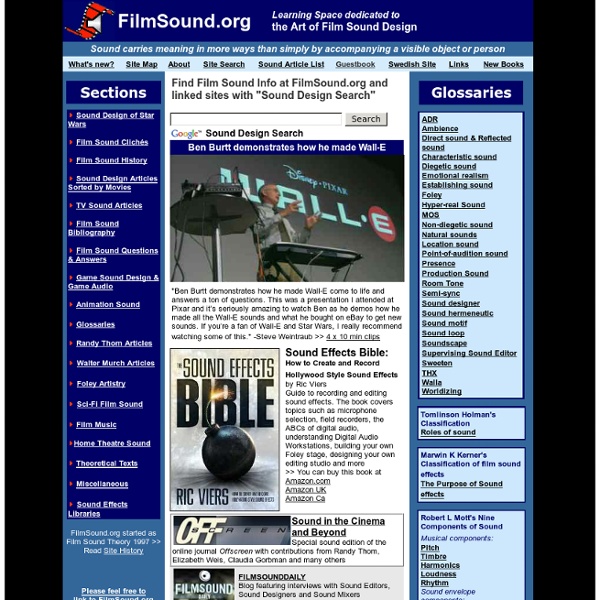
FilmSound.org: dedicated to the Art of Film Sound Design & Film Sound Theory
Film Sound Bibliography Film Sound Theory and Postproduction Books and Articles. Visit New for more articles, radio programmes etc. Film Sound History Sound recording and the ability to photograph and reproduce motion pictures began intersecting at the very beginning, 1895!!!!. - Articles, Timelines, Books, and more Sound Design of Star Wars Articles about how Sound Designer Ben Burtt created the signature sounds for Star Wars. Film Sound Clichés Film Sound Stereotypes and Common Logic Flaws
http://www.filmsound.org/
CML Cameras table of contents
Recent CML Tests 9 cameras RAW Alexa 4 stops over and back Alexa - 435/5219 Film - Alexa - Epic Aces Rushes One Light
A Tripod-On-Skates Lets Amateurs Pull Off Hollywood-Quality Camera Moves
What’s the difference between a compelling, immersive short film and a throwaway piece of sub-viral crap? Not video resolution: nowadays, when every cat-filming schmoe has an HD video camera in his smartphone and the DSLR revolution has unleashed a tsunami of bokeh onto Vimeo.com, you need more than sharp pictures and good lenses to make an impact. According to Justin Jensen, an engineer-cum-amateur photographer/filmmaker who studied Computational Photography at the MIT Media Lab, "I realized that video quality is no longer limited by resolution, but instead by stabilization." In other words, you need smooth camera movement to give your vids that juicy sheen of production value. But since Jensen couldn’t afford a SteadiCam, he invented CineSkates: a tiny, inexpensive, portable, expandable camera-movement platform based on Joby’s Gorillapod.
Download & Streaming : Moving Image Archive : Internet Archive
movies eye favorite 2 comment 0 UContentPlayer-TVC-Default-10032021-fixsound Topic: UContentPlayer Programs in TV News Archive for research and educational purposes.
Stunning Good Looks by Art Adams
The most important thing you will ever learn about lighting is this: LIGHTING IS NOT A FORMULA. Learning about lighting, though, is a process of becoming aware, and in this first of many articles I'm going I'm going to try to increase your awareness of one specific thing per article. The more awareness you have the more easily you'll be able to adapt your lighting to your circumstances because you'll see, with your own eyes, what you need to do to make an image that satisfies your inner artist. I think the best place to start is with classical key light placement. This knowledge is not something you will use verbatim as this is not a style that is in vogue at the moment. The underlying principles, however, should be of daily benefit.
666 DIY Horror Filmmaking Tutorials
It’s that time of year again, so we thought it was time to update last years killer feature “Horror Filmmaking: From Script to Scream.” That’s right a sequel! This time we are narrowing the focus a bit and concentrating on the DIY (Do It Yourself) elements. Hopefully this will help you slash the budget without murdering your production values. DIY: Blood, Bullets & Stunts DIY: Stage Effects/Green Screen
Film Literature Index >> Home
Introducing the FLI Online >> The Film Literature Index (FLI) annually indexes 150 film and television periodicals from 30 countries cover-to-cover and 200 other periodicals selectively for articles on film and television. The periodicals range from the scholarly to the popular.
What We Do - Cineplex Entertainment Film Program
A complete immersion in the art and craft of dramatic filmmaking, the Cineplex Entertainment Film Program offers residents the opportunity to hone their talent, while building strategic relationships in the industry. Over five-and-a-half months, producers, editors, writers and directors are joined by illustrious storytellers and industry professionals who inspire, question and challenge our filmmakers to elevate their craft. Application information for 2014 is available now. CLICK HERE for more details. Take a look at some of the guests we've welcomed for the Cineplex Entertainment Film Program!
Dialogues & Film Retrospectives
The Dialogue and Retrospective series (1990–2020) was begun by Walker film and video curator Bruce Jenkins (1985–1999), who envisioned it as a forum for the critical exploration of the medium and a way to highlight the vast diversity of contemporary filmmakers, from experimental and documentary to international. The program continued through 2020 under the leadership and vision of senior curator Sheryl Mousley, whose contributions reflected her interest in the world-wide independent film movement. Cinema shapes our cultural landscape and informs our understanding of the world. To explore this creative force and its impact, the Walker invited the most innovative and influential filmmakers of the past thirty years to travel to Minneapolis and talk about their work, their ideas, their influences, and their love of film. These in-depth conversations—led by eminent film critics, writers, and historians and held onstage at the Walker Cinema—became the Walker Dialogue and Retrospective series.
Related:
Related: