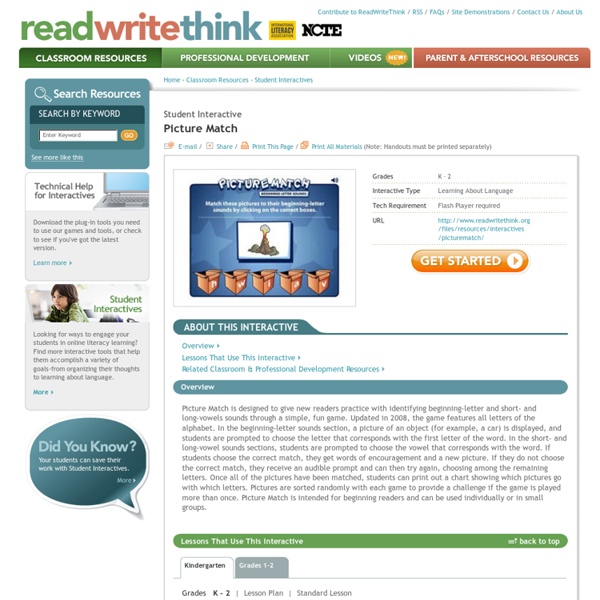
Picture Match
Acrostic Poems
Grades 3 – 5 | Lesson Plan | Standard Lesson Vocabulary Solutions: A Mixture of Science, Conversation, and Writing In this lesson, students conduct a science experiment and later discuss the events of the lab during shared writing. Students explain the procedure in their own words and then revise to include content specific vocabulary. Finally, students reflect on new words added to their writing using the Trading Card Creator interactive. Grades 7 – 10 | Lesson Plan | Standard Lesson Engineering the Perfect Poem by Using the Vocabulary of STEM Students research engineering careers and create poetry to understand the vocabulary of STEM (science, technology, engineering, and mathematics). Grades 6 – 12 | Lesson Plan | Standard Lesson Making History Come Alive Through Poetry and Song Students compare the sinking of the Edmund Fitzgerald with the song, "The Wreck of the Edmund Fitzgerald," then create their own poetry about a historical event. Grades K – 12 | Student Interactive | Writing Poetry
Comic Creator
The Comic Creator invites students to compose their own comic strips for a variety of contexts (prewriting, pre- and postreading activities, response to literature, and so on). The organizers focus on the key elements of comic strips by allowing students to choose backgrounds, characters, and props, as well as to compose related dialogue (shown at left). This versatile tool can be used by students from kindergarten through high school, for purposes ranging from learning to write dialogue to an in-depth study of a formerly neglected genre. The tool is easy to use, made even easier with the Comic Strip Planning Sheet, a printable PDF that comic creators can use to draft and revise their work before creating and printing their final comics. Grades K – 3 | Lesson Plan | Standard Lesson Word Study with Henry and Mudge Henry and Mudge is used in this lesson to build students' word recognition through rereading, high-frequency word banks, word studies, and writing.
Related:
Related:

