

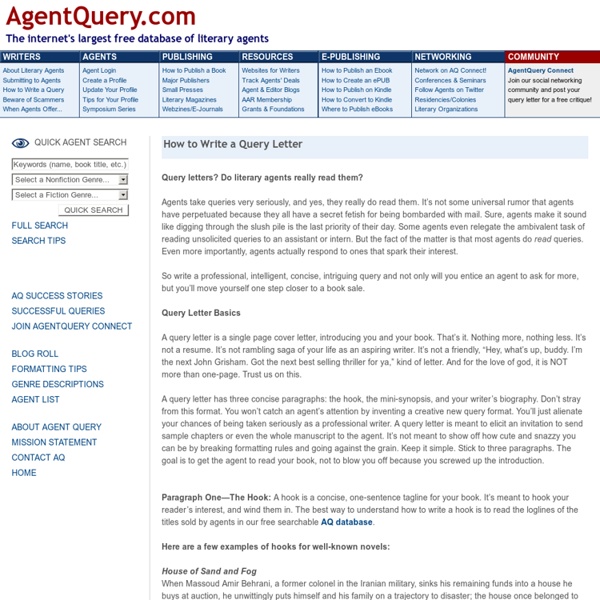
How to Write a Query Letter My friend Leigh Spencer has a new book of poetry called Tequila and Cookies. With a title like that, you KNOW you want to read it. Download a PDF of How to Write a Query Letter Query letters are a much-debated practice in the writing community. Many writers swear by them, but others feel they are a waste of time. Here are some advantages to writing a formal query letter: Here are some disadvantages to writing a formal query letter: Writing a good query letter takes time. Below is a point-by-point description of how to write a query letter. Know your target Study any publication before you submit a query letter.Get writer’s guidelines for the publication if they are available.Study the publication’s masthead (or “about” page) to identify the appropriate editor for your query. Your query letter should have a professional look. There should be no spelling or grammar errors.Be sure to include the date on your letter. Your query letter should be interesting Your query letter should be specific
How to Write a Synopsis Unsure how to condense your manuscript into a well-written and catchy synopsis? Follow our helpful tips to get started. If you’re wondering how to get published, assembling a query package is the first step. Your query package should include a synopsis, which is the lynchpin. Put in the Time to See Results Considering that writing a manuscript of any value takes significant time and resources, misrepresenting it with a poorly written synopsis is never justifiable. Organization Matters Organization is paramount. Summarize As you write your synopsis, think of it as a mini version of your manuscript. Keep it Clear When you’re writing, remember that clarity is your friend. Formatting Tips As far as formatting goes, there aren’t really any set guidelines as to what you have to do, but there are definitely things that are good to do. Writing a synopsis is quite often an author’s least favorite thing to do, but remember that this is your major marketing tool.
How to Write a Query Letter: 10 Dos and Don'ts Learning how to write a must-read query letter is nearly as important as writing a must-read manuscript—after all, an enticing query letter is what will get an agent to say, “Love your story. Send me the full manuscript.” While query letters vary a little depending on who the agent is (and their guidelines) and what type of book you’re writing (novel, nonfiction, poetry, etc.), there are many elements that remain the same. That’s why I’ve developed this list of dos and don’ts to help you navigate what’s really important to include in your pitch and, also, what should be avoided at all costs. By sticking to these 10 specific dos and don’ts of writing a query letter, you’ll give yourself the best opportunity to find success and land an agent. Good luck! When Writing a Query Letter Do … Address the agent by name. Cut right to the chase. Sell your manuscript. Explain why you’ve chosen to query this specific agent. Mention your platform (if you have one). Study other successful query letters.
Written? Kitten! Query Letter Sample #1 Dear [Agent Name], I am currently seeking representation for The Last Great Kickball Player, my complete, 45,000 word young-adult novel. I’m a big fan of many of the YA authors you represent, and I hope you will be interested in adding me to your list. Percival Greensborough is a typical seventh grader (except for the name). To everyone’s surprise, Hollis chooses Percival as her one friend and confidant. My writing credits include one short story published in Short Story Magazine Monthly, and several book reviews posted online. Thank you for your time and consideration. Sincerely, R.
JULIET MUSHENS ON HOW TO APPROACH AN AGENT: DOS AND DON'TS « Tor Books Tor Books When I became an agent in 2011 I didn’t really know what I wanted to represent. Good books, sure; nice people, definitely, but above and beyond that I had no idea as to the genres I wanted to focus on. ‘Growing up’ in an agency where everyone had a specialism led me to believe that I should probably develop one… but the truth is that my reading tastes have always been incredibly broad, and my list reflects this fact. Now, two years into my career as an agent, I represent everything from bestselling crime novelists, to inspirational memoirs, from epic fantasy to literary historical fiction. Genre has always been one of my key loves. As a teenager I found refuge from puberty in Robin Hobb (I might have had spots but at least I wasn’t a royal bastard), David Eddings, Isaac Asimov and Tad Williams. A list as diverse as mine means that I attract a lot of submissions. Your researchSo you’ve finished your book and edited it, and you’re about to send it to agents, but who do you send it to?
Creative Writing Ideas, Courses Online, Free Classes for Writers Successful Queries Successful Queries: Agent Adriann Ranta and “Not a Drop to Drink” This series is called “Successful Queries” and I’m posting actual query letter examples that succeeded in getting writers signed with agents. In addition to posting these query letter samples, we will also get to hear thoughts from the writer’s literary agent as to why the letter worked. The 65th installment in this series is with agent Adriann Ranta (Wolf Literary) for Mindy McGinnis’s young adult novel, NOT A DROP TO DRINK (Sept. 2013, Katharine Tegen Books), a post-apocalyptic survival tale set in a world where freshwater is almost non-existent. GIVEAWAY: Mindy is excited to give away a free copy of her novel to a random commenter. Successful Queries: Agent Julia Kenny and “Sure Signs of Crazy” This series is called “Successful Queries” and I’m posting actual query letter examples that succeeded in getting writers signed with agents. GIVEAWAY: Karen is excited to give away a free copy of her novel to a random commenter.
Michelle4Laughs- It's In The Details: Query Questions with Juliet Mushens Writers have copious amounts of imagination. It's what makes their stories so fantastic. But there's a darker side to so much out of the box thinking. When a writer is in the query trenches, their worries go into overdrive. Is there a particular time of year that is better to query? Not really - the only bad times are April and October because of the book fairs. Does one typo or misplaced comma shoot down the entire query? Not at all. Do you look at sample pages without fail or only if the query is strong? Yes, absolutely. Do crazy fonts caused by email gremlins make for an automatic rejection? No, but do try sending it to yourself first to make sure it looks normal! Do you prefer a little personalized chit-chat in a query letter, or would you rather hear about the manuscript? I want the focus to be on the manuscript but a couple of lines about yourself is welcome too. Is there a bias against querying authors who have self-published? No. How many queries do you receive in a week?
Anatomy of a Book Cover As told by Delphine, the author The adage “You can’t judge a book by its cover [jacket]” is only partly true. It’s not for lack of trying. The look of a book cover jacket is an important aspect of market positioning. In the case of my book, “The Art of Gaman,” published by Ten Speed Press in 2005, coming up with the book title and cover jacket design proved as hard as developing the content for the book. In all, designer Kit Hinrichs and his team at Pentagram/SF comped up about a dozen cover options. one This is the design that accompanied the initial concept proposal presented to Ten Speed Press. two Kit came up with this cover option, based on a title that I had proposed. four The split page with a photograph of the barrack living quarters at Manzanar, an internment camp in California’s Owens Valley, and a closeup of a teapot carved from found slate by an internee seemed to work beautifully with the title “Desolate Beauty.”
6 Steps for Writing a Book Synopsis | Marissa Meyer Confession: I enjoy writing query letters. I know that most writers loathe them, but I always thought the query letter was kind of a fun challenge. The challenge of trying to distill your novel down to its essence, giving just enough information to draw the agent or editor in to the story, but without giving away so much that the manuscript loses all sense of mystery. However, I feel quite differently about the second-most dreaded item of many submission packages: the Synopsis. The book synopsis is that three- or four-page snapshot of the book, that essentially tells your story from beginning to end, while seemingly stripping it of any intrigue, humor, or emotional resonance. Unfortunately, it turns out that getting published does not necessarily mean we don’t ever have to write a synopsis again. – A pitch letter (similar to a query), illustrating the concept and major conflict of the book. – The first 50 pages, edited and polished to a glowy sheen. Step 0: Write the book! Step 2. Step 5.
Pretentious Title: Editing for People Who Hate Editing Note! I am giving away signed copies of my new omnibus on my blog starting tomorrow (Wed, February 8!). Check back for a chance to win! Since I wrote my posts on how I drastically upped my word count and plotted my novels, a lot of people have been asking me to do a post on editing. I can totally understand why, editing can be very intimidating. But after 8 finished books, I've come around to a different way of thinking. So, without further ado, here is my take on the editing process, complete with the tools I build for each book. Disclaimer: Unlike my work count tips, which I think can work for anyone, this process is highly personal. But Rachel, I HATE Editing! I hear this all the time in a million different variations. Editing is writing. I firmly believe that every good writer can become a good editor if they're not one already. Ok, Ms. Rachel's Editing Process Step 1: Changing the way you think about editing. What is editing? Answer: Reader experience. This is my editing mindset.
e-Book Cover File Size Specifications I’ve been getting a lot of questions recently about e-book covers and, specifically the size and proportion requirements for submitting the cover image of your e-book when you upload it to a retailer or a distributor. Here’s a selection of requirements that should help. Keep in mind this information is accurate now but could change at any time, so check when you’re ready to upload. Kindle Direct Publishing From Kindle Direct Publishing help system: Creating a Catalog/Cover Image A book is judged by its cover! Please note: Uploading a catalog cover image in KDP will not automatically add it to the inside of the Kindle book. Requirements for the size of your cover art: At least 500 pixels horizontally and 800 pixels verticallyIdeal height/width ratio of 1.6Maximum of 2000 pixels on the longest side is preferred Save at 72 dots per inch (dpi) for optimal viewing on the web Barnes & Noble Pubit! From Barnes & Noble Pubit! Smashwords From the Smashwords Style Guide: BookBaby Password Incorrect
Example of a Good Query Letter III It's been a while since I last featured a stellar query letter that sent me into a partial requesting frenzy, and this time around I thought I'd take a page from Kristin Nelson's book and share the query for a novel that recently sold. Not only is Lisa Brackmann's debut novel ROCK PAPER TIGER to die for, but when she originally contacted me she wrote one of the best queries I've ever received. (Frequent readers might also know Lisa as blog commenter Other Lisa). Without further ado: Dear Mr. Bransford, The Beijing '08 Olympics are over, the war in Iraq is lost, and former National Guard medic Ellie McEnroe is stuck in China, trying to lose herself in the alien worlds of performance artists and online gamers. ROCK PAPER TIGER is a fast-paced, 108,000 word mainstream novel set in a China where the ultra-modern and cutting-edge clash with ancient neighborhoods and traditions, and in an America where the consequences of war reverberate long after the troops have come home. Best regards, Lisa