

About Established in May of 2009, PetaPixel is the world’s leading independent photography, videography, and imaging technology publication. Its YouTube Channel, founded in 2023 and hosted by Chris Niccolls and Jordan Drake, has quickly risen to be the top resource for photography gear reviews and education. The weekly PetaPixel Podcast is also one of the top-rated and most-listened to in the photo and technology space globally. In case you were wondering, the “peta” in PetaPixel is the prefix that denotes 1015, just as the “mega” in megapixel denotes 106. Have a tip or need to get in touch?
Top ten DIY photography tips On the day the digital camera was invented, the photographer died. Go on to the street these days and the only thing a digital camera tells you about a person is the size of their bank balance. As an alternative-lifestyle statement, SLR ownership is now right up there with owning a Coldplay CD. In these troubled times, when SLRs are no longer a badge of actual photography skills, you need something to distinguish yourself from the crowd. We're going to tell you how to stand out from the Jessops jockeys with ten DIY tips for distinctive looking -- and almost free -- photography hardware. 1. Some 'professional' photographers will tell you that you need to buy a tripod to steady your shots. The principle is simple. You can see the likely insertion point in the diagram above (1). If you've got the length right, you should be able to pull up lightly on the camera to produce tension in the strings. 2. You can fashion your own softbox out of any cardboard you have to hand. 3. Now find a bowl.
What is RAW photographyPhogropathy Update: This post has been updated to include a video that I think clarifies the RAW vs JPEG confusion as best as I can. The original post still exists in its entirety below so feel free to read through if that’s more your style. Enjoy! I’m sure most of you already know what the RAW format is and what it is used for, but according to a recent poll on dPS, 15% of their reader base claims to not know and therefore there’s still quite a few people out there searching for the answer to the question – What is RAW? Admittedly at first I was surprised by the results of this poll. I realized that even today most point and shoot cameras, and certainly all camera phones, both of which account for the vast majority of every-day photographers, only offer you JPEG formats. So anyways, this leads me into this post, about my take on the RAW format and why I personally shoot exclusively RAW. RAW Photography Explained So then, what is a better comparison to the RAW format? So What Can RAW Photos Do?
Homemade Lightbox - Tutorials Homemade Lightbox by rob_smith I needed a lightbox for my recent challenge entry and had a look on the interweb for a guide to make one. There are a few good ones out there, but I needed something I could build in an hour to shoot for the Skin challenge that was a couple of hours away from closing. The Strobist's article was a pretty good guide so I thought I'd build one and document the process. Stage 1: Materials Needed I had some big sturdy boxes left over from moving house so I used one of those, it's the double thickness kind, pretty handy as you'll be removing a lot of the cardboard so you need some strength left in the frame. Some large sheets of tracing paper, mine were 14" x 17", pretty cheap from any art shop. I have a little toy car in the shots for scale. Stage 2: The Build I outlined around my tracing pad to mark how big the sheets were, and then cut using a craft knife about 1cm inside the line I had traced. Stage 3: Inside Stage 4: Backdrop Stage 5: Light Position Rob
Common Photography Lighting Mistakes and Fixes Pin It This is the second in a 4-part series of Common Photography Mistakes tutorials that Jean Smith Photography put together for I Heart Faces. Be sure to read the other three parts of her series here: It’s all about LIGHTING this week! Natural Light Mistake #1 – Looking for location first. The Fix – Always look for light first, THEN worry about location. Natural Light Mistake #2 – Subject has dark or “dead” eyes. The Fix – The eyes are typically the most important part of an image (unless you have a specific or artistic reason for wanting them dark) and they should be filled with light. Natural Light Mistake #3 – Shooting your subject in dappled sun. The Fix – What the heck is dappled light? Natural Light Mistake #4 – Avoiding midday sun. The Fix – We can all admit it. Natural Light Mistake #5 – Facing your subject toward midday sun. The Fix - I know, I know, I JUST told you to get out of your comfort zone and place your subject out in the sun.
How to Photograph the Stars A Post By: John Davenport Photography in general is easy – right? You pick up your camera, point it in the direction of what interests you, and depress the shutter button. However, there are many levels of photography, and I’m sure many of you are aware of the basics. Today I’m going to focus on something a bit more advanced, photographing the star filled sky, also known as astrophotography. For astrophotography you will be delving a bit deeper into the use of some of the manual controls of your camera like shutter speed, aperture, and ISO control. Let’s Start With What You’ll Need Tripod – We’re going to be dealing with exposures in the tens of seconds and I don’t care who you are, you’re going to need something to stabilize your camera.A Camera With Manual Controls – Manual control of your ISO and shutter speed are going to be essential for photographing the stars.A Wide Aperture Lens – You’ll need a lot of light and f/2.8 seems to be the butter zone for astrophotography.
Far Better Than 3-D: Animated GIFs That Savor A Passing Moment | Co.Design You know how people sometimes say that jazz is the only truly American art form? Animated GIFs are like the jazz of the internet: they could only exist, and be created and appreciated, online. That said, PopTart Cat is not exactly on par with Thelonious Monk. But photographer Jamie Beck and motion graphics artist Kevin Burg may have finally found a way to elevate the animated GIF to a level approaching fine art, with their "cinemagraphs" -- elegant, subtly animated creations that are "something more than a photo but less than a video." Here’s one of my favorites: The pair was inspired to create these cinemagraphs while preparing to cover Fashion Week this past February: "We wanted to tell more of a story than a single still frame photograph but didn’t want the high maintenance aspect of a video," they told Co.Design via email. So why did Beck and Burg choose the GIF format, rather than something more flexible like Flash? [See more cinemagraphs at From Me To You and Coco Rocha]
Introduction to Shutter Speed A Post By: Darren Rowse Previously I’ve introduced the concept of the Exposure Triangle as a way of thinking about getting out of Auto Mode and exploring the idea of manually adjusting the exposure of your shots. The three main areas that you can adjust are ISO, Aperture and Shutter speed. I’ve previously looked at making adjustments to ISO and now want to turn our attention to shutter speed. What is Shutter Speed? As I’ve written elsewhere, defined most basically – shutter speed is ‘the amount of time that the shutter is open’. In film photography it was the length of time that the film was exposed to the scene you’re photographing and similarly in digital photography shutter speed is the length of time that your image sensor ‘sees’ the scene you’re attempting to capture. Let me attempt to break down the topic of “Shutter Speed” into some bite sized pieces that should help digital camera owners trying to get their head around shutter speed: Motion is not always bad.
CAMERA ANGLES: the Art of Manipulation Eyelevel Angle An eyelevel angle is the one in which the camera is placed at the subject’s height, so if the actor is looking at the lens, he wouldn’t have to look up or down. Eyelevel shots are incredibly common because they are neutral. Low Angle Low angles are captured from a camera placed below the actor’s eyes, looking up at them. High Angle In a high angle, the camera is above the subject, looking down. Dutch Tilt Also called canted angle, a Dutch tilt has the camera leaning sideways, transforming the horizon into a slope. Point-of-View (POV) As the name suggests, point-of-view shots are angles in which the camera incorporates a character’s eyes. Needless to say, cinematographers will choose different angles for different scenes within the same movie depending of the scene goal or purpose. Sometimes different angles will be chosen to emphasize different elements in the screen.
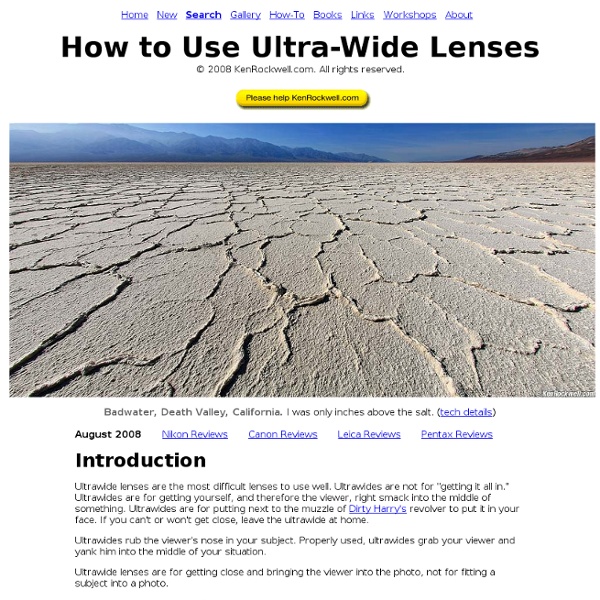
Camera Angles: 5 ways to add impact with unusual perspectives Sometimes you can dramatically alter your photo composition just changing your perspective. This quick guide to using camera angles more effectively will help you take pictures you can be proud of. Below we’ll show you 5 simple techniques you can use to alter your camera angles for dramatic effect. The search for a new angle in photography is a never-ending challenge. Showing everyone how we see the world around us from our own perspective is often the driving force for photographers. Unusual and quirky angles are the mainstay of images with impact. Ideas For New Camera Angles: Shoot straight up You’ve probably seen plenty of shots like this before. It offers a ‘worm’s eye view’ of the world and works extremely well with wide-angle lenses. If you find a reasonably symmetrical pattern, such as here, then keep it central.
Finding Fresh Angles to Shoot From - Digital Photography Composition Tip A Post By: Darren Rowse One of the most effective ways to make your digital images more interesting to the eye is to change the angle that you’re shooting from. Let me use an illustration of a couple of pictures I took of a big pineapple (don’t ask – it’s an Australian thing). In my opinion the first picture is more interesting than the second. While the second one might be good for putting the big pineapple in context of it’s surroundings and giving an accurate picture of ‘how big’ it is – I’m much more likely to get a ‘wow’ factor using the first one (although it’s by no means a brilliant shot for other reasons). There are a number of differences between these pictures in terms of composition. The second shot is taken by me standing some distance from the pineapple as I approached it. Not only does changing the angle that you shoot from impact the feeling of size of your subject but it can have a real effect upon the light and shade and patterns on it. Ideas for New Angles
Family of Angles For today's post we will cover a topic that isn't discussed a lot, but is fundamental to lighting. The term “family of angles” doesn't come up often, if at all in most circles. Is it useful for you? Read on to find out... Terms Defined Before going any farther, I want to define some of the terms that are related to this discussion, just to ensure everyone gets this bit of background. Direct Reflection Reflections that mirror the light source, as one typically gets from a hard, smooth surface, such as glass, plexiglass, metal, plastic, etc., materials that are shiny. Diffuse Reflection Reflection that gets diffused, that is, scattered all directions rather than simply mirroring the source. Angle of View Abbreviated as AOV. Field of View Abbreviated as FOV. The Basic Premise The term “family of angles” refers to the angles from which if light is sourced, a reflective surface will direct light back into the lens creating visible light spots. What's The Point?
5 More Elements of Composition in Photography A Post By: Darren Rowse Yesterday I shared 5 ingredients of composition that I consider when setting up a shot. Today I’d like to talk about 5 more. Framing Image by foreversouls Most of us use ‘frames’ to display our images when we hang them on walls for viewing – however ‘framing’ can be used within the composition of a shot to help you highlight your main point of interest in the image and and/or to put it in context to give the image ‘depth’. Learn how to use framing as an element of composition. Perspective Image by Image by fensterbme The perspective that a shot is taken from is another element that can have a big impact upon an image. Shooting from up high and looking down on a subject or shooting from below looking up on the same subject drastically impact not only the ‘look’ of the image, emphasizing different points of interest, angles, textures, shapes etc – but it also impacts the ‘story’ of an image. Read more on photographing people from different angles. Space Image by .robbie Color