

untitled The international financial crisis of 2008-09 led to the first downturn in global output since 1946 and presented the world with a major new challenge: determining what mix of fiscal and monetary policies to follow to restore growth and jobs, while keeping inflation and debt under control. Financial stabilization and stimulus programs that started in 2009-11, combined with lower tax revenues in 2009-10, required most countries to run large budget deficits. Treasuries issued new public debt - totaling $7.6 trillion since 2008 - to pay for the additional expenditures. To keep interest rates low, most central banks monetized that debt, injecting large sums of money into their economies - between December 2008 and December 2012 the global money supply increased by more than 31%. Fiscal and monetary data for 2012 are currently available for 180 countries, which together account for 98.5% of World GDP. (For more information, see attached spreadsheet, Fiscal and Monetary Data, 2008-2012.)
Espagne principaux Indicateurs économiques (e) : Estimation (p) : Prévision Avantage comparatif élevé dans le domaine des énergies renouvelables (éolienne, solaire) Importantes réformes (marché du travail, secteur bancaire, droit de la faillite, etc.) Augmentation du soutien financier par les institutions européennes Important désendettement du secteur privé avant la pandémie Secteur manufacturier ayant récemment fait preuve d’une capacité de réinvention Niveau élevé de l’endettement privé et public, position très négative des investissements internationaux Dualité du marché du travail, chômage structurel élevé Nombre important de petites entreprises à faible productivité Forte exposition aux secteurs sensibles à la pandémie Paysage politique fragmenté et polarisé, unité territoriale menacée par le mouvement indépendantiste catalan Appréciation du risque Rattrapage rapide mais seulement partiel en 2021, en raison d’un tourisme moribond Retour en force du PP, principal parti d’opposition Paiement
El Mapa Topográfico Nacional - Mapa Topográfico Nacional - Antecedentes - Cartografía - Instituto Geográfico Nacional - Áreas de actividad La obra fundamental de la cartografía del IGN es el Mapa Topográfico Nacional, formado a escala 1:25.000 y publicado a escala 1:50.000, cuyos trabajos se iniciaron en 1857 con la medición de la base geodésica de Madridejos realizada y dirigida por el General Carlos Ibáñez de Ibero. La publicación del mapa se inició en 1875 con la impresión de las hojas de Madrid (559) y Colmenar Viejo (534), y se finalizó en 1968 con la impresión de la hoja de San Nicolás de Tolentino (1125). Inicialmente, se señaló como elipsoide de referencia el llamado de Struve, con origen en el Observatorio Astronómico de Madrid. La proyección elegida para el levantamiento del Mapa fue la proyección poliédrica, sobre planos tangentes al elipsoide de Struve, con un formato de 10' de latitud por 20' de longitud. Hoja 559: Madrid. Primera hoja del mapa topográfico a escala 1:50.000 editada por el Instituto Geográfico y Estadístico en 1875 Hoja 1125: San Nicolás de Tolentino.
Wikipédia, l'encyclopédie libre List of Countries by Land Mass [Ranked by Area] [Stats were last updated 07-Dec-2008] Sort by: Country | Area | Population City-specific population statisticsWorld's Largest CitiesWorld's Largest Urban AreasCountry Population Projections Sources Other reference Informationmongabay.comTropical rainforest informationTropical freshwater fish informationImages / Photos CCI.fr : portail des Chambres de commerce et d'industrie MAPA DEL MUNDO MAPA MUNDI PARA IMPRIMIR Mapa mundi para colorearMapa mundi en blanco Arte – Historia recopila recursos de arte e historia como MAPA DEL MUNDO MAPA MUNDI PARA IMPRIMIR para completar la consulta, formación y/o información al respecto. Puede encontrar más recursos relacionados con MAPA DEL MUNDO MAPA MUNDI PARA IMPRIMIR ya sea en video o imágenes que podrá ampliar haciendo click sobre ellas. La relación de artículos relacionados con MAPA DEL MUNDO MAPA MUNDI PARA IMPRIMIR es la siguiente:. Tags: MAPA, MAPA DEL MUNDO, MAPA MUNDI, MAPA MUNDI PARA IMPRIMIR
Chiffres clés de l'Espagne Capitale : Madrid Population Population totale : 46.404.602 Accroissement naturel : -0,5% Densité : 93 habitants/km² Population urbaine : 79,4% Population des principales métropoles :Madrid (6.779.528) ; Barcelone (3.759.240) ; Valence (1.618.070) ; Séville (1.459.567) ; Bilbao (1.005.286) ; Malaga (864.931) ; Saragosse (851.342) ; Las Palmas (670.925) Origines ethniques : Espagnols : 90%. Langue officielle : Castillan (espagnol) Autres langues parlées : Certaines régions autonomes font un usage courant de leur langue régionale y compris dans les affaires (euskera, catalan, galicien, valencien). Langue(s) des affaires : Espagnol.L'anglais est rare mais en développement. Religion : Catholiques 77% (50% pratiquants) ; Musulmans, Protestants, etc. : 3% ; non croyants : 19%. Heure locale : Il est 04:37 à Madrid Taux de change au 05/02/2016 : Monnaie locale : Euro (EUR) 1 EUR = 1,1194 USD, 1 USD = 0,8934 EUR Profil du pays Superficie : 505.940 km² Nature de l'Etat : Royaume. IDH (rang mondial) : 26/188
Eurostat Home Home Welcome to Eurostat The home of high-quality statistics and data on Europe Learn more about us EU key indicators Skip the carousel Explore data & tools Database Statistical themes Interactive publications Data visualisations Latest news View all Asset Publisher © GH Studio/Shutterstock.com European Statistical Monitor: February edition 19 February 2026 © SemyonSalivanchuk/stock.adobe.com What is the EU’s greenhouse gas footprint per capita? © iurii/Shutterstock.com Production in construction up by 0.9% in the euro area © Stokkete/Shutterstock.com 56% of youth in jobs matching their field of education 18 February 2026 © Avigator Fortuner/Shutterstock.com EU trade in goods: €28.4 billion surplus in Q4 2025 © Vanja Stokic/Shutterstock.com Asylum applications in November 2025 17 February 2026 © JacobLund Business registrations and bankruptcies up in Q4 2025 16 February 2026 © nikkytok/stock.adobe.com Industrial production down by 1.4% in the euro area Quick access Release calendar Statistics Explained Podcasts In focus
lsa-conso En Espagne, l’alimentation est avant tout un plaisir ! Le pays affiche un taux élevé de prises alimentaires : 4,3, dont 2,8 pendant les repas et 1,5 hors repas. Pour la majorité des Espagnols, bien manger signifie avant tout manger équilibré, varié et sain. Le rapport entre alimentation et santé est important. Alimentation en Espagne : portrait type du consommateur espagnol Source : TNS Sofrès Data and Statistics World Economic Outlook Databases (WEO) Updated Download time series data for GDP growth, inflation, unemployment, payments balances, exports, imports, external debt, capital flows, commodity prices. More International Financial Statistics (IFS) More IMF Statistics Data Provides comprehensive access to IFS, BOPS, DOTS, GFS and free access to a range of additional IMF datasets. Data Portal Principal Global Indicators (PGI) A website that brings together data for the major economies available from international agencies covering the financial, governmental, external, and real sectors, and provides links to data in web sites of international and national agencies. More Global Housing Watch A website that tracks developments in housing markets around the world. More Balance of Payments Statistics (BOPS) More Coordinated Direct Investment Survey (CDIS) Updated The CDIS collects data and metadata on inward and outward direct investment positions cross-classified by counterpart economy. More More More More
Pourquoi les compléments alimentaires ? Parce qu'il n'est jamais trop tard pour prendre soin de soi, de nombreux compléments alimentaires nous permettent aujourd'hui d'allier à la fois vie active et santé. Bien que seule une alimentation variée et équilibrée associée à un mode de vie sain restent les clés d'un bon état de santé, les compléments alimentaires peuvent nous aider à combler certains manques en vitamines, oméga, probiotiques, minéraux ou autres substances. Soumis à des contrôles ainsi qu'à une réglementation stricte, ils complèteront parfaitement une alimentation habituelle et ce, sans risque pour le consommateur. En effet, les doses de nutriments contenus dans les compléments alimentaires sont largement inférieures aux premières doses toxiques observables. Définition et règlementation des compléments alimentaires La notion de complément alimentaire est récente. Pourquoi consommer des compléments alimentaires ? La nutrition des Français Qui consomment des compléments alimentaires en France? Il en ressort que :
Inkjet Versus Laser Printers Updated 5/10/2011 Small Business Computing Compares Inkjet Versus Laser Printers Back in 2005, we compared color ink jet printers with laser printers and came out overwhelmingly in favor of laser printers for small businesses. When you do the math, low-cost color inkjet printers typically don't fare well. "What the manufacturers of these printers don't fully explain to consumers is the true cost of ownership of a low-cost color printer," says Jeremy Shulman, vice president of operations at ReInk Technology, a reseller of remanufactured ink cartridges under the Vibrantink, Cartridge Technologies and A2Zink.com brand names. While the printers are almost given away, the refills bring in a fortune for the large printer original-equipment manufacturers (OEM). The worldwide laser printer and multifunction printer (MFP -- copying, printing, faxing and scanning) shipments are about 23 million units a year at a cost of $40 billion. And it isn't just cost that conspires against ink jets.
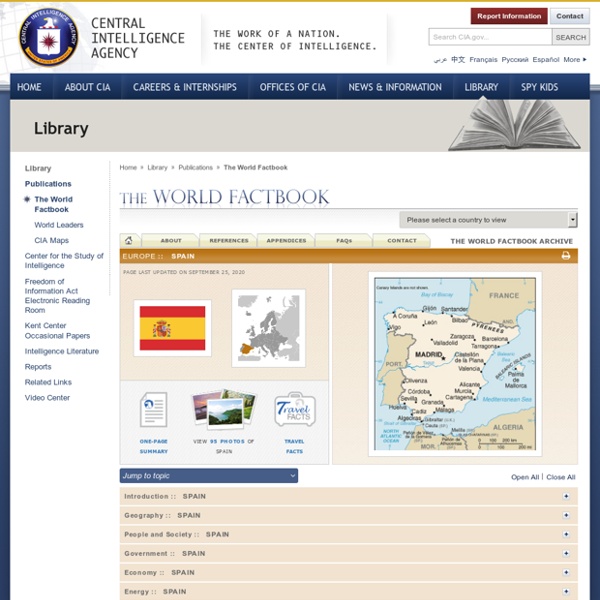
Etude pays gratuite Espagne A / L’accessibilité du marché 1) Facteurs physiques et géographiques • Géographie - Emplacement géographique : L’Espagne se situe au sud-ouest de l’Europe, encadrée par le golfe de Gascogne, l’océan Atlantique Nord, la mer Méditerranée, et la chaîne de montagne des Pyrénées (sud-ouest de la France). - Superficie : 505 990 km². - Capitale : Madrid - Climat : tempéré ; étés clairs et chauds dans l’intérieur, plus modéré et nuageux vers la côte ; hivers nuageux et froids dans l’intérieur, partiellement nuageux et frais vers la côte. - Ressources naturelles : charbon, lignite, minerai de fer, cuivre, fil, zinc, uranium, tungstène, mercure, pyrites, magnésite, fluorine, gypse, sépiolite, kaolin, potasse, hydro-électricité, terres arables. • Transport - Aéroports : 157 - Routes et Autoroutes : 666 292 kilomètres - Chemins de fer : 14 873 kilomètres - Pipelines : gaz 7.962 kilomètres ; huile 622 kilomètres ; produits de raffinage 3.447 kilomètres (cf. annexe 22) 2) Facteurs économiques (cf. annexe 12)