

9 Places to Find Creative Commons & Public Domain Images When students create multimedia projects they might be tempted to simply do a Google Images search and use the first images they see. But as educators we have a responsibility to teach students to respect copyright holders' rights. One of the ways that we can do that is to teach students to use Creative Commons and Public Domain images. Morgue File provides free photos with license to remix. Wylio is an image search engine designed to help bloggers and others quickly find, cite, and use Creative Commons licensed images. William Vann's EduPic Graphical Resource provides free photographs and drawings for teachers and students to use in their classrooms. The World Images Kiosk hosted by San Jose State Universityoffers more than 75,000 images that teachers and students can use in their academic projects. ImageBase is a personal project of professional photographer David Niblack. Photos 8 is a great place to find thousands of images that are in the public domain.
Better Lessons - Free Lesson Plans math english language arts Kindergarten Counting & Cardinality Operations & Algebraic Thinking Number & Operations in Base Ten Measurement and Data Geometry First Grade Operations & Algebraic Thinking Number & Operations in Base Ten Measurement and Data Geometry Second Grade Operations & Algebraic Thinking Number & Operations in Base Ten Measurement and Data Geometry Third Grade Operations & Algebraic Thinking Number & Operations in Base Ten Numbers & Operations-Fractions Measurement and Data Geometry Fourth Grade Operations & Algebraic Thinking Number & Operations in Base Ten Number & Operations—Fractions Measurement and Data Geometry Fifth Grade Operations & Algebraic Thinking Number & Operations in Base Ten Number & Operations—Fractions Measurement & Data Geometry Sixth Grade Ratios & Proportional Relationships The Number System Expressions & Equations Geometry Statistics & Probability Seventh Grade Ratios & Proportional Relationships The Number System Expressions & Equations Geometry Statistics & Probability Eighth Grade Geometry
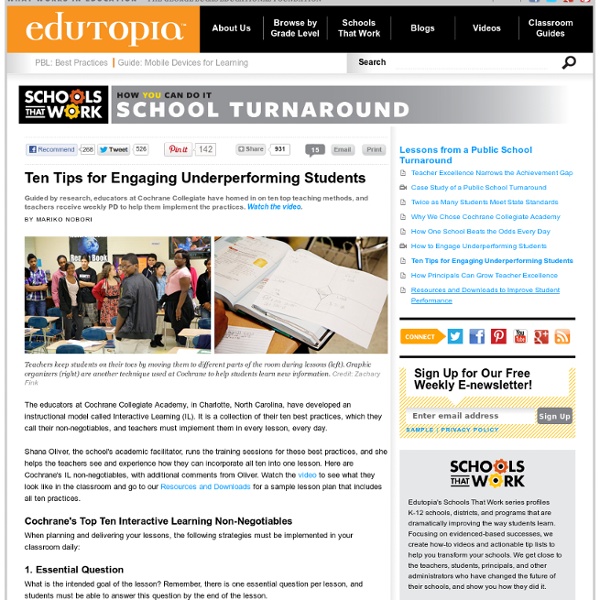
Teacher Excellence Narrows the Achievement Gap By embracing research-backed instructional design, consistent PD, and strong, caring relationships, all boats are rising and teachers have gone from surviving to thriving at this once-failing middle school. Once among the worst-performing middle schools in the state, Cochrane has been making great strides by narrowing its achievement gap and doubling student performance in the past three years. Credit: Zachary Fink The bell rings and most of the ninth-grade students in Ms. Once the song is over, the students settle into their seats, and Ms. Lessons from a Public School Turnaround Running Time: 05:15 min. This is one of the dynamic ways that students learn -- and retain -- lessons at Cochrane Collegiate Academy, a once failing middle school in Charlotte, North Carolina, that's now on the rise. The brisk, energetic start to class is an example of an activating strategy, one of several research-based methodologies used in every class by every teacher at Cochrane. Challenges of Poverty
Tips for Holding Student-Led Conferences What’s Here This page shares a simple format for improving the quality of parent-teacher conferences: hold student-led conferences! Learn how to involve your students in reflecting on their work and sharing their progress with their families. What are student-led conferences? They are parent-teacher conferences in which the child is not only present, but in charge of explaining his or her progress, reflecting on accomplishments, and setting short and long-term goals. Why should I do student-led conferences? Most importantly: because parents and students love doing them! When should I do student-led conferences? You should do what is best for you and your families. In the first conference of the year, the parent primarily provides background information on the child and the teacher clarifies expectations and progress thus far. What preparation do I need to do before the conferences? Because students take responsibility for these conferences, they require very little work for the teacher.
100+ Funny Photos Taken At Unusual Angle [Humor] They say a picture is worth a thousand words, but sometimes this ain’t exactly right. Distance overlapping, positions, and timing can sometimes create a brand new perspective of a photo. This weekend, we want to show you 100+ Funny Photos Taken At Unusual Angle, a compilation of photos taken at the exact right timing and angle, thus creating a humor side of the story; intentionally or unintentionally. (Image source: Matt Stuart) Full list after jump. Magazines, Books and Album Covers More album cover photos – I, II, III The Sunset When Angle Isn’t Exactly Right (Image source: Matt Stuart) Fan Art Creative Perspective More! References/Credits: Photos and images on this post are taken from the following sources: Recommendations If you have more time to kill, here are some articles you might be interested in. Author: Hongkiat Lim
Learning Focused | Home Modeling Positive Behavior in the Classroom By Sheila Kohl Found In: teaching strategies Teachers are role models for their students all day, every day, so I take my actions and behavior very seriously. Modeling positive behavior— and discussing it with my students— helps me create a positive environment where students feel safe and cared for and where they can develop behavioral skills they will use the rest of their lives. Here are three ways I do that. Show Respect I model respect to my students by listening to them and showing them that I care about things that are important to them. Think Out Loud To demonstrate how to think through a problem, I think out loud. Sometimes, I ask students to help me come up with a lesson idea. Show My Human Side To show students that their skills and interests, as well as academics, are valued, I ask them about different aspects of their lives. Related Link Powerful Role Models: Seven Ways to Make a Positive Impact on Children Written for parents but also applicable for teachers. About the Author
Clipart | Free Icons | IconBug.com Academies & Institutes | Evans Newton Incorporated Building Leaders in School Transformation Who should attend Expert teachers, teacher leaders, coaches, principal, instructional leadership teams in districts and schools Academies Evans Newton’s Academies are on-site learning sessions designed to build leaders who are both expert and experienced. You can participate in three academies per year, each covering different topics critical to education transformation. The first two Academies cover critical concepts and information that you’ll need to succeed in the deeper-dive virtual Institutes that follow. Institutes Building on the learning in the Academies, Evans Newton’s Institutes are virtual sessions that dive deeper into the subject matter delivered in the Academies. Academy I - Leading the Conversion to the CCSS and Transformation to 21st Century Instruction Critical to any school’s success now and in the future, this Academy provides attendees with a deep understanding of the CCSS State Standards. Institute Academy II –
10 Things You Can Do In (About) 10 Minutes For A Better Classroom When the school year begins, teachers spend a lot of time getting the classroom ready, planning lessons, and getting to know his/her students. The following list includes 20 ideas that you may not have thought of that can help produce a successful classroom. Each item takes no longer than an hour and can make a big difference throughout the year. 1. Traditional classrooms are normally arranged in a linear format with all the desks facing one direction. If your room allows it, arrange the desks in small groups with no obvious front. 2. To get the day off on the right foot, start with an inspirational quote or quiet meditation. 3. With a class size of 16 or more, chances are one or two students will be absent at least a couple times a week. When a student comes back, they go to the board and take the assignments they missed. 4. When the school year begins, take a few minutes out of your day to sit with your students and design the class rules. 5. 6. 7. 8. 9. 10.