Frank Frazetta Home
Gas
Fondation Marguerite et Aimé Maeght | Art Moderne et Contemporain
The Color That Wasn’t a Color
Lorenzo Lotto’s Portrait of a Young Man against a White Curtain, ca. 1508. Of all the colors artists have had at their command throughout the ages, none has endured more reversals of fortune than black. Indeed, in his book Black: The History of a Color, published by Princeton University Press, historian Michel Pastoureau points out that for a few centuries after Isaac Newton’s discovery of the spectrum, around 1665, “black and white were considered and experienced as ‘noncolors.’” Beginning with the earliest known cave paintings, Pastoureau charts the color’s passage through the realms of art, fashion, and society, noting that in ancient times black was associated with caverns and underground spaces, fearful places that nevertheless had their own sacred energy. In Egypt, black assured the safe passage of the deceased to the beyond and thus was the preferred color for divinities linked to death.
Soleil du matin
Musée des impressionnismes Giverny
Infographic: Mapping The 70-Year Gestation Of Street Art
In the annals of "Fine Art History," graffiti is usually placed squarely outside of the mainstream dialogue. Usually, it’s relegated to a foggy category sometimes called Urban Art--or worse, Urban Contemporary. “Those are not terms that came from the graffiti or street communities,” says writer and theorist Daniel Feral. “They may be a result of categories created by the auction houses. Click to enlarge. Feral is the creator of the eponymous Feral Diagram, a map that revises the role of graffiti and street art in the canon of modern art. What’s clever about the Feral Diagram is that it utilizes the visual language of another very famous diagram, created by the first director of MoMA, Alfred H. MoMA director Alfred H. You can buy a poster of the diagram here.
Hotelroom
100 Ideas That Changed Art
by Maria Popova From cave paintings to the internet, or how art and cultural ideology shape one another. On the heels of yesterday’s 100 Ideas That Changed Photography comes 100 Ideas That Changed Art (public library) — a succinct account of the most influential developments in the history of art, from cave paintings to the internet, compiled by art historian and broadcaster Michael Bird. From conceptual innovations like negative space (#98), color codes (#33), and street art (#94) to landmarks of communication like making books (#21), propaganda (#12), and handwriting (#24) to ideological developments like “less is more” (#30), protest (#79), and the body as surface (#9), each idea is contextualized in a 500-word essay with key visual examples. Bird writes in the introduction: What does it mean to ‘change art’? Polykleitos was credited with 'the idea that statues should stand firmly on one leg only.' Images and captions courtesy of Laurence King Donating = Loving Share on Tumblr
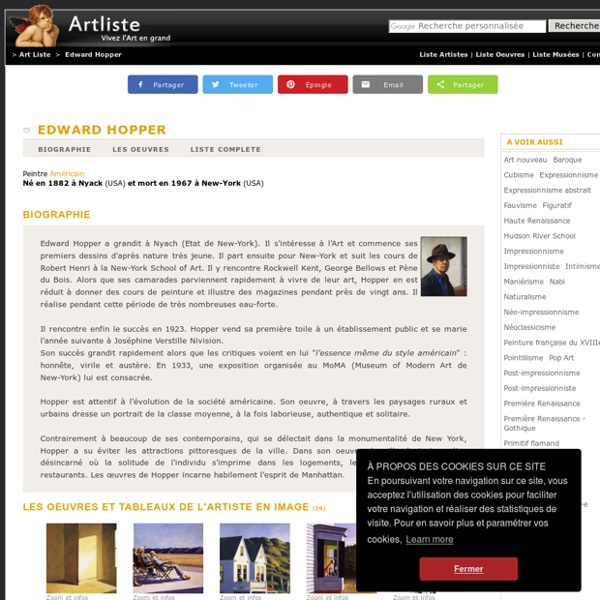
Edward Hopper
Exposition présentée au Grand Palais du 10 octobre 2012 au 28 janvier 2013 Les peintures d’Edward Hopper ont la simplicité trompeuse des mythes, l’évidence des images d’Epinal. Chacune d’elles est un condensé des savoirs hypothétiques, des rêves que nous inspire l’Amérique. Expression des sentiments les plus poignants, ou pures constructions mentales, ces peintures donnent lieu aux interprétations les plus contradictoires. Romantique, réaliste, symboliste, et même formaliste, Hopper a été enrôlé tour à tour sous toutes les bannières. Conçue chronologiquement, elle se compose de deux grandes parties : la première, consacrée aux années de formation, rapproche les œuvres de Hopper de celles de ses contemporains et de celles, découvertes à Paris, qui ont pu l’inspirer. Retrouvez tout l'univers de Edward Hopper sur votre tablette numérique en téléchargeant sur l'Appstore l'application pour iPad ou sur Google play, l'application pour Android.
Musée virtuel - Reproduction de tableaux - Copies de peintures à l'huile peinte à la main
On dit médiéval, pas moyenâgeux ! | Histoire(s) de l'art du Moyen Age