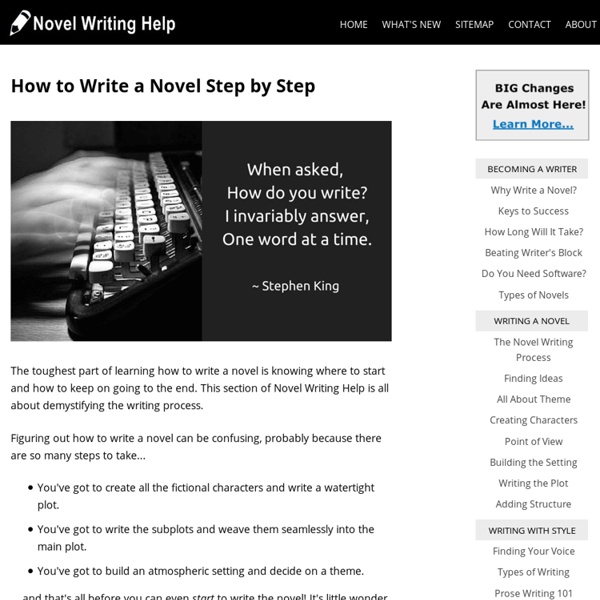
How To Write A Novel Using The Snowflake Method
Writing a novel is easy. Writing a good novel is hard. That’s just life. If it were easy, we’d all be writing best-selling, prize-winning fiction. Frankly, there are a thousand different people out there who can tell you how to write a novel. There are a thousand different methods. In this article, I’d like to share with you what works for me. This page is the most popular one on my web site, and gets over a thousand page views per day, so you can guess that a lot of people find it useful. Good fiction doesn’t just happen, it is designed. For a number of years, I was a software architect designing large software projects. I claim that that’s how you design a novel — you start small, then build stuff up until it looks like a story. If you’re like most people, you spend a long time thinking about your novel before you ever start writing. But before you start writing, you need to get organized. Step 1) Take an hour and write a one-sentence summary of your novel. Shorter is better.
How to self-publish an ebook | Fully Equipped
A while back I wrote a column titled "Self-publishing: 25 things you need to know," which was mostly about how to create and sell your own paper book. After folks asked me to do something similar for e-books, I created this article, which has now been updated a few times. I begin with one caveat: The whole e-book market is rapidly evolving, and a lot of self-publishing companies are offering e-book deals bundled into their print book publishing packages, which makes them harder to break out and evaluate. Tips: It's gotta be good: The same rule applies to self-published e-books as it does to print books. E-book publishing options: Here are the three big questions to bear in mind with e-book creation: first, what is the easiest and most cost-efficient way to produce an e-book? If you don't want to go the total DIY route, you can pay someone a few hundred dollars (or less) to format your e-book for you, but you'll still need to come up with a cover. "Smashwords is great," she said. Booktango
How to Publish Your Own Amazon Kindle Ebook
Would you like to be the next Dan Brown or J.K. Rowling? Perhaps your aspirations are less lofty, but you still have a story--or expert information--to share with the masses. I'm no stranger to publishing, having written or cowritten a dozen books. For a small or medium-size business, self-publishing has a variety of potential benefits. You have assorted options, including Amazon's CreateSpace and Kindle Direct Publishing; Barnes & Noble's PubIt; Lulu; and SelfPublishing.com. If writing an entire book seems daunting, you might prefer to take an existing blog of yours and publish it via Amazon so that everyone with a Kindle can download and read your posted material. What You Need to Publish an Ebook For starters, you need content: Self-published books don't type themselves. Most ebook publishing services are at least capable of working with Microsoft Word files, PDFs, and the open-source ePub format. When the book is done, remember that with self-publishing comes self-promotion.
Tips for Editing Your NaNoWriMo Novel
I have been writing fiction for 30+ years and regularly critique the work of others. The best general advice I can offer is to learn why the rules are important and when to break them. No writing 'rule' will make you a good writer. For example: One of the most abused rules of writing is to eliminate the passive voice, often by searching and eliminating forms of 'to be' (is, am, are, was, were). The problem with simply eliminating the passive voice is I can offer a dozen good examples of reasons when the passive voice is not only acceptable, but preferred. 1) When the the character or actor is unknown or hidden. 2) When you want to highlight the action over the actor. 3) When the character is depressed, equivocal, or unable to decide. 4) To distinguish a lull in action or to precede/follow action to make the action seem more vibrant. 5) In some contemplative, self-reflective character examination situations
Practical Tips on Writing a Book from 23 Brilliant Authors | NeuroTribes
Hello there! If you enjoy the content on Neurotribes, consider subscribing for future posts via email or RSS feed. Steve Silberman reading at the Booksmith in SF. Photo by Heather Champ. I love books. My late father Donald, who taught Wordsworth and Melville to inner-city kids for decades, used to read Ulysses to me while he carried me on his shoulders. The subject of my book is autism, the variety of human cognitive styles, and the rise of the neurodiversity movement. The science of developmental disorders has made significant advances in recent years, and some of the social issues that I raised in the piece — such as the contributions that people with atypical cognitive styles have made to the progress of science, technology, and culture — seem more relevant than ever. I’ve signed a contract with a wonderful publisher — a Penguin imprint called Avery Books — and a sharp and enthusiastic editor named Rachel Holtzman. I’m not sentimental about old media vs. new media. Carl Zimmer
10 Writing Rules You Can't Break...And How to Break Them
A guest post by Eric Cummings of On Violence First, there was the “old school.” A bunch of stubborn grammarians got together and decided what defined “proper English.” Then came the “new school” in the sixties. Well, as part of the millennial generation, I’ve got some criticisms for the “new school”, “the old school” and other pieces of advice that I think hold writers back. 1. This advice is considered gospel for a reason: nothing is worse than confused, labyrinthine prose. At the same time, clear writing is different than simple writing. Also, feel free to write long sentences and paragraphs. 2. I see this advice all the time: write with confidence. This advice is intended to prevent writers from using wishy-washy verbs, adjectives or qualifiers. 3. This has become the new school mantra. That said, let big words come naturally. 4. Even amateur writers know not to use passive constructions like, “Jim was stung by a bee.” So one, learn what the passive voice is. 5. 6. 7. 8. 9. 10.