EIS Business Simulation / Organizational Change / Change Management / Elearning Multimedia / Strategy Game / Behavioral Resistance /Experiential Learning / Learning By Doing / change dynamics /Simulations Game
Changements organisationnels impliquant une évolution structurelle : les symptômes et raisons de l'échec
Dans un environnement instable, les changements organisationnels deviennent une des clés de réponse permettant réactivité et adaptation aux contraintes externes. Ces changements sont parfois synonymes d’évolution structurelle, des entreprises se réorganisent en structure matricielle ou en Business Unit (BU) dans la majeure partie des cas. Ces réorganisations se soldent cependant souvent par un échec (Combes, Lethielleux, 2008). Un des derniers exemples est « la fusion Alcatel-Lucent avec 12 500 suppressions d’emplois dans le monde,dont 1 400 en France et une action dont le cours a chuté de 35% en 10 mois ». Comment expliquer l’échec ? Quels sont les symptômes, qui laissent deviner un échec imminent du changement organisationnel ? I. Dans un premier temps, il convient de définir la notion d’échec en management. Emergence du syndrome du survivant Baisse du capital social Le capital humain et le capital social sont les piliers d’une gestion stratégique des ressources humaines. II. III.
Changement
Un article de Wikipédia, l'encyclopédie libre. Le changement désigne le passage d'un état à un autre. L'on parlera, selon la nature, la durée et l'intensité de ce passage, d'évolution, de révolution, de transformation, de métamorphose, de modification, de mutation (ie transformation profonde et durable)... Il s'exerce dans des domaines très divers et à des niveaux très divers. Il faut distinguer le changement endogène dû à des causes internes (par exemple; les révolutions politiques), et le changement exogène dû à des causes externes (par exemple, la révolution du téléphone mobile). Le changement suscite chez les humains les réactions les plus diverses, allant de l'espoir le plus fou (thème de l'Apocalypse) jusqu'à la crainte, voire la phobie[réf. souhaitée]. Les causes théoriques du changement par auteurs[modifier | modifier le code] Nous listerons ici uniquement les auteurs ayant une forte notoriété dont la notion de changement est au centre de leurs œuvres. Remarques:
Learning Ways : The Change Pro Simulation
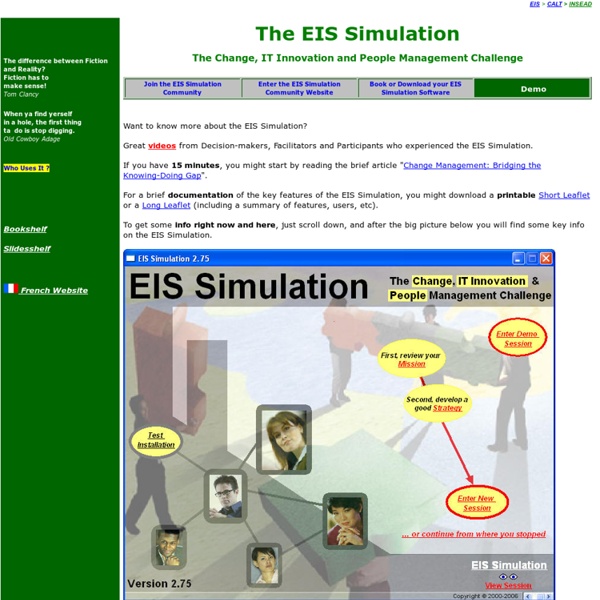
The Change Pro Simulation® is an engaging and realistic computer-based learning tool, available in multiple languages. It is designed to help managers (or Participants) increase their ability to implement change, providing them with a difficult challenge... Sent by Group Head Office into a successful division, the Participants task is to support the implementation of the Group's latest corporate initiative in 120 days or less. They must convince as many of the 24 top managers as possible to "adopt" this initiative and agree to support its implementation within the division. The mission is particularly challenging as the Participants have essentially no hierarchical power over the division's top management team and will have to rely on their soft skills and the 25 tactics provided to succeed. This virtual organization builds on realistic profiles and typically available tactics to provide participants with a credible test environment to explore new change strategies.
Related:
Related:


EIS Business Simulation / Organizational Change / Change Management / Elearning Multimedia / Strategy Game / Behavioral Resistance /Experiential Learning / Learning By Doing / change dynamics /Simulation Game by mindshare2000 Feb 5