

The Problem with Lecturing Back in the late 1970s a colleague came to David Hestenes with a problem. The two of them were physics professors at Arizona State University. Hestenes was teaching mostly graduate students, but his colleague was teaching introductory physics, and the students in his classes were not doing well. Semester after semester, the class average on his exams never got above about 40 percent. "And I noted that the reason for that was that his examination questions were mostly qualitative, requiring understanding of the concepts," says Hestenes. Most professors didn't test for this kind of understanding; students just had to solve problems to pass the exams. This observation prompted a series of conversations between Hestenes and his colleague about the difference between being able to solve problems and really understanding the concepts behind those problems. Testing Understanding They developed a multiple-choice test, now known as the Force Concept Inventory, or FCI. Taking It to Heart
Spaced repetition When should one review? In the morning? In the evening? Any old time? So one reviews at whatever time is convenient. If one is not satisfied with that answer, then on general considerations, one ought to review before bedtime & sleep. Recent advances in our understanding of the neurobiology underlying normal human memory formation have revealed that learning is not an event, but rather a process that unfolds over time.16,17,18,[Squire2003 Fundamental Neuroscience],20 Thus, it is not surprising that learning strategies that repeat materials over time enhance their retention.20,21,22,23,24,25,26 …Thousands of new cells are generated in this region every day, although many of these cells die within weeks of their creation.31 The survival of dentate gyrus neurons has been shown to be enhanced in animals when they are placed into learning situations.16-20 Animals that learn well retain more dentate gyrus neurons than do animals that do not learn well. Prospects: Extended Flashcards
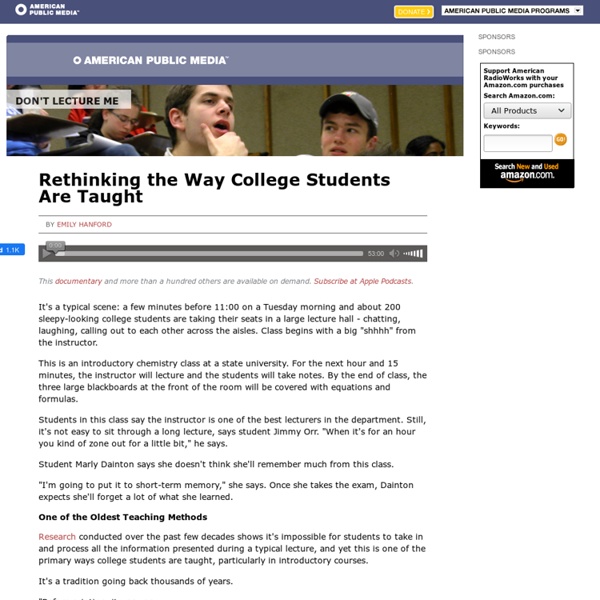
Don't Lecture Me | American RadioWorks by Emily Hanford College students spend a lot of time listening to lectures. But research shows there are better ways to learn. And experts say students need to learn better because the 21st century economy demands more well-educated workers. Lecturing was invented as a way to share information in a time before books were widely available. Now, there are better approaches. The traditional college lecture has never been a good way to learn. In the past 30 years, scientists have discovered a lot about how people learn. The Tomorrow's College series is funded by a grant from Lumina Foundation, which is committed to enrolling and graduating more students from college, and by a grant from the Spencer Foundation, which is dedicated to the belief that research is necessary to the improvement of education.
The nine secrets of learning This article originally appeared in Psychology (11th ed.) (2014). Reprinted with permission. Wade, C., Tavris, C., & Garry, M. (2014). The Nine Secrets of Learning. Psychology (11th ed.). Upper Saddle River, N.J.: Pearson Education, Inc. How do you study? Psychological research has uncovered many secrets to learning. Okay, that’s two sentences, but these secrets are so important, we snuck in an extra one. What to do before class Your instructor has assigned you certain readings from your textbook and possibly other sources as well. Secret #1: Use the 3R technique: Read. Let’s say you’re supposed to read a chapter by your next class. Read a section of the chapter. In one study comparing the effectiveness of various study techniques, students in three groups read long, technical encyclopedia entries (McDaniel, Howard & Einstein, 2009). Secret #2: Dig deep. You can’t read your textbook the same way you check your Facebook page, at a quick, superficial level. Secret #3: Use your imagination.
The effects of school quality on long-term health Volume 30, Issue 6, December 2011, Pages 1320–1333 Special Issue: Economic Returns to Education Edited By Colm Harmon and Matt Dickson Abstract In this paper I estimate the relationship between school quality and mortality. Highlights ► I examine the relationship between school quality and mortality. ► School quality is measured by the pupil–teacher ratio, length of term, and teacher wage. ► I find that increasing school quality increases the health return to education. ► There is also a direct relationship between school quality and overall mortality rates. JEL classification Keywords Educational economics; Rate of return Copyright © 2011 Elsevier Ltd.
Excel Math Tools for Teachers | Excel Math K-6 Curriculum Excel Math Tools for Teachers New Projectable Lessons and Teacher Edition Pages Click on the links below to download revised Excel Math Lesson Pages (PDF files) Math Resources Click on the links below to view and download samples and related Excel Math documents: Excel Math Quick Start Guide 4 Easy Steps to Getting Started 1. The Teacher Edition includes Answers Keys, Lesson Plans to help guide your student to understand each concept, read-aloud problems, reproducible manipulatives, stretch excercises, and lots more! Order a Projectable Lessons CD by grade level for classroom use (optional). 2. The book covers are color coded by grade level: Kindergarten – Grey 1st Grade – Pink 2nd Grade – Blue 3rd Grade – Green 4th Grade – Tan 5th Grade – Yellow 6th Grade – Orange Look for the 4-digit page number at the bottom center of each Student Lesson Sheet. 3. More questions after watching the video? Also visit our Product Updates page to find any updates for your lessons. 4. More about Excel Math Each week
Flash spécial : Le rapport Fourgous pour faire entrer l'Ecole dans son siècle Remis le 15 février, le rapport Fourgous est à la fois un plaidoyer pour l'intégration des TICE dans l'enseignement et un programme de 70 mesures pour faire basculer l'Ecole dans l'ère numérique. "Le numérique représente une vraie chance pour l’école. Donnons-nous les moyens de réussir". Député des Yvelines, Jean-Michel Fourgous avait reçu fin août 2009 du premier ministre une mission " de réflexion et de propositions pour la promotion des TIC dans l'enseignement scolaire". La publication de son rapport est un événement majeur pour l'Ecole qu'il invite non seulement à s'équiper mais aussi à changer ses pratiques pédagogiques pour tirer le maximum de profit des TICE. Le retard français. Mais il y a pire encore : le système éducatif français est plus inégalitaire; il fabrique aussi davantage d'élèves manquant de confiance en soi et malheureux à l'Ecole. " L'école est aujourd’hui trop déconnectée de la société. L'efficacité des TICE. Des TICE pour changer l'Ecole. 70 mesures. Les 70 mesures
Marginalia Search Will Dropouts Save America? Michael Ellsberg is the author of “The Education of Millionaires: It’s Not What You Think and It’s Not Too Late.” I TYPED these words on a computer designed by Apple, co-founded by the college dropout Steve Jobs. The program I used to write it was created by Microsoft, started by the college dropouts Bill Gates and Paul Allen. And as soon as it is published, I will share it with my friends via Twitter, co-founded by the college dropouts Jack Dorsey and Evan Williams and Biz Stone, and Facebook — invented, among others, by the college dropouts Mark Zuckerberg and Dustin Moskovitz, and nurtured by the degreeless Sean Parker. American academia is good at producing writers, literary critics and historians. In a recent speech promoting a jobs bill, President Obama told Congress, “Everyone here knows that small businesses are where most new jobs begin.” Close, but not quite. No business in America — and therefore no job creation — happens without someone buying something.
10 Quick Time-Saving Excel Shortcuts & Mouse Tricks for Marketers Please note, there is a new version of this article, with more up-to-date information: 13 quick time-saving Excel tips and shortcuts. The one thing marketers agree on is there isn’t enough time in the day to accomplish everything. Often the best way to find more time is to save time. Improving your Excel skills is a great place to begin to claw back a few minutes on every project, because Excel is a tool used by most of us on a regular basis. Excel Tip No. 1: Automatically SUM() with ALT + = Quickly add an entire column or row by clicking in the first empty cell in the column. Excel Tip No. 2: Logic for Number Formatting Keyboard Shortcuts At times keyboard shortcuts seem random, but there is logic behind them. Both the SHIFT and 4 keys seem random, but they’re intentionally used because SHIFT + 4 is the dollar sign ($). Excel Tip No. 3: Display Formulas with CTRL + ` When you’re troubleshooting misbehaving numbers first look at the formulas. Create the formula you need in the first cell.
Insights From the 21st Century Talent Sessions Ashoka Classic Books - Read.gov Turn the pages to explore bygone eras, time-honored tales and historical narratives. Adventure awaits in these classic books online. "A Apple Pie" Introduces the letters A to Z while following the fortunes of an apple pie.