

Wikipedia CI Competitive intelligence essentially means understanding and learning what's happening in the world outside your business so you can be as competitive as possible. It means learning as much as possible—as soon as possible—about your industry in general, your competitors, or even your county's particular zoning rules. In short, it empowers you to anticipate and face challenges head on.[1] Key points of this definition: Competitive intelligence is an ethical and legal business practice, as opposed to industrial espionage, which is illegal. A more focused definition of CI regards it as the organizational function responsible for the early identification of risks and opportunities in the market before they become obvious. Historic development[edit] Accepting the importance of competitive intelligence, major multinational corporations, such as ExxonMobil, Procter & Gamble, and Johnson and Johnson, have created formal CI units. Product – what are people selling? Recent trends[edit] Ethics[edit]
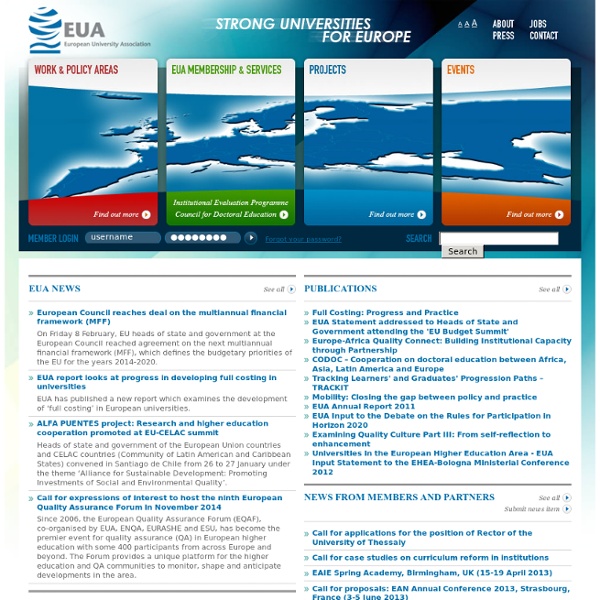
European University Association EUA is the result of a merger between the Association of European Universities (CRE) and the Confederation of European Union Rectors' Conferences. The merger took place in Salamanca on 31 March 2001. See also[edit] External links[edit] Official website EQAR, European Quality Assurance Register for Higher Education Business Model Fab EMUA Homepage | East Midlands Universities Association | EMUA
IGLO - Informal Group of RTD Liaison Offices What Is Competitive Intelligence? Established in 1996, Cipher Systems is a strategic and competitive intelligence consulting firm that supports decision makers across industries and around the world. Cipher specializes in hard-to-answer custom strategic research questions, and can deliver the information you need to make better business decisions. Our analysts specialize in difficult-to-collect primary research and in-depth secondary support and analysis. Supported by our own technology team, we create customized solutions that provide a blend of technology and research expertise to ably address your most difficult intelligence needs. Cipher is based outside of Washington, DC in Annapolis, MD, with offices in San Diego, CA, Sao Paulo, Brazil and Zug, Switzerland. Competitive Intelligence Consulting and Custom Strategic Research. Competitive Intelligence Software. Begin a Conversation with Cipher
The Association of Commonwealth Universities L'agence Europe-Education-Formation France L'agence Europe-Education-Formation France est mandatée par la Commission européenne depuis 1995 pour assurer la promotion et la gestion de plusieurs programmes et dispositifs communautaires. Ces programmes ont tous pour objectif de permettre au citoyen d'acquérir de nouvelles compétences utiles pour un métier, dans les domaines de l'éducation et de la formation professionnelle. Groupement d'intérêt public (GIP) placé sous la tutelle de trois ministères : Enseignement supérieur et Recherche, Education nationale,Travail, Emploi, Formation professionnelle et Dialogue social, l'agence est située à Bordeaux et emploie 87 personnes. C'est la seule agence nationale en France chargée du programme européen Erasmus + pour les volets éducation et formation. L'agence est membre de l'Academic Cooperation Association (ACA). Rôle de l'Agence nationale Un rôle de gestionnaire de projets L'agence attribue les financements européens dans le cadre du programme Erasmus +. Equipes de l'agence
Inteligencia colectiva La inteligencia colectiva es una forma de inteligencia que surge de la colaboración y concurso de muchos individuos o seres vivos de una misma especie. Hoy es un término generalizado de la cibercultura o la sociedad del conocimiento. Aparece en una amplia variedad de formas de toma de decisiones consensuada en bacterias, animales, seres humanos y computadoras. Pero el estudio de la inteligencia colectiva puede ser considerado más destacadamente dentro del subcampo de la Sociología, de las ciencias de la computación y del comportamiento de masas, un campo que estudia el comportamiento colectivo desde el nivel de quarks hasta el nivel de las bacterias, plantas, animales y sociedades humanas. George Pór definió el fenómeno de la inteligencia colectiva como "la capacidad de las comunidades humanas de evolucionar hacia un orden de una complejidad y armonía mayor, tanto por medio de mecanismos de innovación, como de diferenciación e integración, competencia y colaboración Historia[editar]