

Forensic Genomics Consortium Netherlands Khan Academy Ces biohackers qui "jouent aux Lego" avec l'ADN des bactéries- 15 novembre 2014 Jeudi 30 octobre : dans une immense salle d'exposition du centre des congrès Hynes de Boston (Massachusetts), 2.500 étudiants arborant des tee-shirts aux couleurs de leur université installent des affiches aux titres cinématographiques : "Green Demon", "Operation Debug", "The Transformer", "Sponge Patrol", "The Sexy Plant", "Super Dream Factory"... Sur ces posters, de petites bactéries ou algues unicellulaires hilares et conquérantes, représentées façon héroïnes de BD, côtoient toute une série de graphiques scientifiques. Mais ces jeunes, qui ont entre 20 et 25 ans, ne se sont pas contentés de "dessiner" ces micro-organismes. Ils les ont "fabriqués", en reprogrammant leur génome pour la mission de leur choix : guérir la maladie d'Alzheimer ou la malaria, détecter précocement la maladie du sommeil, cracher des biofiouls, sécréter de nouveaux parfums et cosmétiques, protéger nos plantes ou dépolluer eaux douces et océans... "Au début, les biologistes criaient au fou" Le FBI aux aguets
Touch Textiles | open09 turtle During their first semester BA Hons Textiles students at Uclan undertake a series of workshops designed to raise their sensory awareness. The first exercise relates to touch. This workshop involves each participant in an investigation of an unseen, mystery object, while blindfolded. Working in pairs, the non blindfolded, ’sighted’ partner observes, and writes down the descriptive narrative spoken by the ‘touching’ partner, who is asked to memorise the experience as much as possible. In some instances the blindfolded students instantly recognised the name of the object they were feeling and later were able to draw it as an integrated form. Several students thought they had an idea about what colour the object might have, or gave it a stereotypical ‘right way up’ in their drawing, or in one case, a drawing appeared to relate to the ‘fit’ of the object when it was held in her hand. Touch has been called ‘the mother of the senses’. For more about perception:
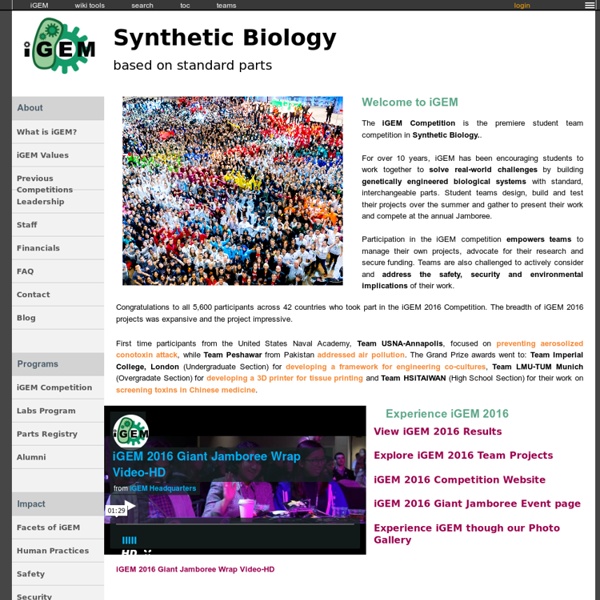
HiveBio Community Lab | a DIYbio hub in Seattle, WA da4ga Des français au MIT pour une compétition de biologie synthétique - Consulat Général de France à Los Angeles Les 5, 6 et 7 novembre dernier s’est déroulé au MIT de Boston l’iGEM (International Genetically Engineered Machine), une compétition mondiale de biologie synthétique. Il s’agit pour les étudiants de modifier une bactérie par l’insertion d’ADN afin de lui donner une nouvelle fonction. Les équipes françaises ont eu l’opportunité de présenter leurs projets devant les meilleures équipes mondiales et un jury d’experts en biologie de synthèse. Les résultats ont été dévoilés lundi 7 novembre lors de la cérémonie de remise des prix qui a clôturé l’événement et distingué quatre équipes finalistes : Imperial College London – MIT - University of Washington - ZJU China. Parmi elles, l’équipe américaine de Washington a été désignée comme “Grand Prize Winner“, suivie par l’équipe londonnienne (“1st Runner Up“) et l’équipe asiatique ZJU-China (“2nd Runner Up“). Dans la catégorie “Environnement”, c’est l’Université de Calgary qui a été primée. En savoir plus :
Flip teaching Flip teaching or a flipped classroom is a form of blended learning in which students learn new content online by watching video lectures, usually at home, and what used to be homework (assigned problems) is now done in class with teachers offering more personalized guidance and interaction with students, instead of lecturing. This is also known as backwards classroom, flipped classroom, reverse teaching, and the Thayer Method."[1][2][3] Traditional vs flipped teaching[edit] The traditional pattern of teaching has been to assign students to read textbooks and work on problem sets outside school, while listening to lectures and taking tests in class. "My AP Calculus class was a really anxious environment, it was weird trying to get through way too much material with not enough time. In flip teaching, the students first study the topic by themselves, typically using video lessons prepared by the teacher[5][6] or third parties. Flipped classrooms free class time for hands-on work. Math[edit]