background preloader

Cleopatra VII

Cleopatra VII
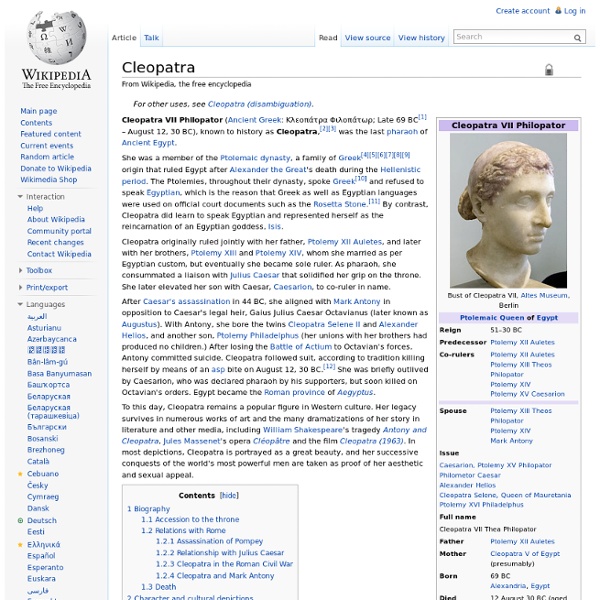
Cleopatra VII Philopator (Greek: Κλεοπάτρα Φιλοπάτωρ; Late 69 BC[1] – August 12, 30 BC), known to history as Cleopatra, was the last active pharaoh of Ancient Egypt, only shortly survived by her son, Caesarion as pharaoh. The name Cleopatra is derived from the Greek name Κλεοπατρα (Kleopatra) which meant "glory of the father" in the feminine form, derived from κλεος (kleos) "glory" combined with πατρος (patros) "of the father" (the masculine form would be Kleopatros Κλεοπατρος).[2][3] Cleopatra was a member of the Ptolemaic dynasty, a family of Greek [4] origin that ruled Egypt after Alexander the Great's death during the Hellenistic period. Cleopatra originally ruled jointly with her father, Ptolemy XII Auletes, and later with her brothers, Ptolemy XIII and Ptolemy XIV, whom she married as per Egyptian custom, but eventually she became sole ruler. Biography Accession to the throne In August 51 BC, relations between Cleopatra and Ptolemy completely broke down. Relations with Rome

La Mort de Cléopâtre Un article de Wikipédia, l'encyclopédie libre. La Mort de Cléopâtre est un sujet classique dans la peinture et dans une moindre mesure dans la sculpture. Il représente les derniers instants de Cléopâtre VII, reine d'Égypte. Tableaux[modifier | modifier le code] Sculptures[modifier | modifier le code] Bibliographie[modifier | modifier le code]

Related:
