

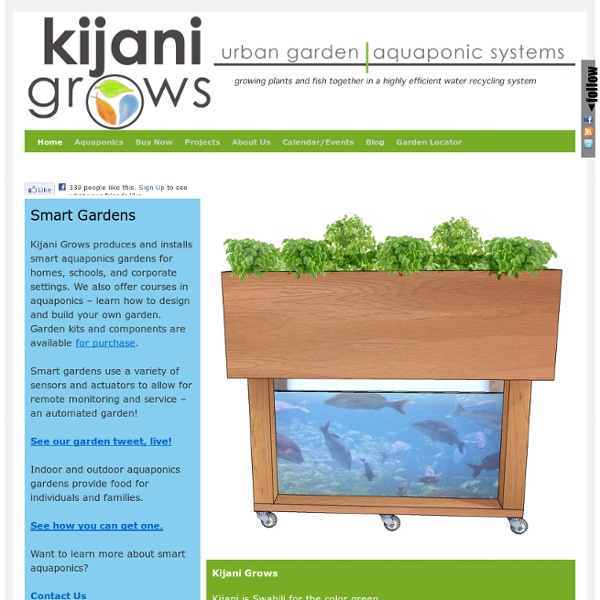
Internet of food: Arduino-based, urban aquaponics in Oakland The land in West Oakland where Eric Maundu is trying to farm is covered with freeways, roads, light rail and parking lots so there’s not much arable land and the soil is contaminated. So Maundu doesn’t use soil. Instead he’s growing plants using fish and circulating water. Farming fish and plants together It’s called aquaponics- a gardening system that combines hydroponics (water-based planting) and aquaculture (fish farming). Aquaponics has become popular in recent years among urban gardeners and DIY tinkerers, but Maundu- who is trained in industrial robotics- has taken the agricultural craft one step further and made his gardens smart. Smart aquaponics Maundu himself ran from agriculture in his native Kenya- where he saw it as a struggle for land, water and resources. “I feel knowledge of electronics and software programming makes me a better farmer than just having a hoe. Future of farming
About the BIOFAB | BIOFAB The BIOFAB: International Open Facility Advancing Biotechnology (BIOFAB) was founded in December 2009 as the world's first biological design-build facility. This professionally staffed public-benefit facility was initiated by a grant from the National Science Foundation (NSF) and is led by bioengineers from UC Berkeley and Stanford University. The BIOFAB is operated in partnership with Lawrence Berkeley National Laboratory (LBNL), the BioBricks Foundation (BBF), and the Synthetic Biology Engineering Research Center (SynBERC). BioFab projects will be designed to produce broadly useful collections of standard biological parts that can be made freely available to both academic and commercial users, while also enabling the rapid design and prototyping of genetic constructs needed to support specific needs of partner efforts such as SynBERC Testbeds.