

How Genderless Dressing is More Than a Trend Fashion Week is, of course, when designers present their new collections to the world and with that their interpretations of the trends for the coming seasons. Except this time things were different. The runways of recent have been distinctly more androgynous than we have seen before. This development is more than a trend; it is evolution. Clothing that is specifically male or female is a relatively new and largely Western-centric phenomenon. Although awareness and tolerance for non-gender conformity is on the rise, there is undeniably still a long way to go before the average consumer is ready for genderless clothing, which still remains largely relegated to the runway. However, the underlying desire of genderless fashion is not to completely merge the sexes into one homogeneous mass though, but rather to eradicate the boundaries that limit us in what we choose to wear. Fashion is a great insight into the mentality of a time and place. Related March 6, 2014 In "London Fashion Week"
Is the Future of Fashion Genderless? Men in womenswear and women in menswear is nothing new, but clothing has taken a turn toward a less gendered appearance of late. And it’s not just avant-garde designers—even Zara has a unisex collection called Ungendered. At the same time, however, the move toward genderless fashion has occurred as growth in menswear outpaced womenswear: a recent Fashionbi report revealed that menswear sales grew 1.9% in 2015, compared to 1.6% growth in womenswear. Coincidence? “From a business standpoint, a move toward genderless categorizations for clothing has been a boon for the menswear market, which already possesses a lot of other pieces with a cross-gender appeal, like a drop-shoulder crewneck sweatshirt, for example,” said Jian DeLeon, senior menswear editor at WGSN, moderating a panel discussion last week at the trend forecaster’s Futures Conference. “To what extent do you think [gender notions are] changing amongst generations and where do you think it will go?”
Why Women Are Walking the Men’s Runways This Season What’s the point of showing women’s clothes to men? I generalize, of course—not everyone in the audience at the men’s shows is male—but, look! Lots and lots of girls have been walking runways in London and Milan these past couple of weeks, in the round of collections that are (ostensibly) aimed at showing the chaps of the menswear industry what they might like to wear, come spring 2016. Regard! Miuccia Prada liberally studded her men’s collection with female models yesterday afternoon. I also spotted women insurgents on London runways: Nasir Mazhar’s total-black looks, Burberry girls in lace dresses and trench coats, Binx Walton walking in Stuart Vevers’s Coach men’s show, Craig Green putting out his first examples of female attire. What is this all about? See more photos of: Read Caption Vogue may earn compensation on these sales through affiliate programs. Photo: Monica Feudi / Feudiguaineri.com Photo: Kim Weston Arnold / Indigitalimages.com Photo: Marcus Tondo / Indigitalimages.com
Is Gender-Neutral Clothing the Future of Fashion? In London last week, Selfridges, the British department store, opened Agender, a three-story pop-up shop devoted to gender-neutral clothing. Billed as “a fashion exploration of the masculine, the feminine and the interplay—or the blur—found in between” and featuring more than 40 brands, Agender is an unprecedented investment by a major retailer in the idea of androgyny. But is it simply a seasonal marketing gimmick? Or does it represent a new element of the fashion industry’s future? Selfridges is not the first big brand to explore gender-neutral clothing. One example is American Apparel, which this fall plans to introduce several gender-neutral pieces. It is those customers—young, trend-conscious but not trend-controlled, and liberated by the Internet—who are demanding a less rigid fashion future. Fabio Costa is on the front lines of the shift. The growing presence of transgender people in society and business is also driving the gender-neutral fashion shift.
Should there be gender in the beauty industry? The world of beauty is a big and diverse one. There are many lotions, potions, beauty brands, up and coming cosmetic lines and the industry is simply getting bigger and bigger. Over the past decade or so, it seems that more men have become open about using and purchasing beauty products. So much so that many beauty brands and companies have made sections featuring products solely targeted towards men. In a society that’s said to be open-minded and equal, is this a step to equality or a step back? (MALIN+GOETZ) is one beauty company that do not believe in stereotyping genders and basing their products on gender. Speaking about their customer base, they then go on to say that their customers ‘are smart, savvy, sophisticated consumers that seek quality and results. Lush Fresh Handmade Cosmetics is another company which strives to have no gender attachment to its product range. Some men will only buy products labelled ‘men’ or ‘male’, and for them those products might be all they need.
Will Genderless Fashion Change Retail? | Intelligence | BoF (L-R) Raf Simons Menswear Spring/Summer 2014, Gucci Menswear Autumn/Winter 2015, J.W Anderson Menswear Spring/Summer 2014 | Source: Indigital LONDON, United Kingdom — Alessandro Michele’s womenswear debut for Gucci was, by far, the most anticipated show of Milan Fashion Week. How would Michele attempt to re-reinvigorate Kering’s ailing cash cow, after chief executive François-Henri Pinault said in December that the brand needed a fresh point of view and more daring shows? The answer: bookish, pussy-bow wearing boys and girls, sharing both the runway and the same tailoring, shoulder-length locks and cut-glass cheekbones. Michele is not alone in his exploration of what it means to clothe both sexes in a time when gender stereotypes read as traditional, even archaic. But will genderless work at retail? Perhaps not. “For decades, we've carried interesting clothes. “Probably around 30 percent of the total menswear buy is genderless. “It’s the future.
Gender-neutral Cosmetics Following the creation of unisex collections in the fashion industry, the cosmetics sector has also begun to blur the concept of gender. Like fashion and its trends, beauty—a gender-specific sector if there ever was one—is now redefining its borders to expand its offer. Some brands, however, didn’t wait for the question of gender to become a social phenomenon before exploring it. This “gender-less” trend as applied to beauty is expressed in many ways and can take on many forms: Gender-neutral Packaging The time has come to celebrate aesthetics that transcend gender differences: neutral and minimalist packaging doesn’t target either sex and promotes a more mixed offer. S.W. Along the same lines, Sam Farmer is a brand created by a former farmer frustrated with the offer available on the teen segment. In her thesis on gender, Finnish graphic artist Saana Hellsten postulated that the only real difference between men’s and women’s razors was their color (blue vs pink). Benefits First
Jaden Smith for Louis Vuitton: The New Man in a Skirt - The New York Times But whatever the motivation of both parties, and however pure (or not), the result has its own substance. It’s not unisex. It’s not gender neutral or gender bending or gender free or any of the other expressions we’ve been using to describe the current clothes-fluid moment, because it is, in fact, entirely gendered, at least going by traditional definitions of men’s versus women’s clothing. And therein lies the rub. But while runways, even in the age of social media, are largely for the fashion-centric few, global ad campaigns have a wider reach. That could be overstating the matter, but there’s no question clothes are one way we order the world. How will we know what floors to shop on? The fear of semiological chaos (and the force of historical convention) explains in part why clothing norms have held on so long.
Inside Selfridges' radical, gender-neutral department store We live in a world where Facebook and Google+ have introduced "infinite" gender options for users, trans models like Andreja Pejic and Hari Nef are burning up the runway; and designers like Hood By Air and Telfar break new ground in fashion every day. Is it any wonder that walking into a store and only heading for your gender-assigned aisle is starting to feel a little passé? Enter Selfridges latest initiative, Agender, a pop-up department that aims to create a "genderless shopping experience" within the London department store. I went down to visit Agender on the opening day to see what a gender-neutral store actually looks like. Is it lightly watered by the tears of queer unicorns; adorned with the statues of LGBT heroes and feminist icons who sought to destroy gender stereotypes at every turn? You see what you mean when you enter her space. "There’s been a big change in what men and women are wearing," she says. So does Agender's radical experiment work?
Style – She's a Gent Sunday’s or as I like to say S U N D A Z E… are just that. A daze! Maybe I’m getting old because bouncing back isn’t as easy as it was in my college days. Read More Who would’ve thought… 10 consecutive days of sun and heat in London. Read More Casual, sporty, chic… They are all just adjectives, right? Read More Little by little I’m drifting back into a more sophisticated style of dressing. Read More I felt it only right to attend this seasons NYFW Men’s after semi-boycotting FW18. Read More Summer attire doesn’t necessarily mean shorts and tanks, but it doesn’t always warrant a blazer or suit. Read More This New York Pride 2017 I had the honor and privilege of partnering with dapperQ (a queer style and empowerment website). dapperQ partnered with Target to produce a Youth Pop-up Fashion (for young adults ages 18-21) as part of NYC Pride’s 2017 inaugural Youth Pride event. Read More I don’t think I could’ve taken one more cold or rainy spring-like day. Read More Read More
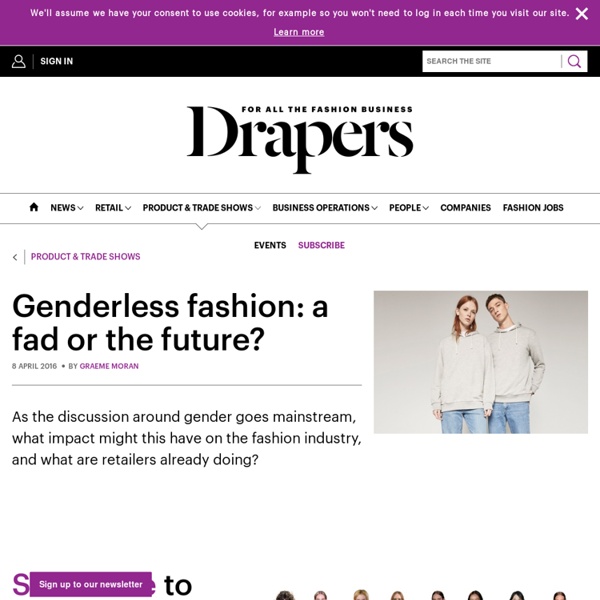
Zara Genderless Clothing Line 2016 - Non Binary It's not the first time Zara's parent company, Inditex, has added genderless clothing to its inventory: Inditex-ownedPull&Bear has offered unisex apparel in past seasons, according to Harper's Bazaar Spain. Recently, more and more retailers have dabbled in gender-free offerings. Last year, British department store Selfridges introduced a pop-up called Agender at both its London flagship and online. Stateside, Target announced a few months later that it would remove any gender-specific signage and colours from its children's bedding and toy sections. (Also, let's not forget that American Apparel has stocked unisex inventory for quite some time.) Zara's announcement represents a huge step in the mainstream fashion space.
Don’t Call It Unisex: Avoc’s Gender-Neutral Utopia | The Spotlight, People PARIS, France — Showing men’s and women’s collections together has become almost de riguer in recent seasons, but when Avoc founders Bastien Laurent and Laura Do first proposed the idea for their debut runway show in 2013, it was initially met with resistance. “When we wanted to start showing on-schedule during Paris Fashion Week, it wasn’t possible to have 50 percent men and 50 percent women on the catwalk,” Laurent tells BoF. “Now that a lot of major labels [like Burberry, Gucci and Saint Laurent] are making statements for it, the Fédération has made it easier, which is great.” For the Paris-based label, mixed-gender runway shows are only the beginning when it comes to unifying its men’s and womenswear offerings. “The idea behind Avoc is to go beyond gender and social conditions, but we don’t call it unisex. “We always try to find the right balance between masculinity and femininity. Avoc Autumn/Winter 2017 | Photo: Shoji Fujii Do and Laurent met in 2012. Avoc for BoF | Source: Avoc
How Fashion is Updating Power Dressing for 2017 In the late 1970s and early ’80s, business-minded women began dressing—if not for power, then simply to fit in. They were joining a boys’ club, and if they wanted to be taken seriously, they had to assume the uniform—which is to say, a slightly below-the-knee skirt suit, preferably in gray or dark blue, with a white blouse, a scarf tie, sensible pumps, and skin-toned pantyhose. “Anything else at work is unthinkable,” proclaimed John T. Molloy in his best-selling 1977 manual, The Woman’s Dress for Success Book. Having spent years conducting “scientific” research, the image guru also counseled women to avoid platform shoes, peasant dresses, floral patterns, and sweaters. But as women made strides in the corporate world, so did their wardrobes. “Nobody understood how busy our lives were,” she says. But while the body-con silhouette raged, the smell of teen spirit started to seep in. Perhaps, then, power dressing in this day and age has less to do with style than with substance.
The Designers Challenging Gender Codes at LFWM It’s not unusual for a fashion designer to use the catwalk to confront the very purpose of a fashion show. London has always been a prime spot to do so – its playfulness and penchant for punk (not to mention world-renowned art schools) making it a breeding ground for hyper-creativity and an intellectual approach that follows in the footsteps of talents like Vivienne Westwood, Alexander McQueen and John Galliano. As schedules and seasons are increasingly reshuffled and rejected and London Fashion Week Mens S/S18 draws to a close, yet more questions about the nature of the catwalk are left in the air. Designers blurred gender boundaries and threw orgies of inclusivity and self-expression, giving platform to hybridity and deconstructing the format of the show season we were watching. Here, we outline the codes of five of our favourite disruptors this season. 1. 2. 3. 4. Men wore dresses and women wore oversized suits, and vice versa. 5.