National Education Technology Plan - Office of Educational Technology
About the National Educational Technology Plan The U.S. Department of Education released the 2024 National Educational Technology Plan (NETP): A Call to Action for Closing the Digital Access, Design and Use Divides. First released in fulfillment of Improving America’s Schools Act of 1994, NETP has been updated multiple times since its original release, most recently in 2016. While past NETPs have largely served as surveys of the state of the field, the Department of Education’s 2024 NETP frames three key divides limiting the transformational potential of educational technology to support teaching and learning, including: The Digital Use Divide, addressing opportunities to improve how students use technology to enhance their learning, including dynamic applications of technology to explore, create, and engage in critical analysis of academic content and knowledge;
Ten Tips for Engaging the Millennial Learner and Moving an Emergency Medicine Residency Curriculum into the 21st Century
The Next Generation of (Personalized) Learning
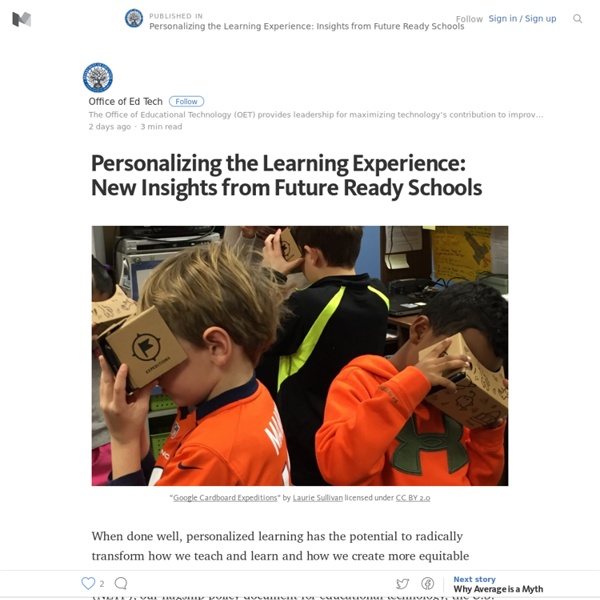
We all want our children to receive the best education possible. One of the key questions we’re interested in answering, as a foundation, is “what does high-quality instruction look like in U.S. schools?” And one way we’re looking at answering that question is by looking at the potential of what the foundation calls personalized learning for students. Before we delve into what this looks like for our students, we’ve got to provide some basis for why it’s so critical. Did you know that less than half of the 2012 graduating class that took the ACT college entrance exam scored at the level that predicts earning a “C” or better in math as freshman in college? Only 24 percent scored at this level on all four sections of the ACT. Sixty years is too long. For more than 150 years, the system has been organized around the idea that students of similar ages should move along together, through the same material, at roughly the same pace.
Future Ready Librarians - Future Ready Schools
We are super excited that you are registering to join us at the Denver Future Ready School Institute. Complete the registration below to make it official! The Future Ready Librarians (FRL) strand of the Institute will provide opportunities to explore how librarians can support FRS via the FRL framework;learn how to develop teacher librarians as educational and instructional leaders;create conversations about the role of librarians supporting strategic work of schools; anddevelop networks and cross-functional teams to support and sustain FRL in districts. Since you are registering as a Future Ready Librarian, don’t forget to check to make sure your superintendent has taken the pledge and become familiar with the FRS Framework as well the FRL program.
Updated Personalization vs. Differentiation vs. Individualization Chart Version 3
Personalization v Differentiation v Individualization (PDI) Chart (Version 3) The PDI chart was created for a reason: to clarify the differences in these terms. In 2010, the National Ed Tech Plan defined all three of these terms as they are related to instruction. We needed to emphasize the differences: Personalization is learner-centered. The other two, Differentiation and Individualization are teacher-centered. It has been some time since we initially published the PDI Chart in January 2012. We updated the chart again to version 3 from your feedback. Individualization involves assessment OF learning.
Moving Towards Next Gen Learning
*Reposted with permission from GettingSmart.com Raise your hand if you have uttered any of the following phrases in the past week: Blended learning Competency-based learning Personalized learning Digital learning Online learning Connected learning Deeper learning Project-based learning Student-centered learning Optimized learning Hybrid learning Next generation learning Now raise your hand if you can define them so that the neighbor you barbecued with last weekend could remember and articulate the distinctions. An extra hot dog – with relish! – goes to that neighbor who could also describe how they overlap, connect with, and build on each other. We are, let’s face it, a Tower of Babel when it comes to defining what we’re all doing here. We can make the accomplishment of positive change a few degrees easier, though, by continuously striving to introduce bits of clarity amidst the messiness. Who’s working to design and implement next gen learning?
School Libraries Transform Learning
This digital magazine produced by AASL in partnership with American Libraries, is designed to be shared with parents, colleagues, administration, and policymakers. Available electronically or as a PDF download, this tool can open the door to discussions on the multiple ways school libraries transform learning. Articles "I'm an Expert" School Librarians Transform Learning Reimagining Advocacy for School Libraries "Do Kids Even Use the Library Anymore?" Extras Give printed copies to your stakeholders during your conversations! School Library Advocacy Packs These advocacy packs are intended to be used as tools to spread the word about the many ways school librarians are transforming teaching and learning. This pack includes: 25 copies of a limited print edition of “School Libraries Transform Learning,” an American Libraries Digital Supplement Assorted brochures from the “School Library Programs Improve Student Learning” series, also sponsored by BTSB 2015 | Item # 9200-2015 | Free.
3 Areas Where Having “The Innovator’s Mindset” is Crucial – The Principal of Change
As I have contended for years, “Innovation” is about mindset, not skill set. How we look at the world, is how we move forward, learn, and create. In my book, “The Innovator’s Mindset“, I defined it as the following: “Belief that abilities, intelligence, and talents are developed so that they lead to the creation of new and better ideas.” Yet the term “innovation”, has often been equated with either technology or directly with business. Although this image is no longer being used, I still see it as very relevant graphic to many things we are trying to do to school today. I wanted to talk about each “E” individually and what their connections are to the characteristics of “The Innovator’s Mindset”, and how this is crucial to our thinking in education today. (The definitions of each of the three “Es” in italics under each area are from the Peace Wapiti Public School Division website.) Entrepreneurial Spirit Yet our notion of “creation” is changing. Critical Questions Moving Forward
Post Millennial Learner Characteristics -
Today’s guest blogger is Kevin Bolinger, Ph.D. Dr. Bolinger is an associate professor of education and the Curriculum Instruction and Media Technology dept interim chair at Bayh College of Education, Indiana State University. Dr. Post Millennial Learner Characteristics Each generation of children in America bring unique talents and perspectives to the classroom as well as unique learning styles. Generational characteristics are good indicators of shared formative experiences but are limited indicators of learning style preference by unique personality differences. As an overprotected generation, post millennials, are less likely to be independent learners and more likely to develop into conformist young adults.