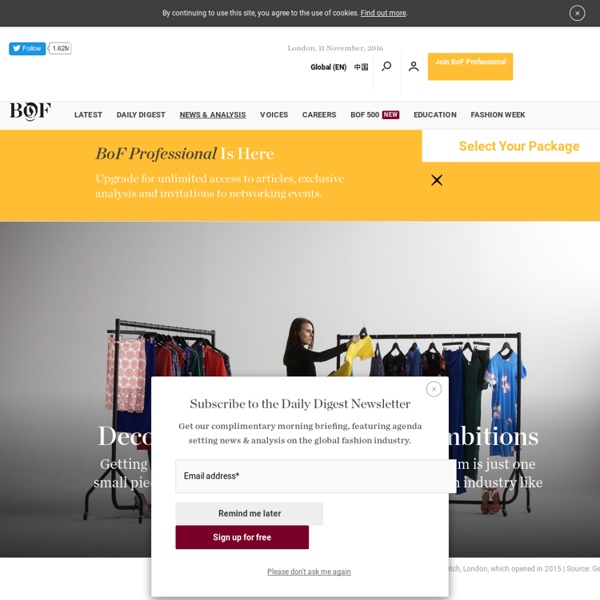
Software Is Reshaping Fashion's Back End | Fashion-Tech | BoF
NEW YORK, United States — From e-commerce to social media, digital has revolutionised the consumer-facing front-end of fashion, reshaping sales and marketing. Yet, for years, the industry’s less glossy back-end systems — used to manage everything from production to excess inventory — have remained relatively untouched. “Brands and retailers have been focused on what’s sexy,” says Ronen Lazar, co-founder and chief executive of Inturn, which helps brands more easily unload unsold inventory to off-price retailers. And while new platforms can certainly offer advantages, “technology in general creates really serious demands on time, from managing data flows and storage to [sharpening] accuracy and flexibility,” he adds. “Everyone has been putting it off to the side.” Now, as more millennials and executives trained in other sectors join fashion companies, expectations are rising and brands and retailers are rethinking their back-end solutions. Related Articles:
Is Stitch Fix the Goldilocks of Fashion? | Fashion-Tech | BoF
SAN FRANCISCO, United States — When Melora Simon goes shopping for clothes at the mall, she has no trouble finding what she likes. “I use labels and brands to help signpost,” says the 37-year-old mother of two, who is currently employed by Stanford University’s School of Medicine. “I know I like the look of J. Crew, the aesthetic of Theory and Diane von Furstenberg. I kind of go there and end up spending more money than I need to.” But after Simon had her second child, her trips to the mall became less frequent. For Simon, the concept held real appeal. The first box was a “total miss,” Simon says. We have so much control. More than a year later, “I still wear those things all of the time,” she says. Indeed, for many Stitch Fix users, the service is often as much about entertainment as it is about buying clothes. Getting things “just right” — à la Goldilocks — was one of Lake’s main motivations for starting the company. Consider a tough-to-fit category like denim. Related Articles:
Arcadia Group to introduce 'Buy Now, Pay Later' scheme
London - Arcadia Group aims to satisfy all UK consumers who can't wait until next pay day for their latest shopping haul with the introduction of its new payment plan, 'Buy Now, Pay Later.' The UK fashion conglomerate has partnered up with payment provider Klarna, which sees Arcadia's brands become the first to use Klarna's new e-commerce retail financing option in the UK, which offers shoppers the option to purchase something immediately online and pay for them over time. The new partnership will offer customers from Arcadia's brands, including Topshop, Miss Selfridge and Dorothy Perkins, the choice to pay their purchase up to 90 days later, interest free. Under the new system, Klarna separates buying from paying and pre-authorises customers eligible for credit in real time as soon as an order is place. The new finance option aims to streamline retail financing, while delivering a seamless financing solution for time-poor customers shopping online or via the mobile.
Selfridges ‘most active’ department store on Snapchat
Danielle Wightman-Stone UK retailer Selfridges has been named the ‘most active’ department store Snapchat user, according to L2’s Digital IQ Index Department Stores 2016 report. The index reveals that Selfridges posts 95 times per week, five times the index average, taking 26 percent share of the snaps posted, ahead of American department store Bloomingdales with 17 percent. L2 states that Selfridges has opted for a variety of posts to target millennials using Snapchat, featuring content on fashion week, collaborations with partner brands, as well as using filters. Other retailers listed as being active on Snapchat included Next, Harrods, Dutch department store chain de Bijenkorf, Asos, Neiman Marcus, Gilt, Mr. However, L2 did note that only 37 percent of its index brands maintains a presence on Snapchat, adding that brands have been slow to embrace the social media platform due to its limited statistics as brands are unable to calculate how many times their videos were viewed.
Fashion’s Made-For-Instagram Moments | Opinion, Right Brain, Left Brain | BoF
PARIS, France — In recent seasons, it’s become increasingly common for fashion shows to end with a tableau of models, perfectly positioned to be snapped and shared on social media. But at the most recent round of Paris menswear and couture shows, the staging of these instantly sharable moments rose to a whole new level of sophistication. On Thursday, it was Rick Owens’ over-the-top musical extravaganza featuring Estonian punk band Winny Puhh, followed by the huge gold backdrop at the Dries van Noten show, an ideal canvas for the Belgian designer’s stunning collection of dark floral prints. Then, the next day, arriving at Berluti’s magical menswear presentation in the gardens of a private hôtel particulier in the Place des Vosges, attendees were guided through a darkened hallway fitted with a pair of stationery multi-rider bicycles, manned by models wearing the brand’s iconic shoes, exposed through a perfectly-lit window that ran the length of the hallway.
Issey Miyake's focus is "being innovative with technology"
Interview: technological innovation is driving increasingly experimental fashion design at Issey Miyake according to the Japanese brand's womenswear creative director, who has developed a new technique for folding fabric into origami-like patterns (+ movie). "Technology has been hugely influential on the fashion industry all across the world," said Yoshiyuki Miyamae, who took over as head of womenswear at Issey Miyake in 2011 after working with the brand for ten years. The 38-year-old designer's most recent application of technology is the creation of a new type of fabric that contracts into rigid structures when exposed to steam, called 3D Stretch Seam. Computer software is used to calculate the composition of different cotton and polyester weaves, which react to the steam and turn into three-dimensional patterns that are first tested as paper prototypes. "It looks like origami but it's folded by steam, not by hand," said Miyamae. Dan Howarth: What type of yarn have you used?