

How to Bring ‘More Beautiful’ Questions Back to School In the age of information, factual answers are easy to find. Want to know who signed the Declaration of Independence? Google it. Curious about the plot of Nathaniel Hawthorne’s famous novel, “The Scarlet Letter”? Curiosity is baked into the human experience. “Kids are lighting up their pleasure zones and getting dopamine hits every time they learn something that solves something they were curious about,” Berger said. Luckily, kids are hard-wired for that kind of generative curiosity. There are a lot of understandable reasons why questioning drops off in school. But knowledge can also be the enemy of questioning. And of course there are social barriers to questioning. These barriers to questioning are real and challenging, but there are lots of ways parents and teachers can work to make questioning a normal part of school and life. “You don’t have to have the answers. “We want their questions to be large and expanded instead of being diminished and eventually going away,” Berger said.
Useful Tips on Writing Essential Questions written by: Keren Perles • edited by: Wendy Finn • updated: 9/11/2012 Essential questions can make the lesson planning process more effective, but many teachers struggle to write quality essential questions for their lessons. Read on for a step-by-step guide to writing essential questions. 1. Writing Lessons and Mini Lessons The mini lesson is an often overlooked tool that teachers can use to teach basic writing skills. Fostering Student Questions: Strategies for Inquiry-Based Learning 1. The Question Formulation Technique The Question Formulation Technique offers a starting place to teach students how to construct questions that meet their needs. The QFT is a process for coaching students on the value and pitfalls of closed-ended and open-ended questions, including where and how to use them. 2. One challenge to generating substantive questions and ideas is getting every student's voice heard. Post a topic as a statement starter or a question on chart paper for small groups. Traditionally, the teacher collects the results at the end to use as data for later activities based on the students' contributions. 3. One challenge with reading articles or other pieces of writing is getting students to read for meaning and make connections beyond summary. Divide students into groups of 2-4. This process encourages students to express themselves and explore their ideas with a group. 4. It's amazing what students come up with when the teacher is silent. No Time to Wait
The Questioning Toolkit - Revised The first version of the Questioning Toolkit was published in November of 1997. Since then there has been substantial revision of its major question types and how they may function as an interwoven system. This article takes the model quite a few steps further, explaining more about each type of question and how it might support the overall investigative process in combination with the other types. photo ©istockphoto.com Section One - Orchestration Most complicated issues and challenges require the researcher to apply quite a few different types of questions when building an answer. Orchestration is the key concept added to the model since its first version. orchestrate: To combine and adapt in order to attain a particular effect: arrange, blend, coordinate, harmonize, integrate, synthesize, unify. As the researcher moves beyond mere gathering to discovering and inventing new meanings, the complexity and the challenge of effective orchestration grows dramatically. --- Essential Questions ---
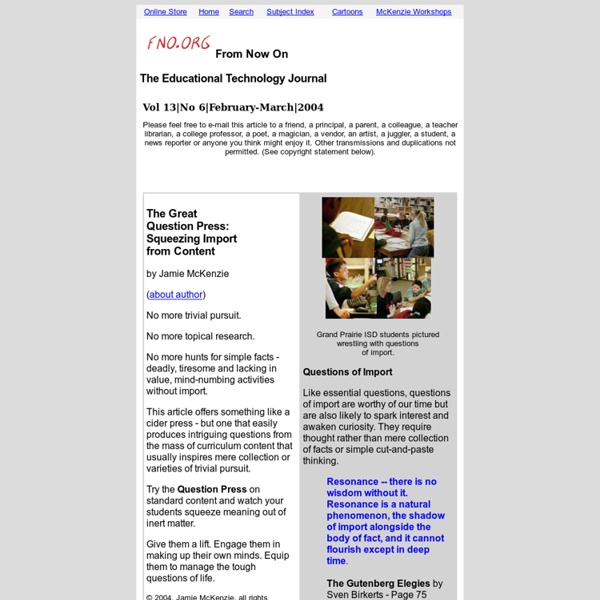
Reflecting on reflection This is hardly wasting time. It is this kind of sitting that allows the mind to wander, to wonder and to speculate. Sven Birkert calls this process "resonance" in The Gutenberg Elegies: Resonance—there is no wisdom without it. Resonance is a natural phenomenon, the shadow of import alongside the body of fact, and it cannot flourish except in deep time. Incubation We are looking for something. Making our way toward inspiration and illumination - the "Aha!" This incubation process usually thrives on reverie and musing - mood states within which the subconscious works its best magic. Reverie Reverie is the dream state during which incubation, percolation and fermentation may take place. daydream, daydreaming, trance, musing; inattention, inattentiveness, woolgathering, preoccupation, absorption, abstraction, lack of concentration Reflecting on a Painting, a Poem, a Photograph or an Essay Here are some examples that require such thought: What will it mean to be "well read" in the next decade?
FILLING THE TOOL BOX The above ads are generated by Google and FNO does not endorse the products displayed in any manner. From Now On The Educational Technology Journal Classroom Strategies to Engender Student Questioning © 1986 by Jamie McKenzie, Ed.D. and Hilarie Bryce Davis, Ed.D. all rights reserved. Most of the strategies described below have been developed and tested by teachers in Princeton, Madison and elsewhere. As one of the primary goals of education is to develop autonomous but interdependent thinkers, students deserve frequent opportunities to shape and direct classroom inquiry. 1) Beginning A New Unit (K-12) If a class is about to spend several days or weeks studying a particular topic or concept, traditional practice and unit design gives the teacher primary responsibility for identifying the key questions and the key answers. Try starting a new unit by asking your class to think of questions that could be asked about the topic; "What questions should we ask about the Civil War? 2. 3. 4. 5. 6.
A Brilliant Question Not Essential There is a difference between essential questions and brilliant questions. While essential questions touch upon the most important issues of life, they are rarely brilliant. Essential questions touch our hearts and souls. They are central to our lives. They help to define what it means to be human. Most important thought during our lives will center on such essential questions. What does it mean to be a good friend? In contrast with essential questions, brilliant questions are important for their power to unlock mysteries and open doors. What will it take to win her heart? Brilliant questions may also be essential, but they almost always deal with strategy and change of some sort. A Vivid Example In studying important figures from history we might ask the essential question, "What kind of person was Joan of Arc or Matthew Flinders?" But all this gathering may not bring us to the heart of the matter. Here is where the brilliant question comes into play. Where did Joan go wrong?
Why Understanding These Four Types of Mistakes Can Help Us Learn by Eduardo Briceño This article was first published in the Mindset Works newsletter. We can deepen our own and our students’ understanding of mistakes, which are not all created equal, and are not always desirable. After all, our ability to manage and learn from mistakes is not fixed. We can improve it. Here are two quotes about mistakes that I like and use, but that can also lead to confusion if we don’t further clarify what we mean: “A life spent making mistakes is not only most honorable but more useful than a life spent doing nothing” – George Bernard Shaw “It is well to cultivate a friendly feeling towards error, to treat it as a companion inseparable from our lives, as something having a purpose which it truly has.” – Maria Montessori These constructive quotes communicate that mistakes are desirable, which is a positive message and part of what we want students to learn. Types of mistakes The stretch mistakes Stretch mistakes happen when we’re working to expand our current abilities.
Bringing Inquiry-Based Learning Into Your Class In the shallow end of the Types of Student Inquiry pool, Structured Inquiry gives the teacher control of the essential question, the starting point—for example, “What defines a culture?” or “What is the importance of the scientific method?” These questions are not answered in a single lesson and do not have a single answer, and, in fact, our understanding of an essential question may change over time as we research it. In Controlled Inquiry, the teacher provides several essential questions. And finally, in the deep end of the inquiry pool, Free Inquiry allows learners, with the support of the teacher, to construct their own essential question, research a wide array of resources, customize their learning activities, and design their own summative assessment to demonstrate their learning. How Are the Types of Student Inquiry Helpful? Inquiry is most successful when strongly scaffolded. How to Move Forward in Adopting Inquiry Second, think big and start small.