

An Instructional Designer's Guide to the Project Kickoff Meeting by Claire Narum The importance of a strong kickoff to a training project can’t be understated. Not only does the project kickoff meeting define the road map, set expectations for your stakeholders, and clarify each team member’s roles, it’s also an opportunity for the team to forge a positive and enthusiastic working relationship that builds a solid foundation for collaboration on future projects. We’ve already provided tips for the L&D Manager on how to conduct a great project kickoff meeting. But, what can the instructional designer do to increase the chances of project success? Three Things the Instructional Designer Should Bring to the Table 1. Other stakeholders almost never have instructional design expertise. A caveat: Don’t derail the kickoff meeting by getting into these issues in detail; that will happen during the design phase of the project. 2. When we go into a kickoff, we build in time to discuss creative direction. 3. 1. Conversely, what don’t they need? 2. 3.
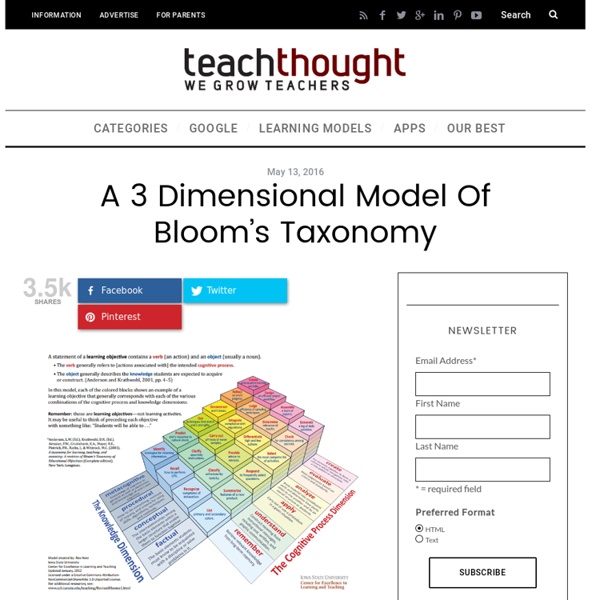
4 Strategies For Teaching With Bloom's Taxonomy 4 Strategies For Teaching With Bloom’s Taxonomy by TeachThought Staff Bloom’s Taxonomy can be a powerful tool to transform teaching and learning. By design, it focuses attention away from content and instruction, and instead emphasizes the “cognitive events” in the mind of a child. And this is no small change. For decades, education reform has been focused on curriculum, assessment, instruction, and more recently standards, and data, with these efforts only bleeding over into how students think briefly, and by chance. This stands in contrast to the characteristics of the early 21st century, which include persistent connectivity, dynamic media forms, information-rich (digital and non-digital) environments, and an emphasis on visibility for pretty much everything. Using Bloom’s Taxonomy In The 21st Century: 4 Strategies For Teaching 1. There is nothing wrong with lower levels of Bloom’s taxonomy. 2. 3. 4. Conclusion Thinking isn’t any different in 2014 than it was in 1214.
edutopia Leaders are full of power. They share powerful ideas, make powerful decisions, and create powerful results. Initially, the power of leadership is inspiring, but after looking deeper, maybe not so much. We overlook how the exertion of power sometimes leaves others feeling powerless. I'm not used to supposing. I share this quote because while teachers are thought leaders, like bosses, we hold a lot of power. To be fair, there has been some progress with this dilemma. Unfortunately, our students deserve more. 1. Don't simply begin the conversation by asking, "Who wants to help create our curriculum?" 2. Don't mislead students as to the extent of their influence on curriculum development. 3. Don't begin the student brainstorm session blindly. 4. Don't lead students to believe that contributing to curriculum decisions means that they will have sole power over every assignment, test, and project. 5. Would working independently or with partners be best for the assignment? 6. 7.
Design & Development 44 Prompts Merging Reflective Thinking With Bloom's Taxonomy 44 Prompts Merging Reflective Thinking With Bloom’s Taxonomy by Peter Pappas It’s been four years since I first published my “Taxonomy of Reflection.” My interest in reflective thinking is rooted in a simple but powerful statement by Donald Finkel who wrote that teaching should be thought of as “providing experience, provoking reflection.” Most school mission statements include a reference to “fostering life-long learners.” Unfortunately, self-reflection is rarely taught in school. I developed my Taxonomy of Reflection in an effort to provide a schema of prompts that could be used by students, teachers and administrators to hone their reflective skills. Seen through Bloom, that’s the equivalent of “Remembering: Retrieving, recognizing, and recalling relevant knowledge from short- or long-term memory.” Below are 44 sample of higher order reflective prompts. 1. Student 2. 3. Teacher 4. 5. 6. Principal 7. 8. 9. 10. 11. 12. 13. 14. 15. 16. 17. 18. 19. 20. 21. 22. 23. 24. 25. 26. 27. 28. 29.
14 Questions To Guide Your Curriculum Mapping And Lesson Design by Grant Wiggins How teachers plan – I think this is one of the more interesting ‘black boxes’ in education. There are few studies of it, yet it is clearly one of the most vital elements of the enterprise. Winging it is sometimes fun, but it’s a bad way to run a family, a business, or a classroom. Marzano reports that a “guaranteed and viable curriculum” is the key factor in academic achievement in schools, regardless of how flexible plans have to be. How do you plan? Typical plans focus too much on fragmented day-to-day lessons and activities on discrete topics instead of deriving coherent plans ‘backward’ from long-term performance, leading to excessive ‘coverage’; many plans focus far too much on what the teacher and students will be doing instead of mapping out a plan for causing specific results; a surprising number of plans do not make student engagement a central design consideration; many plans have no Plan B ready when Plan A doesn’t work. The Misconception Happy Planning!
Top 5 Tips To Convert Your Traditional Course Into An eLearning Format During my MBA program at BGSU I remember Dr. Garcia saying "Cash is the King". In our case, you should always remember that "eLearning Content is the KING". As a result, I assume that in your f2f course you use the most amazing content. What are the criteria for determining if a face to face course actually is convertible to eLearning? 1. A f2f course can be converted in the following three eLearning formats: a) Asynchronous Learning Learning in which interaction between instructors and students occurs intermittently with a time delay. b) Synchronous Learning A real-time, instructor-led eLearning program in which all participants are logged on at the same time and communicate directly with each other. c) Hybrid Or Blended Learning Learning programs that combine synchronous and asynchronous learning, and face-to-face instruction. The question is "What eLearning format is best for me?". Boost your Learners' Experience with the Best LMS for Blended Learning! 3) Use Of Interaction 1.
Resources for Bloom's Taxonomy My initial interest in linking Bloom's Taxonomy to apps stems from a deep-seated desire to meet the unique educational needs of gifted and talented students. During the first ten years of my teaching career, I watched as schools did everything possible to make sure test scores remained strong and “no child was left behind”. Meanwhile in the wake of these changes, students lost opportunities to develop creative problem solving skills, critical thinking, and experience deeper, more meaningful learning. To add fuel to the fire, Gifted Programs began to slowly vanish from our schools. Like most of the public schools in California, the school district in which I was currently working cut their Gifted and Talented Program. I began to look elsewhere for alternative ways to provide and advocate for gifted students. It was clear that laptops and desktop computers offered a slew of media creation options, streams of information, and data analysis tools.
The school curriculum: about time - Teacher When it comes to the school curriculum, it’s about time we asked a question about time. An essential feature of the school curriculum is the specification of what teachers are to teach and students are to learn at particular times in the schooling process. In other words, the curriculum spells out not only what teachers are to teach and students are to learn, but also when this is to occur. This intention usually is captured in a ‘scope and sequence’ chart of some kind. The NSW curriculum specifies the strands and substrands of mathematics to be covered by teachers in each of the four terms of Year 6, the recommended amounts of time to be spent on these strands and substrands each week, and the outcomes students are expected to achieve as a result. The timed nature of the school curriculum reflects the current organisation of schooling. Most aspects of school are then built around this timed curriculum. A problem A time-free curriculum? A matter of equity A focus on growth
ADDIE Model - InstructionalDesign.org The ADDIE model is the generic process traditionally used by instructional designers and training developers. The five phases—Analysis, Design, Development, Implementation, and Evaluation—represent a dynamic, flexible guideline for building effective training and performance support tools. While perhaps the most common design model, there are a number of weaknesses to the ADDIE model which have led to a number of spin-offs or variations. It is an Instructional Systems Design (ISD) model. Most of the current instructional design models are spin-offs or variations of the ADDIE model; other models include the Dick & Carey and Kemp ISD models. Instructional theories also play an important role in the design of instructional materials. In the ADDIE model, each step has an outcome that feeds into the subsequent step. Analysis > Design > Development > Implementation > Evaluation Analysis Phase * Who is the audience and their characteristics? Design Phase These are steps used for the design phase:
A New Fantastic Bloom's Taxonomy Wheel for iPad Apps March 21, 2014 Today while I was browsing through my Twitter feeds I came across this fabulous Bloom's Taxonomy wheel of apps shared by Anthony. If you still recall, some previous versions of this wheel have already been featured here in Bloom's Taxonomy for Teachers section . As you can see, the wheel outlines a wide variety of verbs and activities related to each thinking level of Blooms taxonomy coupled with iPad apps that go with it. These apps are supposed to help teachers and students better cultivate these different thinking levels in their use of iPad apps. And because the the visual is not hyperlinked, I went ahead and provided the links for each of these apps in the lists below. Enjoy Create Evaluate Annalyse Apply Remember/understand This wheel is originally discovered on the website of Paul Hopkin's education consultancy site mmiweb.org.uk adopted by Allan Carrington.
New: Bloom's Taxonomy Planning Kit for Teachers March 28, 2014 Somebody shared with me this wonderful Bloom's Taxonomy Planning Kit for Teachers and want you to have a look as well. The image is huge and so can't upload it here but you can use the provided link to access the original version. The reason why I am sharing this work here is because it provides a new way to think about Bloom's Taxonomy. In Bloom's Taxonomy Planning Kit, you will be offered with a variety of key words, action verbs, outcomes and questions related to each of the thinking levels in the taxonomy. Here is the link of the original chart, try to zoom it in to make it legible.
A New Wonderful Wheel on SAMR and Bloom's Digital Taxonomy The buzz that the Modern Taxonomy Wheel generated over the last couple of weeks has not yet died out and now we have a new updated wheel from the same guy Allan Carrington. We love Allan's work and we find it really interesting. His wheels come along in such a visually attractive way summarizing most of the apps and web tools we have been sharing here with you. If you already had a chance to have a look at the previous wheel and compare it with this new one you will notice that Allan has brought about some new updates to the new wheel. There is now a particular shared focus on both SAMR model and Bloom's digital taxonomy to help teachers better leverage technology in their teaching. If you are not familiar with what SAMR is all about, please read this post. Now, Click on this LINK to get the poster as PDF.