

Halloween – Conversation.se – Dialoger på engelska Dialog 1 Person 1: – I’m having a Halloween party on Friday. Would you like to come? Person 2: – Yeah, sounds like fun. Person 1: – It starts at 6pm and there will be food and drinks. Person 2: – Is it a costume party? Person 1: – Yes, and the person wearing the best costume will win a prize. Person 2: – Cool, I need to ask my parents, but I think I can come. Person 1: – Can you text me tonight, if you can make it? Person 2: – Yes, I’ll text you later. Dialog 2 Person 1: – Are you going to Ella’s Halloween party tomorrow? Person 2: – Yes, I am. Person 1: – Yeah. Person 2: – Either as a zombie cheerleader or as a witch. Person 1: – My mom’s making my costume. Person 2: – I heard that whoever has the best costume will win an awesome prize. Person 1: – I know, I heard that too. Person 2: – It’s gonna to be a lot of fun. Person 1: – Yeah, I can’t wait. Person 2: – Me neither, see you tomorrow. Person 1: – See you tomorrow! Dialog 3 Dad: – Nellie, are you ready to carve the pumpkin? Dad: – Let me see!
TOEIC Grammar - TestDEN About | Accent | TOEFL® | TOEIC® | IELTS | GMAT | GRE® | Online Degrees | Buy Now | Partners TestDEN©1997-2015, ACT360 Media Ltd. All rights reserved. Privacy Policy TOEFL®, GRE®, and TOEIC® are registered trademarks of Educational Testing Service (ETS). This web site is not endorsed or approved by ETS.
Video Lesson: Mr. Bean – Tim's Free English Lesson Plans Follow me on twitter Just a quick note… Before you use these materials… We’ve created a new podcast aimed at B2+ level English students and teachers alike. You can listen for free at our SoundCloud page below. We have released 5 episodes so far and you can download teacher’s notes to accompany them from our Facebook page or from this blog. All comments and feedback welcome! This is a video lesson based around the video “Mr. Kids and lower levels The aim of this lesson plan is to practice holiday vocabulary (clothes and items that go in a suitcase) and some basic grammar structure. Project a picture of a suitcase on to the board (or draw one) and ask “What do you put in your suitcase when you go on holiday?” toothbrushtoothpasteswimming shorts/trunkstowelunderpantscan of baked beanscloth/flannelsoapbooksuitcasetrousersshortsshoesteddy bearscissors You could also use this quizlet set to go over clothes vocabulary. Mr. Objects:
Do Does Did Done The word DO appears a lot in English. This is because it can be a verb TO DO (Do / Does / Did / Done) and can also be an AUXILIARY verb (Do / Does / Did). The Verb - To Do The verb TO DO has four forms. Present Tense: Do / Does Past Tense: Did Past Participle: Done TO DO - Present Tense - (Do / Does) The present tense of TO DO is: I / you / we / they - DO he / she / it - DOES I do my laundry on Saturdays. TO DO - Past Tense - (Did) The past tense of DO is DID for all subjects: I / you / we / they / he / she / it - DID I did my homework in record time. TO DO - Past Participle - (Done) The past participle of DO is DONE. I have done my homework. TO DO - To replace a verb We sometimes use the verb DO to replace a verb when the meaning is clear or obvious. Do I need to do my hair? DO vs DOES in Questions To make a question in the Simple Present Tense in English we normally put the auxiliary Do or Does at the beginning of the question before the subject. Affirmative: You speak Arabic. DID in Questions
Engage Now - Student Interactions - teacher heath Do you hear your students say things like: "No! That's Wrong!" "What are you talking about?" "Stop being so bossy!" Students Learn MORE when they discover new ideas from each other. I created 4 posters to hang on the wall, model, practice and constantly refer to during lessons. PROBLEM 1: Students weren't LISTENING to each other: First and foremost, I created a list of things that I wanted to 'see and hear' my kids doing that showed they were LISTENING to each other. PROBLEM 2: Students weren't STATING their thoughts clearly: Then, I created a list of idea 'stems' that would encourage students to use evidence to back up claims - this way, other students can see why a student made a claim. PROBLEM 3: Students were ARGUING and DISAGREEING: I created a list of 'respectful' ways to disagree. PROBLEM 4: Students weren't ASKING EACH OTHER FOR CLARITY: This was so weird to me. Here's a Music Video that shows each of the 4 topics in the posters:
Comprehension Tests 7-9 – WebEnglish.se Talk, talk and talk some more Every spring the Swedish schools must arrange National Tests in English for all 9th graders to attend. An essential part of this test is speaking English. The students need to be able to tell something about themselves, their experiences and/or their thoughts, and also to discuss given topics with a… In "Teaching Matters" Spread Inspiration via WebEnglish.se WebEnglish.se has opened a new link category for intermediate (yr 7-9) students. Salem Witch Hunt WebEnglish.se has added a reading chapter, activities and a relevant YouTube series about the Salem Witch Hunts in 1692 in Intermediate 7-9.
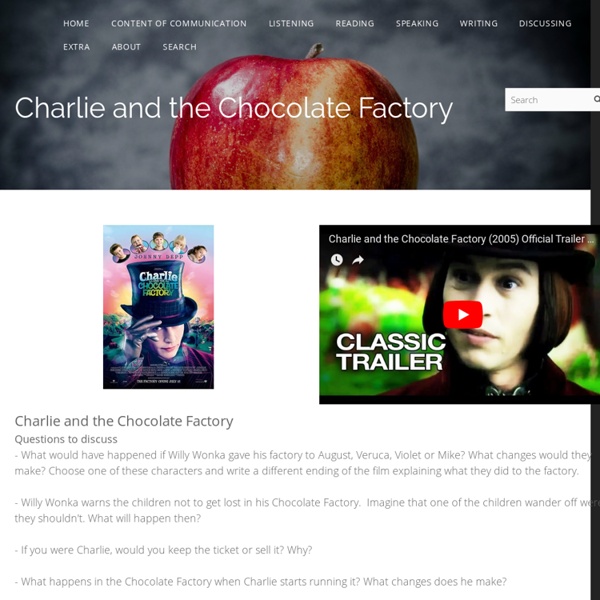
Språkutveckling med karaktärer och oväntade slut med hjälp av Roald Dahl Roald Dahl skulle ha fyllt 100 år den 13 september. Det uppmärksammas på olika håll genom att flera av hans böcker ges ut på nytt och nyligen släpptes hans bok SVJ som spelfilm. På hans officiella hemsida RoaldDahl.com finns det lektionsupplägg som du kan använda i undervisningen och du hittar även en hel del upplägg som lärare i delar på hans fan site. Jag har tidigare arbetat med några av hans böcker. Jag delar kort med mig av två upplägg. 1.Revolting Rhymes Ett av de upplägg jag arbetat med är Revolting Rhymes, som är omskrivna klassiska sagor som många av oss känner igen som barn men som har helt oväntade slut. Stödstrukturer hjälper eleverna förstå och jämföra För att kunna jämföra använde jag mig av olika stödmallar som Venn-diagram. Jag använde upplägget i en årskurs sju som behövde mycket stöd då många var nybörjare i engelska. 2.Gestaltningar med Willy Wonka Ett annat tips är att använda Kalle och chokladfabriken för att träna gestaltning och hur man bygger karaktärer.
915 FREE Speaking Worksheets Learning to speak a new language is definitely a challenge. It’s very difficult for your students to do if they don’t practice on a regular basis. Luckily, you need to look no further because BusyTeacher.org has the tools to help your students practice their speaking - and want to do it, too! These worksheets are great to use for your lessons because they come in many different styles and formats. You can preview the worksheets you want to use before you download them. Do you have a worksheet, PowerPoint presentation, or game that you use in your classroom, and works like a charm every time?
Classic Short Stories Educational Technology and Mobile Learning: 5 Great YouTube Channels for Learning English Youtube is undoubtedly a great source of educational content to use in class with your students. It also hosts tons of channels that provide instructional tutorials specifically tailored for different learning needs and styles. We have already reviewed some of these channels in previous posts and today we are sharing with you some of our favourite YouTube channels for learning English. You can use them with your ELL/ESL/EFL students to enhance their grasp of English in different areas: speaking, writing, listening , vocabulary, and grammar. 1- BBC Learning English ‘Do you want to learn how to speak English? 2- Learn American English Online This is another great YouTube channel that provides free English language instruction. 3- Speak English with Misterduncan Misterduncan is an English teacher who has been creating video tutorials and instructional clips to help learners from all around the world learn English. 4- Learn English with Let's Talk 5- Jennifer ESL
Free Printable Bookmarks for Children We've got free printable bookmarks here for kids of all ages - great for teachers to hand out in class, parents to slip into a party bag, grandparents to use to encourage kids to read. There is nothing like an appropriate bookmark to prompt a child to turn the pages! We are constantly adding more bookmarks and have tried to include some for most of our themes and holidays, and to provide something for boys and girls of all ages. ..or Explore All Bookmarks Choose from two versions of these fun high frequency word bookmarks - one with white backgrounds, and one in full colour (as seen below). We've provided large quirky outline numbers for 2016 for the kids to colour in. Print out a set of four bookmarks for Leap Year 2016. Here are four sets of Afghanistan bookmarks featuring the flag either in colour or black and white. These bookmarks are great to hand out to children, or use when you are studying the countries of the world. These little bookmarks are always popular.
25 Reading Strategies That Work In Every Content Area 25 Reading Strategies That Work In Every Content Area Reading is reading. By understanding that letters make sounds, we can blend those sounds together to make whole sounds that symbolize meaning we can all exchange with one another. Without getting too Platonic about it all, reading doesn’t change simply because you’re reading a text from another content area. Only sometimes it does. Science content can often by full of jargon, research citations, and odd text features. Social Studies content can be an interesting mix of itemized information, and traditional paragraphs/imagery. Literature? This all makes reading strategies somewhat content area specific. But if you’d like to start with a basic set of strategies, you could do worse than the elegant graphic above from wiki-teacher.com. Looking for related curricula ideas? 1. 2. 3. 4. 5. 6. 7. 8. 9. 10. 11. 12. To the above list, we’d add: 13. 14. 15. 16. 17. 18. 19. 20. 21. 22. 23. 24. 25. 25 Reading Strategies That Work In Every Content Area
How to Improve Your English Pronunciation to Talk Like a Native “What?” “Can you say that again?” How many times do you hear this when you’re speaking? Even if your vocabulary and English grammar are perfect, it can still be difficult for people to understand you because of your pronunciation. Learning to pronounce English words correctly can be one of the hardest parts of learning English. The English language has some sounds that your native language might not, so you will have to learn how to make completely new sounds. Plus, English vowels make it really tricky to know how to say a word. Ah! So that’s why we have eight tips for you, to help you pronounce English words better. 1. Before you learn how to speak, you’ll need to learn how to listen. There are many guides to get you started in learning to listen. The pronunciation practice at Many Things is really slick, especially its huge selection of lessons on minimal pairs. When you want to listen to authentic English instead of pronunciation exercises, you can watch videos on FluentU. 2. 3. 4. 5. 6.
Skriva brev och e-post på engelska Här är några fraser och tips på hur du skriver brev och e-postmeddelanden på engelska. Skriva ett informellt brev Börja ditt brev med att använda ordet Dear, följt av mottagarens förnamn, t.ex: Här är några saker du kan skriva: Här är några vanliga sätt att avsluta ett informellt brev: Om du skriver till en familjemedlem, partner eller nära vän, kan du avsluta på följande sätt: Avsluta med ditt förnamn. Skriva ett e-postmeddelande E-postmeddelanden skrivs vanligtvis på ett mer informellt sätt oavsett om de är avsedda för sociala eller proffesionella ändamål. Du bör alltid ge ditt e-postmeddelande ett ämnesord som kan sammanfatta dess syfte med några få ord. Hur man inleder ett affärsmail varierar, men det är ganska vanligt att man använder adressatens förnamn i både jobbmail och personliga mail om du känner personen. Det är inte nödvändigt att skriva Dear, men vissa personer föredrar det. I allmänhet bör innehållet i ett jobbmail vara kortfattat och koncist. Skriva ett formellt brev