Learn JavaScript | Mozilla Developer Network
Our policy on modern JavaScript JavaScript is an actively evolving language and has changed greatly over the years. In particular, the 6th edition of the language (sometimes known as ECMAScript 2015 or ES6), introduced in 2015, added many new features. At the same time, to maintain backwards compatibility with older websites, old features of the language have been retained, even when they are no longer considered good practice. We think that the features added to JavaScript in ECMAScript 2015 and subsequent versions enable developers to write more readable, reliable, and expressive code, and that it's important to learn about them. The features we teach in this course are stable and have been supported by all major browsers for several years. This topic contains the following modules, in a suggested order for working through them. JavaScript first steps In our first JavaScript module, we first answer some fundamental questions such as "what is JavaScript?" JavaScript building blocks
PHP for Beginners: Building Your First Simple CMS
The Magic of PHP + MySQL It’s safe to say that nearly every website that’s up-to-date these days is using some form of content management system (CMS). While there are a ton of great free options that provide us with a CMS to power a website (WordPress, Drupal, etc.), it doesn’t hurt to peek under the hood and get a feel for how these systems work. To get our feet wet as back-end developers, we’ll be creating a simple PHP class that will: Create a databaseConnect to a databaseDisplay a form with two fieldsSave the form data in the databaseDisplay the saved data from the database Download Files This class is intended to give you a feel for how PHP and MySQL interact together, and to show the basics of a CMS. Building the Class Our first step is to simply lay out the class in a file named ‘simpleCMS.php’ so we have a road map to work with. As you can see, we’re creating one class with four variables and five methods. The Variables Build the Database Connect to the Database Build the Form <! <?
50+ Refreshing Web Design Interfaces | SherifAbdou - The Design Blog
{*style:<b>Apr 2009 </b>*} There’s a million billion trillion ga-gillion websites out there all sporting different web design interfaces. Web 2.0 is all about the so I whipped up a list of 50 amazing web interface designs from DeviantArt. Cisco 642-661 courses is helpful for refreshing web design interfaces along withother cisco courses like 642-631 for advanced wireless LAN and 650-393 for Cisco lifecycle services express. Incoming Search Terms : web interfaces , best web interfaces , 50 web design , web design interface , web design interfaces , interface web design , amazing web interfaces , amazing web interface , vanci online portfolio , designing web interfaces In: Blog | Web Design
PHPBuilder.com, the best resource for PHP tutorials, templates, PHP manuals, content management systems, scripts, classes and more.
I wish I had known these 10 tips the day I started working with PHP. Instead of learning them through painstaking process, I could have been on my way to becoming a PHP programmer even sooner! This article is presented in two parts and is intended for folks who are new to PHP. Tip 1: MySQL Connection Class The majority of web applications I've worked with over the past year have used some variation of this connection class: class DB { function DB() { $this->host = "localhost"; // your host $this->db = "myDatabase"; // your database $this->user = "root"; // your username $this->pass = "mysql"; // your password $this->link = mysql_connect($this->host, $this->user, $this->pass); mysql_select_db($this->db); } } // calls it to action $db = new $DB; Simply edit the variables and include this in your files. $result = mysql_query("SELECT * FROM table ORDER BY id ASC LIMIT 0,10"); More information can be found in the manual--be sure you read the comments:
d3.js
OBJECT ORIENTED PHP TUTORIAL FOR BEGINNERS
Preamble The hardest thing to learn (and teach btw,) in object oriented PHP is the basics. But once you understand them, the rest will come much, much easier. But don’t be discouraged! … Or so I’ve been told. About This Tutorial This tutorial is designed to teach total beginners object oriented PHP. This is not a long-winded theoretical blathering that you see all too often; instead, we actually start writing OO code very quickly. So before you begin, get out your favorite PHP code editor and be ready to write and run some object oriented PHP code. PS: scroll to the bottom of the page for the supporting videos. Thanks for reading, Stefan Mischook Introduction With the release of php5 in 2004, php programmers finally had the power to code with the ‘big boys’. In this tutorial, you will be guided (step-by-step) through the process of building and working with objects using php’s built-in OOP capabilities. OOP Videos
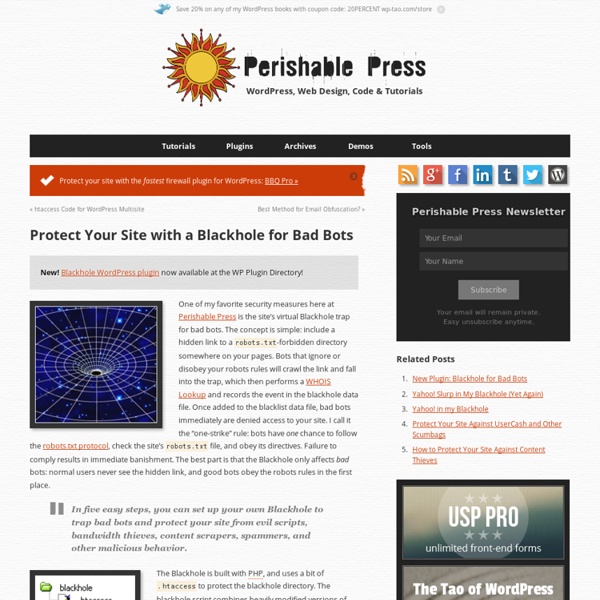
Bed Against The Wall: Running A SSH Honeypot With Kippo: Let's Catch Some Script Kiddies
So sorry about that, you were probably trying to reach a link on my blog before I moved it to a self-hosted, static home. It was on Blogger with a custom domain before... tl;dr: click here: Want some more options? I'll try to see if I can help you out. Go to old blog First, you can try to see if you can reach the article at my old blog, which is still archived at blogger. Try this link: (come back if it doesn't work)... Google search No dice? Visit the new site You shouldn't be visiting the old URL anyway, that one is so outdated, you know? Breaking URLs is bad and I should feel bad Therefore, why not message me at @macuyiko and ask me where to find the content... or just tell me that I should do better URL redirecting. — Seppe "Macuyiko" vanden Broucke
Improve website load time by 500% with 3 lines of code | Aciddrop.com
Major New Update - PHP SPEEDY: latest version available here There are 4 relatively easy ways by which you can speed up the time it takes a browser to download a page: Make fewer HTTP requestsAdd a far-future expires headerGzip your page's componentsMinify your JavaScript, CSS and HTML Following on from my post on joining CSS and JavaScript files, I have written a PHP script which will automatically do all of the above. All you have to do is call the following at the top of your page: The code require_once('class.compressor.php'); //Include the class. And the following at the bottom of the page: The Demo That's it! The class can be downloaded here: site speed boost class download Requirements A server running at least PHP4. Setting basic options Options can be set with a comma separated string as follows: $compressor = new compressor('css,javascript,page'); The string can contain 'css', 'javascript' and 'page' depending on which elements you would like to be compressed. Setting advanced options